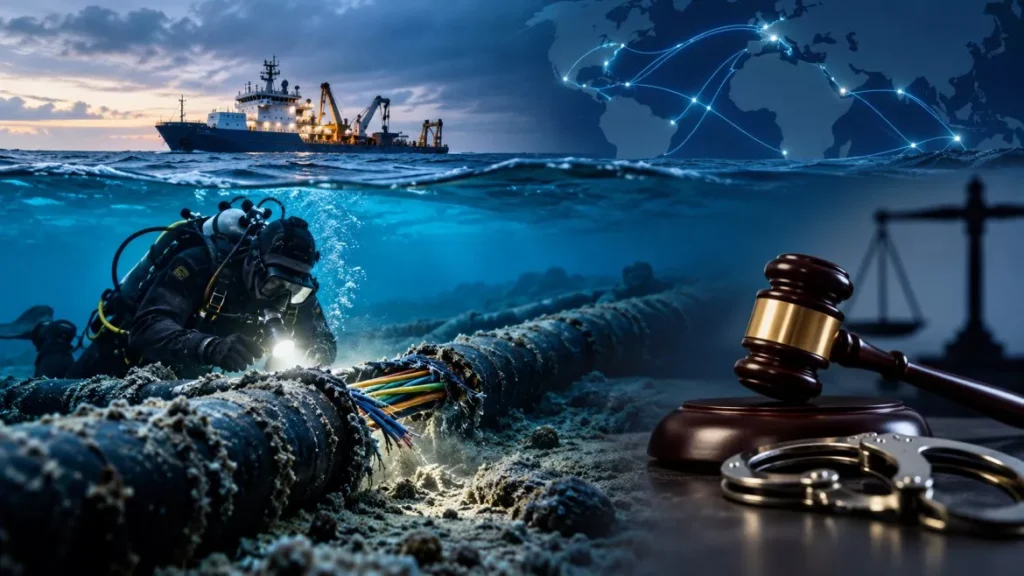

Subsea cable sabotage would carry up to 14 years in prison under a UK white paper published on 22 October 2026. The government is also weighing life sentences where damage causes death or serious prejudice to national security. A 12-week consultation closes on 14 January 2027.
The Four Tiers of Offence
The paper grades punishment by intent rather than by damage done. Fines sit on top of every tier, and the paper proposes “unlimited fines across all categories, including for legal persons”, which means companies as well as individuals.
| Conduct | Proposed maximum |
|---|---|
| Intentional damage | 14 years |
| Reckless damage | 10 years |
| Grossly negligent damage | 2 years |
| Supplementary offences | 2 years |
Above that scale sits an option the headlines have largely passed over. The paper says the government is considering a higher maximum, up to life imprisonment, for intentional or reckless conduct that causes loss of life or serious prejudice to national security. That element is a consultation question, not a settled proposal.
The scope is wider than cables alone. It covers subsea data systems including cables, repeaters, branching units and landing stations, and subsea energy systems including power cables, electricity interconnectors and pipelines. Cables whose only job is linking offshore installations to each other are excluded.
Why an 1885 Law Is Being Scrapped
The Submarine Telegraph Act 1885 is the law in force, and the government argues it no longer describes the thing it protects. The Act refers to “telegraphic” communications, which leaves it uncertain whether it reaches modern fibre-optic cables at all, and it does not cover pipelines.
Its penalties are also a different era’s. The white paper notes that the current maximum for grossly negligent conduct is three months in prison. For deliberate damage, The Record and Help Net Security both report the Act’s ceiling as a £1,000 fine and five years.
Matt Western, who chairs Parliament’s Joint Committee on the National Security Strategy, told The Record that the legislation covering attacks on undersea cables “was written in a different age”. The stakes have changed with it: The Record reports that the assets in scope carry 99% of the UK’s international data traffic and supply 74% of its gas. Fibre-optic links of the kind at issue are the same technology used in projects such as the submarine cable system connecting Kochi to the Lakshadweep Islands.
The Jurisdiction Gap the Paper Admits
A 14-year sentence only bites if a court can reach the defendant, and the white paper concedes the limits. Its proposed offences would apply inside UK territory and the territorial sea whatever the offender’s nationality or the vessel’s flag. Beyond that, they would reach UK nationals, UK-flagged vessels in international waters, and conduct outside the territorial sea that affects UK-connected infrastructure and has significant effects in the UK.
Enforcement against a foreign-flagged ship is qualified: the paper says such powers could be used “in accordance with international law”, and states plainly that while it considers the approach justifiable, state practice is not settled.
That caveat has already been tested. Under the UN Convention on the Law of the Sea, a ship on the high seas falls under the exclusive jurisdiction of its flag state, and penal jurisdiction over navigation incidents rests with the flag state or the accused’s state of nationality. When the tanker Eagle S dragged its anchor through the Estlink 2 cable between Finland and Estonia on Christmas Day 2024, Finnish courts concluded they could not proceed, because the vessel flew the Cook Islands flag and carried a foreign crew; the decision was appealed. The Record puts Elering’s repair estimate for that cable at €50 million to €60 million, about $56 million to $67 million.
So the realistic effect of the new sentences falls on conduct in British waters and on British ships. A deniable incident by a foreign vessel in international waters remains a diplomatic problem more than a criminal one.
What Cable Operators Would Have to Do
Alongside the criminal regime, the paper sets statutory duties for operators of subsea systems and services.
- Manage risk: Take appropriate and proportionate measures against security compromise.
- Respond and recover: Mitigate and recover from compromises when they happen.
- Notify: Tell the government and the regulator as soon as reasonably practicable, and warn direct users of significant risks.
- Register: Registration with the regulator is under consideration rather than confirmed.
The money attached is substantial. Breaching the duties could cost up to £10 million or 10% of qualifying worldwide revenue, whichever is higher. A separate national security power would let the Secretary of State direct data-system and repair-capability providers to act or refrain from acting; contravening a direction could cost up to £17 million or 10% of global turnover, plus up to £100,000 a day while the breach continues. That power does not extend to energy providers.
A sixth chapter proposes a screening regime for fibre-optic sensing technology, which can detect movement at sea along a cable but can also expose sensitive information. Operators would notify the government of deployments, which could be made conditional or, rarely, prohibited.
Status and Timetable as of 25 October 2026
Nothing in the paper is law, and no bill exists. As of 25 October 2026 the consultation is open and runs until 23:59 on 14 January 2027, with responses taken through an online questionnaire and a separate cost impact survey.
After it closes, the government says it will publish a response on GOV.UK summarising feedback and the actions it will take, then legislate “when parliamentary time allows” — a formula that carries no date. The white paper also leaves the identity of the regulator unresolved, so who would police the new duties is still open. The foreword is signed by Ian Murray MP of the Department for Digital, Culture, Media and Sport and Michael Shanks MP of the Department for Energy Security and Net Zero, and opens: “The first duty of government is to keep the country safe.”
The resilience argument is not hypothetical for British users. UK banking apps and card payments went down for about eight hours in the same month, as covered here when a Google Cloud outage hit UK banks from a single zone.
Accidents, Not Only Attacks
Most cable faults are not sabotage, which is why the lower tiers matter more than the headline number. The government says the usual causes are anchors, fishing nets, environmental hazards and technical failures; Help Net Security reports UK government estimates attributing up to 97% of faults to fishing vessels and dragged anchors, a figure the white paper’s published text does not repeat.
The suspicion of deliberate activity is separate and officially stated. The Ministry of Defence said in April that British and allied forces had tracked a Russian attack submarine and vessels linked to Russia’s Main Directorate of Deep Sea Research near cables and pipelines north of Britain. Several Baltic incidents that were first read as hostile were later assessed by officials as accidental.
Frequently Asked Questions
What Would the Maximum Sentence for Subsea Cable Sabotage Be?
Fourteen years for intentional damage, with unlimited fines. The government is consulting on whether to go up to life where the damage kills someone or seriously prejudices national security.
Is This the Law Now?
No. It is a consultation white paper. Legislation would follow only when parliamentary time allows, and no date has been set.
Could the UK Jail the Crew of a Foreign Ship?
Inside UK waters, yes, whatever the flag. On the high seas it is far harder, and the paper acknowledges that state practice on reaching foreign-flagged vessels is unsettled.
When Does the Consultation Close?
At 23:59 on 14 January 2027, twelve weeks after publication.
What Does the Law Currently Say?
The Submarine Telegraph Act 1885 applies. It speaks of telegraphic cables, says nothing about pipelines, and caps grossly negligent damage at three months in prison.