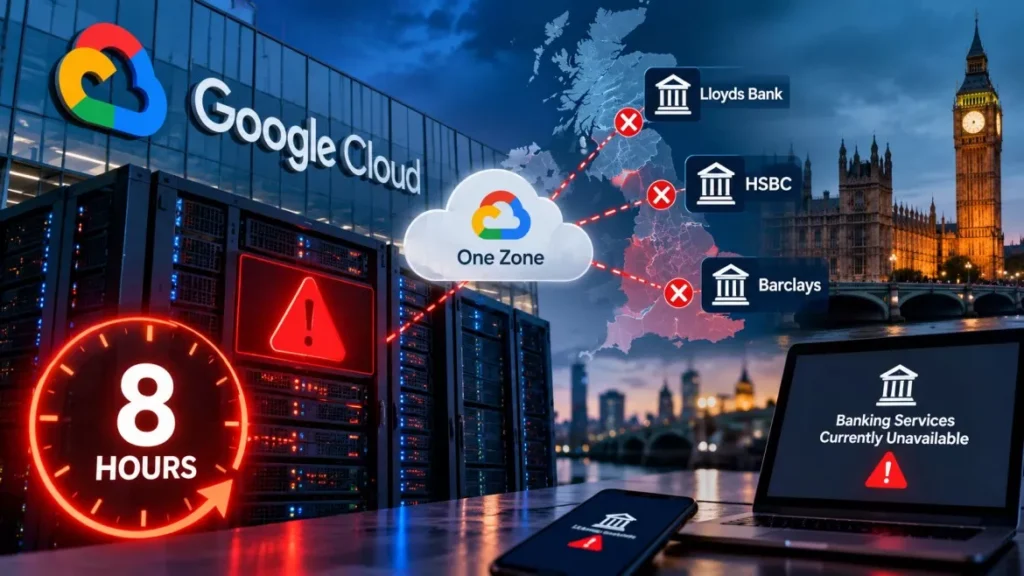

A Google Cloud outage hit UK banks on 20 October 2026, knocking out apps and card payments for about eight hours. Google blamed a power event in europe-west2-b, one of three availability zones in its London region. Lloyds, HSBC, Halifax and Revolut customers were among those unable to pay or withdraw cash.
The disruption was confined to the United Kingdom and nearby services that depend on Google’s London region. It is also the first significant failure at a cloud provider since the UK brought the largest cloud companies under direct financial-sector supervision in July 2026, which is why regulators, not just engineers, spent the day on it.
Google Cloud Outage Timeline: What Broke and When
The failure began early in the UK morning and was not fully cleared until mid-afternoon. All times below are Coordinated Universal Time, which in October is one hour behind UK clock time.
- 06:08 UTC, 20 October: Services in the europe-west2-b zone began failing, after what Google described on its status page as a power event.
- 11:58 UTC: Google’s status page said full recovery was “completed, tentatively” by 13:00 UTC.
- 14:03 UTC: Google said the issue was mitigated and normal service had resumed for the majority of customers, with a small number still affected.
That puts the disruption at roughly seven hours and 55 minutes before most customers were restored, by The Register’s count. Google’s own wording on the status page was that “a power event caused an outage within europe-west2-b zone”, and that customers “may not be able to yet create new workloads” while recovery continued. Google said it would publish an analysis once its internal investigation is complete, and has not given a date for it.
Which Banks and Services Went Down
The outage reached well beyond banking, because many British consumer services run in the same London region. Reported disruption included the following.
- Banks and payments: Lloyds Bank, HSBC, Bank of Scotland, NatWest, Halifax and Revolut, according to The Telegraph. Revolut customers reported problems with ATM withdrawals, bank transfers and card top-ups.
- Retail and logistics: Royal Mail, Rightmove, DPD, BT and Screwfix, as listed by The Register.
- Courts: live streams run by HM Courts and Tribunals Service, including proceedings in the Russell Brand trial, as reported by the ABC.
Revolut said its customers’ money and data remained safe. Lloyds said it understood the root issues had been resolved. HSBC said it was aware that some customers had difficulty reaching its services. One report also listed NHS England among the affected organisations; that claim appeared in a single outlet and is not corroborated elsewhere.
On the scale of the technical failure, accounts differ in an important way. Google’s status page named a smaller set of affected products, including Google Kubernetes Engine, Cloud Run, Cloud Filestore, Google App Engine, Google Cloud NetApp Volumes, Managed Service for Apache Kafka and the BigQuery Data Transfer Service. The widely repeated figure of 38 affected services is an estimate by Dr Amro Al-Said Ahmad, a lecturer at Keele University, not a count published by Google.
Why One Zone Took Down Entire Banking Apps
The London region has three availability zones, and only one of them lost power. An availability zone is a physically separate part of a cloud region with its own power and cooling, designed so that a failure in one does not reach the others.
That design is the reason this outage raises a question about the customers as well as the supplier. A service spread across two or three zones should survive the loss of one; a service running in a single zone will not. Google has not said which customers were architected which way, and none of the affected banks has published that detail, so it is not yet possible to say for any individual bank whether its own configuration extended the damage.
The distinction matters for what happens next, because UK rules place the duty to plan for a supplier failure on the regulated firm, not only on the supplier. A comparable question followed the ConnectWise cloud backup breach, where business customers found their own continuity arrangements tested by a supplier’s incident.
Google Cloud Is Now a Designated UK Critical Third Party
Since 13 July 2026, Google Cloud has been subject to direct oversight by UK financial regulators. HM Treasury designated four providers as critical third parties to the UK financial sector, and the Bank of England, the Prudential Regulation Authority and the Financial Conduct Authority oversee them jointly.
The four designated legal entities are Amazon Web Services EMEA SARL, Google Cloud EMEA Limited, Microsoft Ireland Operations Ltd and Oracle Corporation UK Limited. Under the regime, designated providers must identify and manage risks to the critical services they supply, and keep what the Bank calls open, timely communication with regulators and with the firms that rely on them, particularly during major incidents.
Two limits on the regime are easy to misread, and the Bank has stated both. Designation is not approval: the Bank of England’s announcement says that “Designation under this regime is not the same as authorisation by the regulators.” And the regime complements rather than replaces existing rules, so regulated firms remain responsible for their own third-party arrangements, including due diligence, risk management and contingency planning.
The reasoning behind the regime was set out when it began. Sarah Breeden, the Bank’s Deputy Governor for Financial Stability, said of such providers that “they can introduce new forms of systemic risk”. Nikhil Rathi, chief executive of the FCA, said “a single failure can reverberate across the financial system”.
What Regulators Have Done So Far
No regulator has published a finding, and no enforcement action has been announced. What has happened is engagement and a request for explanations.
- FCA: said it is engaging with Google and affected firms to understand the impact, and that it expects firms to “fix issues quickly, keep their customers informed”.
- Bank of England and PRA: both declined to comment. The Telegraph reported that the FCA, the Bank and the PRA are all in contact with Google.
- Treasury Committee: Dame Meg Hillier, the committee’s chair, wrote on 20 October to Andrew Bailey, Governor of the Bank of England, and to Nikhil Rathi, asking them to explain how they responded, what steps will follow, and how they will strengthen the resilience of the UK financial system. She also raised the prospect of compensation for customers who could not reach their accounts.
The powers available under the regime are real but graduated. Regulators can require a designated provider to commission an independent review, or run one themselves, and in the most extreme case can restrict a critical third party’s work with financial firms. None of those steps has been taken here.
On compensation, there is an official route rather than a scheme. A customer who lost money because they could not access banking services would ordinarily complain to their bank first, and may refer the complaint to the Financial Ombudsman Service, the statutory body for unresolved financial complaints in the UK, if they are not satisfied with the response. Outcomes depend on the individual circumstances of each complaint.
Separately, British financial authorities and major firms had rehearsed a cloud-services disruption less than two weeks before this outage, in an exercise reported as SIMEX26. The findings of that exercise have not been published. Sector-wide rehearsals of this kind have become routine, as with the G7 exercises on AI-enabled cyberattacks.
What Is Still Unknown
As of 21 October 2026, Google has said the incident was mitigated for the majority of customers but has not published its full incident analysis, so the underlying cause of the power failure in the London zone has not been explained publicly.
Also undetermined: how many customers in total were affected and for how long; whether any individual bank’s own single-zone configuration worsened its outage; whether regulators will require an independent review; and whether any bank will pay compensation. Google has not said when its analysis will appear.
Frequently Asked Questions
What Caused the Google Cloud Outage That Hit UK Banks?
Google said on its status page that a power event caused an outage in the europe-west2-b zone of its London region on 20 October 2026. Google has not yet published a detailed explanation of the power failure itself.
How Long Did the Outage Last?
It began at 06:08 UTC on 20 October 2026, and Google said normal service had resumed for the majority of customers by 14:03 UTC, a span of about seven hours and 55 minutes. A small number of customers remained affected after that point.
Which UK Banks Were Affected?
Lloyds Bank, HSBC, Bank of Scotland, NatWest, Halifax and Revolut customers all reported problems, according to The Telegraph. Non-financial services including Royal Mail, Rightmove, DPD, BT and Screwfix were also disrupted.
Can UK Regulators Take Action Against Google Over the Outage?
Yes, within limits. Since 13 July 2026, Google Cloud EMEA Limited has been a designated critical third party, which allows the Bank of England, the PRA and the FCA to require independent reviews and, in extreme cases, to restrict its work with financial firms. No such action has been announced over this incident.
Are UK Banks Still Responsible if Their Cloud Provider Fails?
Yes. The Bank of England has said the critical third parties regime complements rather than replaces existing rules, and that regulated firms remain responsible for their own third-party arrangements, including due diligence, risk management and contingency planning.
How Do Affected Customers Pursue a Complaint?
The official route in the UK is to complain to the bank first and, if the response is unsatisfactory, to refer the matter to the Financial Ombudsman Service. Dame Meg Hillier has asked regulators about compensation, but no compensation scheme has been announced.