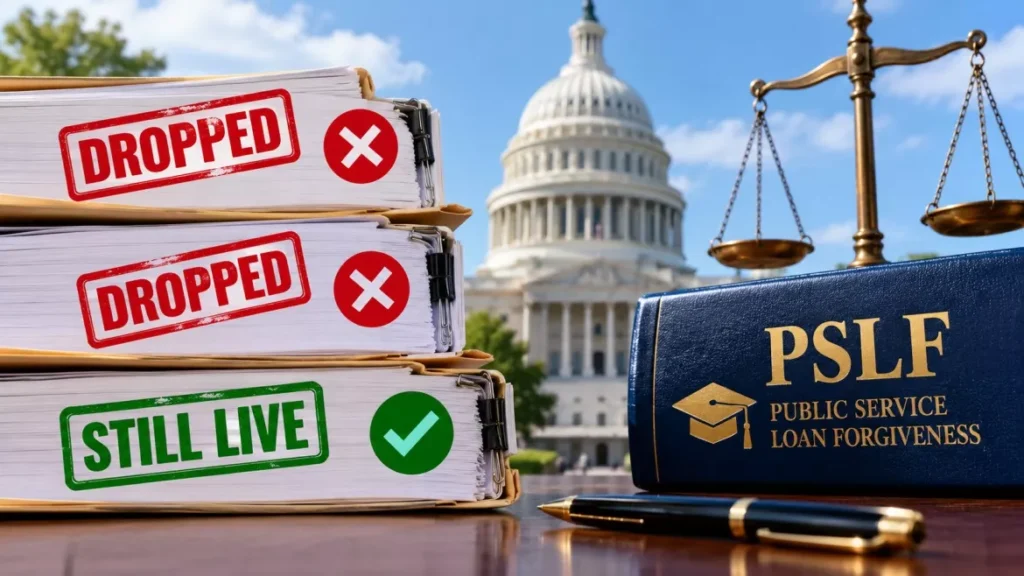

The PSLF employer rule remains vacated after the United States Justice Department dropped two of its three appeals on 21 October 2026. The rule would have let the Education Department disqualify employers it accused of illegal activity. A third appeal, led by 22 states, is still live.
Public Service Loan Forgiveness is a United States federal programme only. It cancels a borrower’s remaining federal student loan balance after 120 qualifying monthly payments, roughly ten years, while working full time for a government body at any level, a public school, or an eligible 501(c)(3) non-profit.
What the Justice Department Filed on 21 October
Government lawyers filed joint stipulations to dismiss two appeals, meaning both sides agreed to end them.
One was before the United States Court of Appeals for the District of Columbia Circuit, in the case brought by the Robert & Ethel Kennedy Human Rights Center and others. The second was case number 26-1972 in the First Circuit in Boston, brought by non-profit organisations, unions and the cities of Albuquerque, Boston and Chicago.
The stipulations gave no reason for the reversal, and each side agreed to bear its own fees and costs. The Education Department did not immediately respond to a request for comment from the Associated Press, whose reporting CBS News carried on 22 October 2026.
Dan Zibel, chief counsel at Student Defense, called the outcome “a significant victory for millions of Americans who have dedicated their careers to public service”. Diane Yentel, chief executive of the National Council of Nonprofits, said that “with the appeal dismissed, the court’s order vacating the rule stands, and PSLF remains as Congress designed it”.
The Appeal That Is Still Live
One appeal was not dismissed, and it has a deadline this autumn.
Case number 26-1973 in the First Circuit, brought by 22 states and the District of Columbia, remains open. The government’s opening brief in that case is due on 4 November 2026.
Because the government dropped the other two appeals on the same day, several outlets reported that the states’ appeal is likely to be dropped as well. That is an expectation, not a filing. Until the government either files its brief or withdraws, the case stays on the First Circuit’s docket.
Sources also disagree on the size of the state coalition, with some reports putting it at 21 states plus the District of Columbia rather than 22.
What the Vacated Rule Would Have Done
The rule would have let the Secretary of Education strike employers off the list of qualifying employers for having what it called a “substantial illegal purpose”.
It was published as final regulations on 31 October 2025, amending 34 CFR 685.219 in the Federal Register, with an effective date of 1 July 2026. The categories of illegal activity it enumerated were:
- Immigration: aiding and abetting violations of federal immigration laws.
- Terrorism and political violence: supporting terrorism, or engaging in violence to obstruct or influence federal government policy.
- Procedures on children: chemical or surgical castration or mutilation of children in violation of federal or state law.
- Child trafficking: trafficking children to another state to emancipate them from their lawful parents, in violation of federal or state law.
- Discrimination: a pattern of aiding and abetting illegal discrimination.
- State law: a pattern of violating state laws.
No employer was ever determined ineligible under these provisions. The rule was vacated the day before it was due to take effect, so the screen never operated against anyone.
Announcing the rule, Under Secretary of Education Nicholas Kent framed its purpose as “supporting public servants who strengthen their communities and serve the public good”.
How Payment Credit Would Have Worked
The mechanics of the rule drew little attention, and they explain why non-profit employers treated it as an existential issue rather than a paperwork change.
Under the regulations, a borrower would have kept full credit for work performed before the effective date of any determination against their employer. Payments made on or after 1 July 2026 would not have counted as qualifying payments for any month in which the employer was no longer eligible.
Disqualification was not quickly reversible. An employer could regain qualifying status either ten years after the Secretary’s determination, or sooner if the Secretary approved a corrective action plan. If an employer regained eligibility, the Department was required to update the qualifying employer list within 30 days.
Each of those provisions now has no legal effect, because the rule was struck down in full rather than narrowed.
Why Two Judges Struck It Down
Two federal district judges vacated the rule on 30 June 2026, in separate cases decided the same day.
Judge Myong J. Joun of the United States District Court for the District of Massachusetts held that the Department had no authority to disqualify otherwise eligible employers by adding a new “substantial illegal purpose” requirement. His decision also found the rule arbitrary and capricious and invalidated it on First Amendment grounds. The American Bar Association’s Washington Letter and The College Investor both reported the ruling as running to 68 pages.
Judge Amir H. Ali of the United States District Court for the District of Columbia reached a similar conclusion in the case brought by non-profits, holding the rule “contrary to and exceeds the Secretary’s authority under the Higher Education Act”.
Vacatur means a court wipes out a regulation rather than merely pausing it. That is why the programme reverted to the qualifying-employer definition that applied before the rule, and not to a temporary hold. A similar distinction arose when a United States appeals court vacated a telecoms fee but left the underlying fund standing.
How Many Borrowers Were Actually at Risk
No agreed figure exists, and the published numbers measure different things.
| Figure | What it counts | Reported by |
|---|---|---|
| 2.3 million borrowers | Borrowers said to benefit from the appeals being dropped | Forbes, 23 October 2026 |
| Nearly 1.2 million borrowers | Borrowers in the programme | IBTimes UK, 22 October 2026 |
| About 720,000 loans | Federal student loans discharged through PSLF from 2018 to mid-2025 | Education Data Initiative, cited by CBS News and the Associated Press |
None of these is a count of borrowers who would have lost eligibility had the rule taken effect. That number was never published, because disqualification depended on determinations the Department never made.
What Applies to PSLF Borrowers Today
The eligibility rules that governed before 1 July 2026 are the rules in force as of 23 October 2026.
Qualifying employment continues to mean full-time work for a federal, state, local or tribal government agency, a public school or college, or an eligible 501(c)(3) non-profit. Borrowers must be direct employees of that organisation. Qualifying payments carry over when a borrower moves between eligible employers.
Reporting on the vacatur also noted that the Department removed the employer attestation added by the rule from the PSLF form in order to comply with the court’s order. The Department’s own PSLF Help Tool at studentaid.gov remains the official channel for confirming whether a specific employer qualifies.
Separate changes to repayment plans are a different matter from this case. The SAVE plan’s own deadline has already passed, and the Department has said that time on the tiered standard plan earns no PSLF credit, after 1.5 million of 7.5 million affected borrowers had switched by late September 2026.
Dates in the Case So Far
- 31 October 2025: the Education Department publishes the final regulations creating the employer screen, with an effective date of 1 July 2026.
- 13 March 2026: a correction to the regulations is published, keeping the same effective date.
- 30 June 2026: judges in Massachusetts and the District of Columbia vacate the rule, one day before it would have taken effect.
- 21 October 2026: the Justice Department files joint stipulations dismissing the D.C. Circuit appeal and First Circuit case 26-1972.
- 4 November 2026: the government’s opening brief falls due in First Circuit case 26-1973, the states’ appeal.
PSLF Employer Rule: Frequently Asked Questions
Is the PSLF Employer Rule in Force?
No. Two federal district courts vacated it on 30 June 2026, the day before its 1 July 2026 effective date, and it remains vacated as of 23 October 2026.
Did the Government Give Up the Whole Case?
Not entirely. Two of three appeals were dismissed by agreement on 21 October 2026. A third, brought by 22 states and the District of Columbia in the First Circuit, is still pending, with the government’s opening brief due 4 November 2026.
Do PSLF Borrowers Need to Do Anything?
The pre-rule eligibility criteria apply, so nothing in the programme’s requirements changed as a result of the dismissals. The Education Department’s PSLF Help Tool is the official place to check whether an employer qualifies.
Which Employers Would the Rule Have Excluded?
Employers the Secretary of Education determined had a “substantial illegal purpose” across six enumerated categories, including immigration law violations, support for terrorism, and a pattern of violating state laws. No employer was ever excluded, because the rule never took effect.
Would Past Payments Have Been Cancelled?
No. The regulations preserved credit for work performed before the effective date of a determination. Payments from 1 July 2026 onward would not have counted for months in which an employer was ineligible.
How Many Borrowers Does This Affect?
Published figures differ and measure different things, ranging from nearly 1.2 million borrowers in the programme to 2.3 million cited by Forbes. No count was ever published of borrowers who would have lost eligibility under the rule.