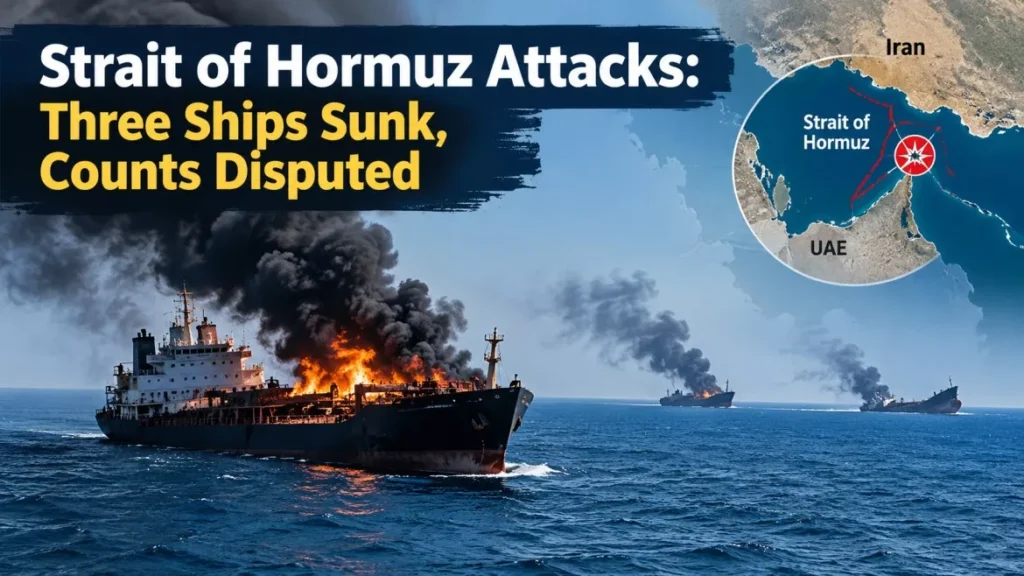

Strait of Hormuz attacks have sunk three ships since the war began on 28 February 2026, two of them within 24 hours in mid-October. The International Maritime Organization verified 80 attacks and at least 22 seafarer deaths in and around the strait by 16 September. Counts after that date differ by tracker.
The strait is the sea passage between Iran to the north and Oman and the United Arab Emirates to the south, through which roughly a fifth of the world’s crude oil and liquefied natural gas moves. As of 17 October 2026, commercial traffic is continuing in reduced volumes under convoy, no ceasefire has been agreed, and the parties give irreconcilable accounts of who controls the waterway.
What Is Agreed, What Is Claimed and What Is Unverified
Separating these three categories is the only way to read this story accurately, because the attacker is rarely confirmed independently.
- Agreed: ships have been struck by projectiles in and around the strait in rising numbers through September and October 2026; three vessels have sunk; at least 22 seafarers had died by mid-September; oil flows have fallen well below pre-war levels.
- Claimed by Iran: that it controls the strait, that it is acting in self-defence, and that the container ship GFS Pride struck a naval mine on an “unauthorised route”.
- Claimed by the United States: that American forces and regional partners control the strait, and that Iran’s Revolutionary Guard Corps is directing attacks using spotters in small boats.
- Unverified: who fired on most individual vessels; the precise cause of the GFS Pride sinking; and the exact running total of attacks, which no two bodies report alike.
The International Maritime Organization, the United Nations agency that regulates shipping safety, has pointedly declined to attribute the campaign to one party. Its Secretary-General, Arsenio Dominguez, said on 16 September 2026 that “in the Strait of Hormuz, it is not only one country attacking merchant vessels”. He also said: “We are reaching a point where these conflicts are being used as a pretext to attack merchant vessels and innocent seafarers.”
How Many Ships Have Been Attacked
There is no single agreed number, and the published figures cover different windows, different vessel types and different definitions. This is what each body has reported.
| Source | Period | Figure reported | What it counts |
|---|---|---|---|
| International Maritime Organization (UN agency) | To 16 September 2026 | 80 attacks verified; at least 22 seafarer deaths | Verified attacks on international shipping in and around the strait |
| Kpler (commodity data firm) | 28 September to 4 October 2026 | 10 tankers struck, plus one on 5 October | Tankers only |
| UKMTO (United Kingdom Maritime Trade Operations) | 5 to 11 October 2026 | 12 vessels attacked, described as its highest weekly total since the war began | Attack reports received from shipping, as reported by the BBC |
| UKMTO | 6 to 14 October 2026 | 15 attacks, 11 of them in the final four days | Attack reports, as reported by Al Jazeera on 14 October |
| UKMTO, via a single secondary report | 30 September to 14 October 2026 | 26 confirmed attacks | Not independently confirmed |
| International Maritime Organization incident data | Early October 2026 | Nine vessel-related incidents | Casualty incidents, a narrower measure |
The figures diverge for identifiable reasons rather than because one is wrong. UKMTO advisories are sometimes filed after the event, so the date an attack happened can differ from the date it was reported; the BBC’s verification desk has noted that the resulting timeline is approximate. Kpler counts tankers, not container ships. The IMO’s casualty data records a narrower class of incident than a report of an attack. And the windows overlap, so the totals cannot simply be added.
On the threat level the bodies agree. The Joint Maritime Information Center, which is led by the United States Navy, kept its assessment for the strait at “severe”, its second-highest rating, in its most recent report before 14 October 2026, citing continued attacks, attempted attacks, harassment, drone overflights and radio hailing.
The Three Ships That Have Sunk
Two sank within a day of each other in mid-October. According to Reuters’ analysis of IMO casualty data, they were the second and third vessels lost since the war began on 28 February 2026.
- GFS Pride: a Singapore-registered, United Arab Emirates-operated container ship struck about one nautical mile east of Ras Makhbuq, Oman, on 13 October 2026. It caught fire, was reported adrift at 0300 UTC on 14 October, and sank. All 21 crew were evacuated and none was injured.
- Cape Dao: an Antigua and Barbuda-flagged bulk carrier managed from the United Arab Emirates, hit by two projectiles about 15 nautical miles north-east of Khasab on 23 September 2026. One crew member was killed — reported by the trade press as an Indian seafarer — and the rest were evacuated. The ship was being towed towards a dry dock in Oman when it deteriorated and sank in mid-October.
- A third vessel: an earlier loss recorded in the same IMO casualty data since February 2026, which the reporting does not name.
Other ships were hit without sinking. Singapore’s Maritime and Port Authority said GFS Pride and its sister ship GFS Giselle were struck by unknown projectiles while transiting the strait, and called the attacks “unprovoked, unjustifiable, and a breach of international law”. GFS Giselle took hull damage, reached a safe anchorage under its own power, and all 22 crew were unharmed. The container ship Al Saadiyat was struck on 13 October and continued its voyage. The tanker Alfonso was hit the same day, in an incident logged as UKMTO Alert 171. The tanker Gol was intercepted by Iranian forces near Lima, Oman, and turned back.
Note that Singapore’s authority said the projectiles were of unknown origin and did not assign blame.
What Iran Says, and What the United States Says
The two sides describe the same waterway in incompatible terms. Neither account can be independently verified from open sources.
Iran’s navy said on 13 October 2026, through the state broadcaster Press TV, that it had deployed units “east of the Strait of Hormuz and across the Sea of Oman and the Arabian Sea” to provide “real time surveillance of enemy activities and maritime traffic in the region”, and instructed vessels to keep transponders on and coordinate with Iranian forces. Iran casts the campaign as national self-defence in response to the war.
Iran’s security chief, Mohsen Rezaei, said on 11 October that United States Central Command, assisted by the UAE military, was transferring oil between small and large vessels, and that Iran was striking five or six participating vessels a night. “You are smuggling, but the strait is under Iran’s control, and we manage it,” he said. Iran’s Revolutionary Guard Corps separately claimed GFS Pride hit a naval mine; the maritime security firm Marisks said it found no independent evidence for that, and analysts quoted in trade coverage considered a drone strike more likely.
United States Central Command rejected the claim of control, stating that “American forces and regional partners clearly control the Strait of Hormuz”. A United States military official told Reuters on 14 October that after American strikes damaged much of Iran’s radar coverage, the Revolutionary Guard began using unarmed spotters in small wooden boats to identify targets, and that US forces destroyed one such boat.
One further claim rests on a single anonymous source: an Iranian official told Reuters that Tehran adopted new offensive tactics about ten days earlier and linked the strategy to influencing the United States midterm elections in November. That motive is asserted by one unnamed official and is not corroborated.
What Has Happened to Oil Flows
Volumes have fallen sharply and move day to day, so each reading below carries its date. All are attributed to the commodity data firm Kpler unless stated, as cited by Al Jazeera on 14 October 2026.
- Pre-war baseline: about 17.1 million barrels a day, and roughly 125 large commercial vessels a day.
- September 2026: Gulf oil flows through the strait, excluding Iran, recovered to more than 81% of pre-war levels.
- 8 October 2026: nearly 20.8 million barrels passed through the strait.
- 11 October 2026: 2.9 million barrels, the lowest reading that month.
- 13 October 2026: about 12.6 million barrels a day, against the pre-war level of about 17 million.
United States Central Command said on 12 October that American forces had helped Gulf partners ship more than 19 million barrels of crude. On prices, Brent crude was quoted at $106.58 a barrel at 00:30 GMT on 14 October 2026, after closing at $105.69 on 13 October, while West Texas Intermediate settled at $94.14. Oil prices move continuously and those are single readings, not a current price.
This site has reported earlier stages of the same disruption, including when traffic through the strait fell to about 10 ships a day.
Where the Diplomacy Stands
No settlement is close. Iran has said the United States accepted some of the seven conditions it set for fully reopening the strait and ending the war, but describes Washington’s response as “insufficient”, and says a deal depends on all its demands being met. Those reopening conditions were set out in late September, and talks at the United Nations produced two different accounts of what was discussed.
Chris Featherstone of the University of York told Al Jazeera that the United States administration “has not moved to engage with continued negotiations”, argued that the strait is not under Iranian control, and expected American allies to press Washington for greater stability. That is one analyst’s assessment, not a finding.
Frequently Asked Questions
How Many Ships Have Been Attacked in the Strait of Hormuz?
The International Maritime Organization verified 80 attacks on international shipping in and around the strait up to 16 September 2026. Figures for the period since differ by body: UKMTO reported 12 vessels attacked between 5 and 11 October and 15 between 6 and 14 October, while Kpler counted 10 tankers struck between 28 September and 4 October.
How Many Seafarers Have Died?
At least 22 had died in and around the strait as of the IMO’s statement on 16 September 2026, which also recorded injuries to many others. At least one further death, on the Cape Dao on 23 September, has been reported since.
Which Ships Have Sunk?
The container ship GFS Pride, which sank on 14 October 2026 after being struck the previous day, and the bulk carrier Cape Dao, which sank in mid-October after being hit on 23 September. Reuters, analysing IMO casualty data, described them as the second and third vessels lost since the war began on 28 February 2026.
Is the Strait of Hormuz Closed?
No. As of 17 October 2026 commercial traffic continues at reduced volumes, with convoys running. Kpler readings cited on 13 October put flows at about 12.6 million barrels a day against a pre-war level of about 17 million.
Who Is Carrying Out the Attacks?
The United States attributes them to Iran’s Revolutionary Guard Corps, and Iran says it is acting in self-defence and controls the strait. For most individual vessels the attacker has not been independently confirmed, and the IMO has said that in the strait it is not only one country attacking merchant vessels.
Why Do the Attack Counts Differ?
Because the bodies measure different things over different windows. UKMTO advisories are sometimes filed after the event, Kpler counts only tankers, and the IMO’s casualty data records a narrower class of incident than an attack report. The periods also overlap, so the totals cannot be added together.