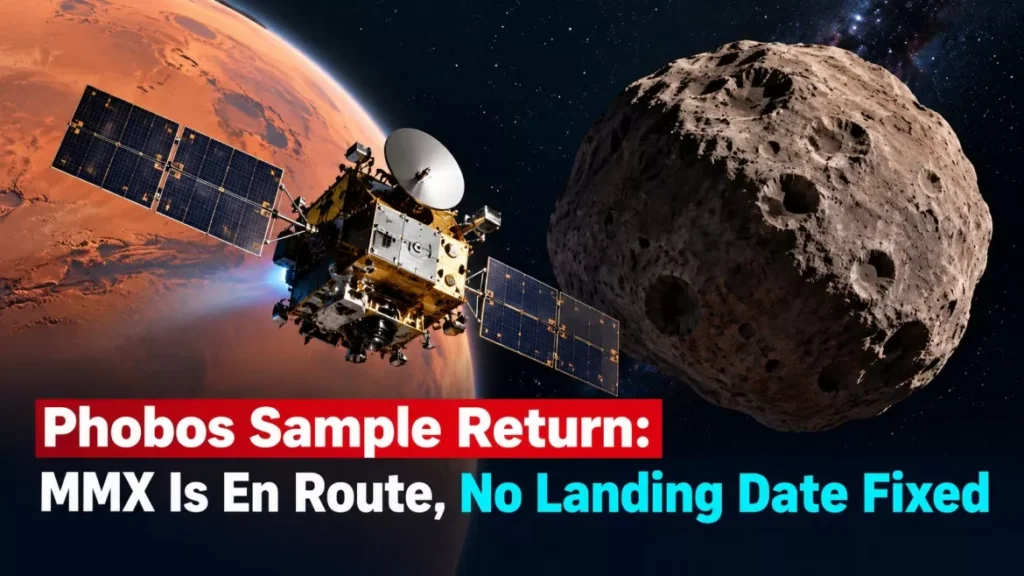

Japan’s Phobos sample return mission has launched. The MMX spacecraft lifted off at 4:41:03 a.m. JST on 20 October 2026 from the Tanegashima Space Center, and JAXA confirmed separation 71 minutes and 13 seconds after liftoff. It aims to deliver more than 10 grams of soil to Earth in 2031.
What Happened at Tanegashima
An H3 rocket carried MMX off the pad on its tenth flight and released the spacecraft a little over an hour later. JAXA, the Japan Aerospace Exploration Agency, said in its launch statement that “the H3 Launch Vehicle flew as planned” and that the spacecraft “was then injected into the predetermined orbit”.
The vehicle was H3 flight No. 10, built by Mitsubishi Heavy Industries. In United States time the liftoff fell on the afternoon of Monday 19 October, at 3:41 p.m. EDT, which is why some coverage carries that date. CBS News reported that the rocket’s upper stage fired twice as planned and put the spacecraft’s mass at about 9,900 pounds, roughly 4,500 kg.
The Mission Schedule, Stage by Stage
MMX stands for Martian Moons eXploration, and almost nothing happens for the next ten months. This is the sequence JAXA has published.
| Stage | Timing | What happens |
|---|---|---|
| Launch | 20 October 2026 | Liftoff and spacecraft separation, both confirmed |
| Cruise | About one year | Transfer toward Mars; no course events announced |
| Mars arrival | 2027 | Braking into orbit around Mars, not a landing |
| Phobos phase | 2027 to 2030 | Quasi-satellite orbit, rover release, two soft landings to collect soil |
| Deimos | Within the Phobos phase | Observations of Mars’s smaller moon |
| Departure | 2030 | Spacecraft leaves the Martian system |
| Earth return | 2031 | Capsule separates and re-enters; recovery in Australia |
As of 21 October 2026, the launch and the separation are the only two stages that have actually happened. Everything below the first row is a plan.
Why the Phobos Landing Date Is Not Fixed
No agency has committed to a date for the touchdown that collects the sample, and published accounts disagree by as much as two years.
- JAXA: Gives a window rather than a date, describing a 2027 to 2030 Phobos phase containing two soft-landing operations.
- SpacePolicyOnline: Reports a Phobos landing no earlier than December 2028.
- CBS News: Places the touchdown in the 2030 timeframe, with the rover dropped in early 2029.
The spread is not sloppy reporting. The landing site has not been chosen yet, and choosing it is part of the mission: the spacecraft must map Phobos from orbit first, and the Idefix rover is meant to spend up to 100 hours on the surface scouting candidate areas before the main spacecraft commits. The sources also differ on Mars arrival, with SpacePolicyOnline naming August 2027 and CBS News September 2027 against JAXA’s unspecific “about one year” of cruise.
A reader should take 2031 as the only date with real weight behind it, because the sample has to be back before the mission counts as a success, and treat the intermediate dates as estimates that will move.
What MMX Is Carrying
The spacecraft has three sections and a borrowed international payload. The propulsion module gets it to Mars, the exploration module does the landing and sampling, and the return module brings the capsule home.
- MEGANE: A gamma-ray and neutron spectrometer supplied by NASA and built at the Johns Hopkins Applied Physics Laboratory, which reads Phobos’s elemental composition from close range.
- MIRS: A near-infrared spectrometer from CNES, the French space agency, for identifying surface minerals and looking for organic compounds.
- Two samplers: A corer that drives into the surface and a pneumatic sampler, the latter from Honeybee Robotics.
- Idefix: A 25 kg rover built jointly by CNES and DLR, the German Aerospace Center, carrying a Raman spectrometer, a radiometer and wheel-facing cameras.
- Imaging and monitors: A telescopic nadir imager, an optical radiometer, lidar, a dust monitor, an ion mass analyser and 4K and 8K cameras.
Phobos has so little gravity that the rover’s weight becomes a problem in reverse. By the European Space Agency’s reckoning, the 25 kg Idefix will weigh about 15 grams once it is on Phobos, which is why it is designed to be released from low altitude and settle rather than drive down.
Why 10 Grams of Phobos Is Worth Five Years
The sample is meant to settle an argument about where Phobos came from, and the answer changes the history of Mars itself.
One explanation is that Phobos is an asteroid that strayed too close and was captured by Mars. The other is that it formed at Mars, either alongside the planet or out of debris thrown up by a giant impact. The two scenarios predict different chemistry, so a direct measurement of the soil can separate them in a way telescope observations and orbital surveys have not. JAXA states the goal as understanding “the origin of the Mars system” and the conditions that lead toward habitability.
Phobos itself is small and strange: roughly 27 by 22 by 18 kilometres, orbiting about 6,000 kilometres above the Martian surface, which is the closest orbit of any moon in the Solar System. It circles Mars in a little over seven and a half hours, faster than Mars turns. Our earlier reporting on what lies beneath the Martian surface covers the other half of that origin question.
What Is Still Unknown
JAXA’s launch statement stopped at orbital injection. It did not report solar array deployment, the spacecraft’s health or its communications status, and no agency has published a detailed trajectory or health check since. Those updates are expected over the coming months rather than days.
Mars missions do not become safe once they leave the pad, as the loss of NASA’s MAVEN orbiter showed. We covered that spacecraft’s unexplained spin earlier this month. MMX now faces a ten-month cruise before anything can be judged.
Phobos Sample Return FAQ
When Did MMX Launch?
At 4:41:03 a.m. JST on 20 October 2026 from the Tanegashima Space Center in Japan, which was 3:41 p.m. EDT on 19 October in the United States.
When Will the Phobos Samples Reach Earth?
JAXA plans a 2031 return, with the capsule separating for atmospheric entry and recovery in Australia. No month has been announced.
How Much Soil Will MMX Collect?
The requirement is more than 10 grams, gathered across two soft landings. The actual amount depends on how the surface behaves.
Will MMX Land on Mars?
No. It brakes into orbit around Mars and operates near the moons. Only Phobos gets a touchdown.
Has the Phobos Landing Site Been Chosen?
No. The spacecraft has to survey Phobos from orbit first, and the Idefix rover is intended to scout candidate sites before the main spacecraft descends.