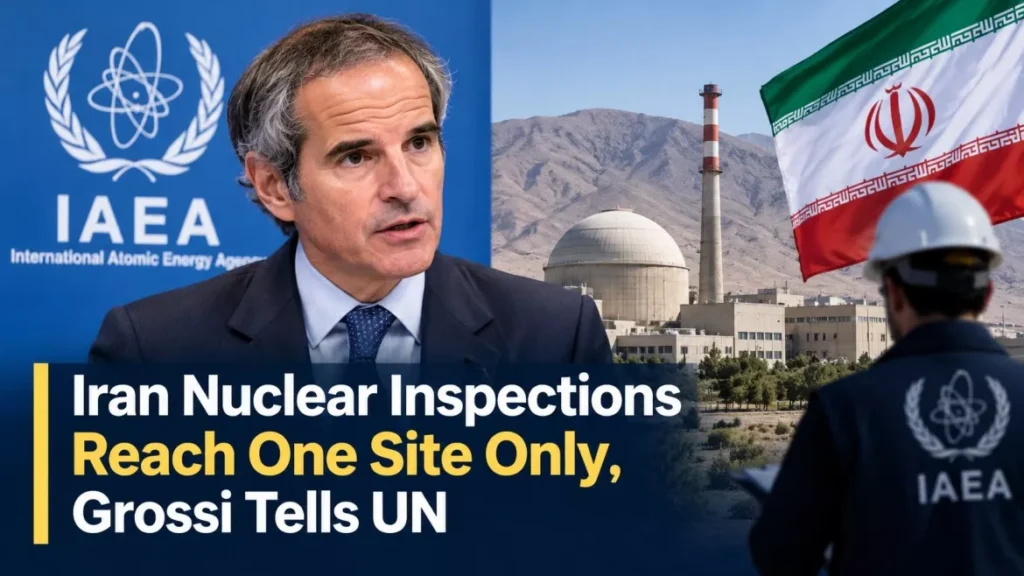

Iran nuclear inspections are now running at a single declared site, the Bushehr power plant, the head of the International Atomic Energy Agency told the United Nations Security Council on 27 October 2026. Rafael Grossi said the agency still cannot confirm that no safeguarded nuclear material has been diverted. He called access “Iran’s legal obligation”.
What Grossi Told the Security Council
The IAEA’s central message was that verification has broken down and can be repaired. Grossi, the agency’s Director General, said inspectors have been unable to carry out normal work for more than a year, and that Iran has not provided the information and access needed to verify previously declared nuclear material at its safeguarded facilities, damaged and undamaged alike.
According to the United Nations’ own account of the meeting, Grossi said the situation “can and must be rectified” and that “constructive engagement is possible” on the basis of the agency’s past work with Iran. He said satellite monitoring is “no substitute for access on the ground”, and closed by saying that “only diplomacy, underpinned by IAEA verification, can prevent nuclear proliferation in the long term”.
He also told the Council that Iran should clarify outstanding safeguards questions “without any further delay”, in remarks reported by the AFP news agency. Safeguards are the inspection and accounting rules a state accepts under the Treaty on the Non-Proliferation of Nuclear Weapons, which allow the IAEA to confirm that declared nuclear material has not been moved to a weapons programme.
Where Inspectors Can and Cannot Go
Access is partial, and the pattern follows which sites were struck. Grossi set out the position as follows:
- Bushehr nuclear power plant: Inspectors are working there now. Iran’s atomic energy organisation helped install safeguards equipment to verify spent fuel before it moves to dry storage, which the agency expects early in 2027.
- Sites hit in June 2025 and in 2026: No access. The agency has seen no sign of any work to repair or rebuild them.
- Isfahan Fuel Enrichment Plant: The agency is seeking access. Iran declared the facility shortly before the June 2025 strikes.
- Other safeguarded facilities: Normal inspections have not resumed, and material previously declared there has not been verified.
Iran’s ambassador to the IAEA, Reza Najafi, has argued that access to bombed facilities is materially impossible because of the damage caused by United States and Israeli strikes. Grossi’s account that no reconstruction is visible and Iran’s account that the sites cannot safely be entered are not the same claim, and the Council has not adjudicated between them.
The 440 Kilogram Question
The figure at the centre of the dispute is an estimate that predates the strikes. Before the June 2025 conflict the IAEA assessed Iran’s stock of highly enriched uranium at about 440 kilograms enriched to 60 per cent, a figure reported by AFP and cited at the briefing as of particular concern.
Three things about that number need stating plainly. It is an estimate as of mid-2025, not a current reading. Sixty per cent enrichment is well above the 3.67 per cent ceiling set by the 2015 nuclear agreement, which is no longer in force, and below the roughly 90 per cent generally described as weapons-grade. And the material’s present condition and location are unknown: the agency has not verified the stockpile since June 2025, and no party has produced evidence of where it now is.
Grossi did not say the material has been diverted. His statement was narrower and is the one the agency is obliged to make: it cannot confirm that it has not been.
How Iran’s File Reached the Council
The briefing was the first time the Council took up the referral in open session, and the chain behind it is dated and documented:
- June 2025: Israeli strikes hit Iranian nuclear sites during a 12-day conflict. Iran subsequently suspended cooperation with the IAEA.
- June 2026: The IAEA Board of Governors finds Iran in non-compliance with its safeguards obligations.
- 28 February 2026: Nuclear facilities are struck again in the conflict that began that day, which AFP describes as involving Israel and the United States.
- 1 September 2026: An IAEA report cites Iran’s “continued refusal to engage the Agency”.
- 9 September 2026: The Board votes 23 to 3, with eight abstentions, to report Iran to the Security Council. China, Russia and Niger vote against. Britain, France, Germany and the United States back the resolution.
- 27 October 2026: Grossi briefs the Council, at a meeting requested by Bahrain, Denmark, France, Latvia, the United Kingdom and the United States.
It is the first such referral in two decades over nuclear reporting obligations. This site covered the September vote and its margin at the time.
What Each Side Says, and What Is Disputed
The positions set out around the briefing diverge on the law as much as on the facts.
| Party | Stated position |
|---|---|
| IAEA (Rafael Grossi) | Access is Iran’s legal obligation; the agency cannot confirm no material has been diverted; engagement remains possible. |
| Iran (Amir Saeid Iravani, UN representative) | Criticised the Council’s “silence” on the strikes, describing “an established double standard in which the aggressor is shielded with impunity”. |
| Iran (President Masoud Pezeshkian) | Iran is willing to submit to verification, but as part of a broader diplomatic agreement. Told Fox News Iran does not want nuclear weapons: “Not at all.” |
| Russia, China and Iran (joint statement) | The referral “lacks a legal basis”. |
| United States | Co-sponsored the IAEA resolution. Ambassador Mike Waltz said Washington and its allies would never allow Iran to acquire nuclear weapons. |
What is agreed is narrow: inspectors do not have access to the struck sites, Bushehr is an exception, and the 2015 agreement’s limits no longer apply. What is claimed and contested is whether the referral has a legal basis, whether the lack of access is Iran’s choice or a physical consequence of the strikes, and whether the strikes themselves were lawful. A separate report on alleged war crimes made findings against both the United States and Tehran. What is unverified is the state and location of the 440 kilograms, and whether any weaponisation work has occurred; the Arms Control Association reported that Iran does not appear to be excavating the bombed material or restarting weaponisation-related activity.
What the Security Council Can Do Next
The Council has powers here but is widely expected not to use them. After the 2006 referral it passed resolutions requiring Iran to halt certain nuclear activities and cooperate with the IAEA, followed by sanctions resolutions when it did not. Those sanctions were suspended under the 2015 agreement and reimposed in 2025.
The obstacle is arithmetic. Russia and China hold vetoes and both voted against the referral, which is why AFP and other coverage describe the move as largely symbolic. As of 28 October 2026 no draft resolution has been reported, and no date has been set for further Council action. Closed consultations were expected to follow the open briefing.
Two further developments are worth watching but are not decided. A small group of Iranian lawmakers has submitted a bill calling for withdrawal from the Non-Proliferation Treaty; that is not government policy. And AFP reported that President Trump, asked about Iran on Fox News, said: “Do I make a deal with them, or do I finish them off?” Earlier talks between the two governments produced two different accounts of the same meeting.
Frequently Asked Questions
Where Are Iran Nuclear Inspections Still Taking Place?
At the Bushehr nuclear power plant, where IAEA inspectors were working as of the 27 October 2026 briefing. Grossi said normal inspections have not resumed elsewhere, and the agency has no access to sites damaged in the strikes of June 2025 and 2026.
How Much Enriched Uranium Does Iran Have?
The IAEA assessed Iran’s stock at about 440 kilograms enriched to 60 per cent before the June 2025 strikes, a figure reported by AFP. That is an estimate from mid-2025; the agency has not been able to verify the material since, and its current location and condition are not publicly known.
Did Grossi Say Iran Has Diverted Nuclear Material?
No. He said the agency cannot confirm that no safeguarded material has been diverted, which is a statement about missing verification rather than a finding of diversion.
Why Was Iran Referred to the UN Security Council?
The IAEA Board of Governors voted 23 to 3 on 9 September 2026, with eight abstentions, to report Iran for failing to meet its safeguards obligations, after a 1 September report cited Iran’s refusal to engage. China, Russia and Niger voted against, and the three states have said the referral lacks a legal basis.
Can the Security Council Impose New Sanctions on Iran?
It has done so in the past, but any resolution can be vetoed by Russia or China, both of which opposed the referral. As of 28 October 2026 no draft resolution had been reported.