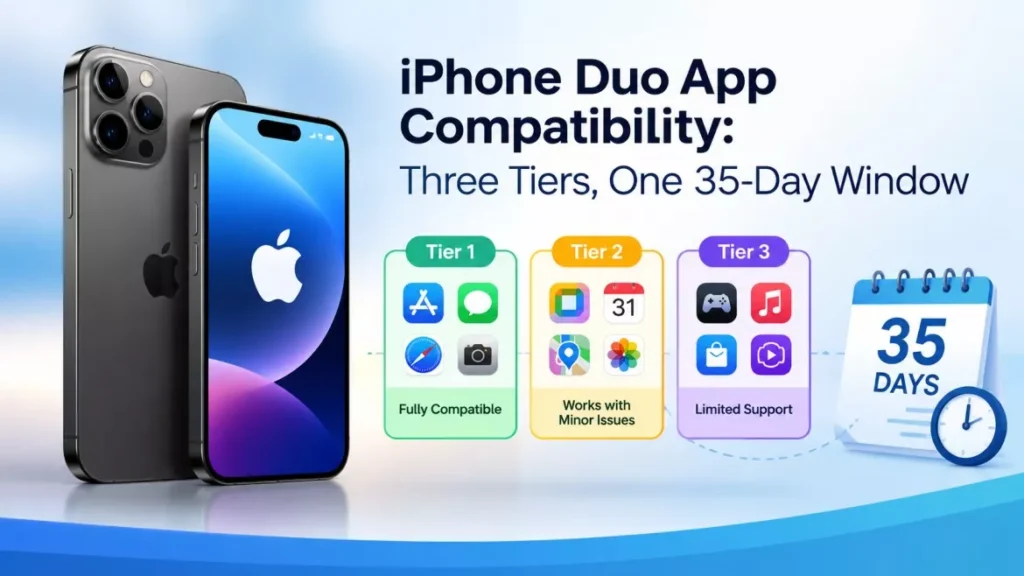

iPhone Duo app compatibility comes in three tiers, and only apps rebuilt with the iOS 27.1 SDK fill the 7.6-inch inner screen. That SDK reached developers as an Xcode beta on 18 September 2026. The foldable ships on 23 October, 35 days later, and Apple has published no list of which apps will be ready.
The Three Ways an App Will Look on the iPhone Duo
How much of the screen an app uses depends entirely on which software development kit its last build was compiled against, and the difference is visible to anyone holding the phone. Apple set out the three outcomes in its developer session “Prepare your app for iPhone Duo.”
| App built with | On the 7.6-inch inner display | What the owner sees |
|---|---|---|
| iOS 26 SDK or earlier | Runs inside a phone-shaped safe area | Black bars around a centred iPhone-sized window |
| iOS 27 SDK | Extends to the left of the status bar and camera | Most of the display used, with empty space remaining |
| iOS 27.1 SDK | Extends to the edge of the screen | Full display, with navigation and toolbar buttons laid out vertically under the status bar |
Apple’s wording is unambiguous on the top tier: “When you build your app with the iOS 27.1 SDK, your app extends to the edge of the screen.” Nothing breaks at the lower tiers. An unmodified app still launches, still works and still handles the fold, as Apple notes that apps run on iPhone Duo even without recompiling. It simply looks like a phone app stranded on a tablet.
Why Developers Have So Little Time
The tool needed for the top tier did not exist until five weeks before the shipping date. The sequence, all in 2026, runs like this:
- 9 September: Apple announces the iPhone Duo at its “Surprise and Shine” event, with pre-orders from 16 October and availability from 23 October.
- 14 September: iOS 27 is released to the public, starting the annual round of compatibility work every iOS developer has to do anyway.
- 16 September: Xcode 27.2 is available but Xcode 27.1 is not. Apple tells developers the iOS SDK and simulator support for iPhone Duo “will be available later this month in an upcoming release of Xcode 27.1.”
- 18 September: Apple releases the first Xcode 27.1 beta, with updated iPhone Duo SDKs and a simulator supporting the device’s poses and orientations. It requires an Apple silicon Mac running macOS 26.6 or later.
- 16 October: Pre-orders open at 5 a.m. Pacific time, 28 days after the beta appeared.
- 23 October: The iPhone Duo goes on sale in more than 70 countries, with further regions following on 30 October.
As of 20 September 2026, Xcode 27.1 is still a beta release, and Apple has not said when the final version arrives. Apple has named Netflix, Zoom and Slack among the apps already adapting to the foldable. It has not published a broader list, a deadline, or any requirement that developers update at all.
What Apple Is Actually Asking Developers to Change
Recompiling is the start, not the whole job. The iPhone Duo changes shape in the owner’s hands, so an app has to survive being folded, unfolded and rotated without redrawing itself badly.
Apple’s guidance asks developers to lay out interfaces using size classes rather than interface orientation, and states plainly: “Avoid checking interface orientation for layout decisions. Use size classes instead.” It also warns that “safe areas and layout margins are often asymmetric on iPhone Duo, so handle each side independently,” and that code referring to the device’s main screen is ambiguous on a two-display phone and will be deprecated.
That is structural work in an app’s layout code, not a checkbox. It is why a recompile alone lands most apps in the middle tier rather than the top one, and why large suites from companies that historically move slowly on new iOS form factors are unlikely to be finished on 23 October.
How to Check Your Own Apps Before Pre-Orders Open
There is no official compatibility list, so the check has to be done app by app. Apple has not committed to publishing one, and the App Store does not label Duo readiness.
- List the five or six apps you actually use for hours a week rather than the ones you own. Those are the only ones whose layout will matter.
- Open each app’s App Store page and read the version history. Look for iPhone Duo, iOS 27.1, adaptive layout or Split View in the release notes.
- Check the developer’s own site or changelog, which is usually more specific than the App Store entry about which SDK a build targets.
- For work software, ask the vendor directly. Enterprise suites are the slowest to adopt a new form factor and the least likely to announce it publicly.
- If the apps you rely on are silent, weigh whether the phone is worth $1,999 before they are updated. The middle tier is usable; it is not what the hardware was built for.
Our earlier coverage of the iPhone Duo release date and what Apple dropped from the design sets out the hardware itself, and the iOS 27 release explains the update that has to be installed first.
Frequently Asked Questions
Will Old Apps Work on the iPhone Duo at All?
Yes. Apps compiled against older SDKs still install and run. They render inside a phone-shaped area with black space around them on the 7.6-inch inner display rather than filling it.
Which SDK Does an App Need to Use the Full Inner Screen?
The iOS 27.1 SDK. Apple says an app built with it extends to the edge of the screen and lays standard navigation and toolbar buttons out vertically under the status bar.
When Does the iPhone Duo Go on Sale?
Pre-orders open on Friday 16 October 2026 at 5 a.m. Pacific time, and the phone is available from Friday 23 October in more than 70 countries, with additional regions from 30 October. It starts at $1,999 in the United States.
Does the iPhone Duo Ship With iOS 27.1?
Yes. Apple says the device ships with iOS 27.1 and the A20 Pro chip. The operating system being current does not make third-party apps current; each app has to be rebuilt separately.
Has Apple Set a Deadline for Developers to Update?
No. Apple’s developer guidance for iPhone Duo contains no compliance deadline, and apps that are never updated will keep working in the lowest rendering tier.