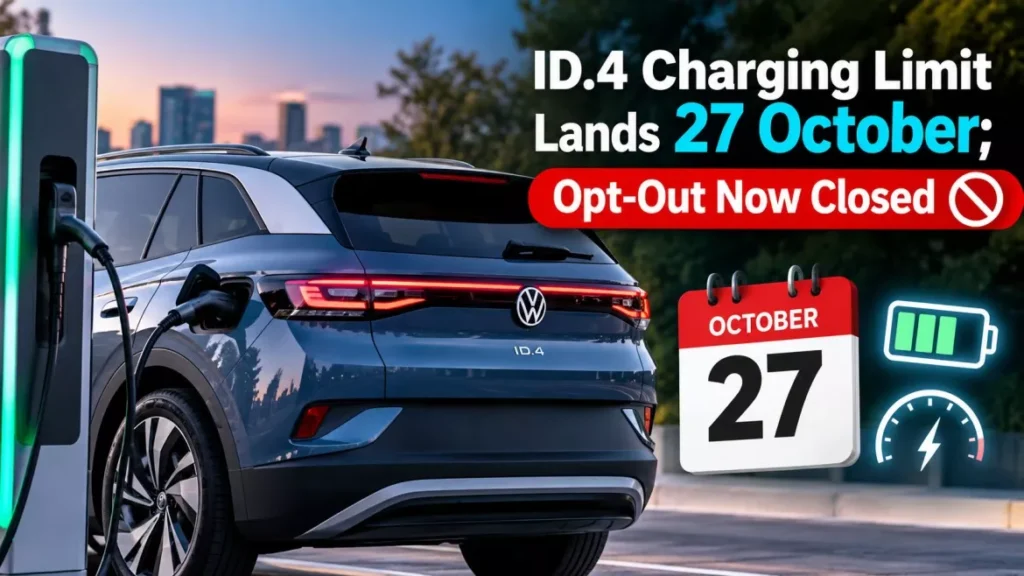

The ID.4 charging limit takes effect on or about 27 October 2026, when Volkswagen remotely caps charging at 80 percent on 22,524 recalled electric SUVs in the United States. The deadline for owners to decline the setting through the myVW app passed on 21 October. No permanent repair exists yet.
What the 27 October Update Does
The cap is a software setting, not a repair. Volkswagen pushes it over the air to connected vehicles in the recall population, and once applied it prevents the battery from charging beyond 80 percent of its capacity. The change is reflected in the myVW app.
Owners were sent a notification in that app headed “93EX High-Voltage Battery Settings”, offering a choice between “Accept Setting” and “Decline Setting”, as Electrek reported when the notice went out. Owners who declined keep full charging capacity and manage the 80 percent ceiling themselves. Whether the setting reaches a particular car depends on its configuration and connectivity, so cars that are offline may not receive it on schedule.
Why the 80 Percent Cap Is Not the Recall Remedy
The fix has not been built. According to NHTSA’s record for campaign 26V630, “the remedy is currently under development”, and owners are “advised to only charge their vehicles to a maximum of 80% battery capacity until the repair has been completed.”
That distinction matters because the recall is open-ended. Volkswagen told the regulator the root cause is unknown, stating only that certain charging profiles combined with a state of charge over 80 percent may trigger thermal propagation in the high-voltage battery — the process by which one overheating cell sets off the cells around it. The agency’s summary of the defect is blunter: “The high voltage battery may fail and lead to a vehicle fire.”
A recall with a defined repair behaves differently. When Volvo recalled the EX30, for example, the repair was available as the campaign opened. Here the interim restriction is all that is on offer, and Volkswagen has not said when a remedy will follow. This is the latest step in a sequence our earlier report traced when it noted this was the third ID.4 battery recall in 11 months.
Which ID.4s Are Covered, and How Volkswagen Chose Them
The campaign covers 22,524 ID.4s from the 2023 to 2026 model years, built between 1 January 2023 and 1 February 2025, with cells supplied by SK Battery America of Commerce, Georgia.
Volkswagen did not simply recall every car of that vintage. It told the regulator it built the recall population from vehicle assembly records, battery traceability information, supplier production records and available vehicle charging data, and excluded cars whose recent charging records showed use below a defined threshold. In effect, some owners are included because of how they charged. Volkswagen estimates that 0.1 percent of the recalled vehicles carry the actual defect, which is about 23 cars.
Owners can confirm whether a specific car is affected by entering its vehicle identification number on the NHTSA website, where the VINs for this campaign became searchable on 6 October 2026. Volkswagen’s reference for the recall is 93EX, and its customer service line for it is 1-800-893-5298.
What Owners Are Told to Do, and What They Are Not
The guidance stops at the charging ceiling. NHTSA’s record for this campaign does not carry a “park it” or “park outside” warning, the two flags the agency applies when it considers a defect severe enough that a vehicle should not be driven or should be kept away from buildings.
- Advised: charge to no more than 80 percent of battery capacity until the repair is completed.
- Not advised: stopping driving, parking outdoors, or avoiding the vehicle, none of which appear in the recall record.
- Reimbursement: none is offered under this campaign, because the affected cars remain inside the new-vehicle limited warranty period.
Volkswagen reported 22 claims connected to the issue in the United States between 18 January 2024 and 7 August 2026. It has not reported any injuries in connection with the recall.
How Much Range the Cap Costs
Roughly a fifth, in proportion to the battery. An ID.4 rated at 263 miles (423 km) on the United States EPA cycle gives about 210 miles (338 km) when charged to 80 percent rather than full; a 2023 entry model with the 62 kWh pack drops to roughly 162 miles (261 km).
These are arithmetic illustrations rather than figures Volkswagen has published. Real-world range moves with temperature, speed, terrain and load, and many electric cars are routinely charged to 80 percent anyway to reduce battery wear, so the practical loss falls mainly on long journeys and on owners who habitually charged to 100 percent.
Dates From Here
As of 24 October 2026, the charge cap has not yet been applied, the opt-out window has closed, and no remedy date has been set.
- 30 September 2026: Volkswagen filed its defect report with NHTSA.
- 6 October 2026: affected VINs became searchable on the NHTSA website.
- 21 October 2026: deadline passed for owners to decline the temporary setting in the myVW app.
- On or about 27 October 2026: Volkswagen applies the 80 percent charging limit remotely.
- 27 November 2026: interim letters notifying owners of the safety risk are expected to be posted.
- Not scheduled: the permanent remedy, and the further letters that will follow once it exists.
The action is not confined to the United States. Volkswagen is recalling about 72,668 electric cars worldwide across three campaigns, including 9,881 in Germany according to the German regulator KBA, covering batches of the ID.3, ID.4, ID.7 and ID. Buzz along with the Cupra Born. Those figures come from Volkswagen’s disclosures as reported by Electrek and have not been matched by a filing available in the United States.
Frequently Asked Questions
Can I Still Opt Out of the ID.4 Charging Limit?
Not through the app notification, which closed on 21 October 2026. Volkswagen has not published an alternative route for owners who missed it, so the company’s customer service line on 1-800-893-5298 is the only stated point of contact.
Is It Safe to Drive a Recalled ID.4?
Volkswagen and NHTSA have not told owners to stop driving or to park outside, and the recall record carries neither warning. The only instruction given is to keep the charge at or below 80 percent until the repair is done.
How Do I Check Whether My ID.4 Is Affected?
Enter the vehicle identification number on the NHTSA recalls website. VINs for campaign 26V630 became searchable on 6 October 2026, and Volkswagen’s own reference for the same action is 93EX.
When Will Volkswagen Actually Fix the Battery?
No date has been given. The regulator’s record states the remedy is still under development, and Volkswagen says it has not identified the root cause of the failure.
Will the Charge Cap Be Removed After the Repair?
Volkswagen has not said. The setting is described as temporary and tied to the period before the repair, but the company has not stated whether full charging returns automatically once a remedy is fitted.