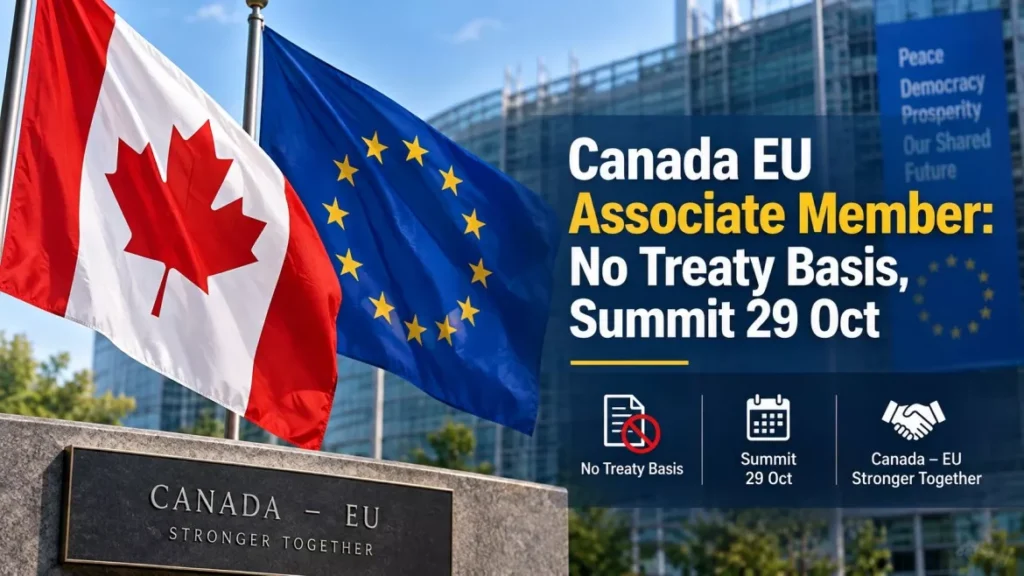

Canada has been invited to become the first EU associate member. The status does not exist in the European Union’s treaties. European Commission President Ursula von der Leyen made the offer on 16 September 2026 in her State of the European Union address in Strasbourg, with Prime Minister Mark Carney present.
What Von Der Leyen Said in Strasbourg
The invitation came near the start of the European Commission president’s annual address to the European Parliament, delivered on 16 September 2026.
Speaking directly to Carney, von der Leyen said she would “like to work with you on opening the door for Canada being the first associate member of the EU”, in the wording carried by the Associated Press and Reuters. She framed the move as a step beyond the existing trade relationship, saying the two sides would move from CETA to what she called an “Alliance for the Future” to create a common prosperity and economic security space.
She also said the proposal was “a partnership not against anyone else, but for our common strength”. Carney attended as guest of honour and was applauded by members of the European Parliament. Euronews reported that he was due to address the Parliament the following morning.
CETA is the Comprehensive Economic and Trade Agreement, the EU-Canada trade deal that has been applied provisionally since 2016 and removed tariffs on most goods traded between them.
Why Associate Member Has No Definition in EU Law
There is no category called associate member in the European Union’s founding treaties, and von der Leyen did not set out what one would involve.
Membership of the European Union is governed by Article 49 of the Treaty on European Union. It opens: “Any European State which respects the values referred to in Article 2 and is committed to promoting them may apply to become a member of the Union.” Canada is not a European state, so the accession route in Article 49 is not open to it.
EU law does recognise association agreements, which are treaties with non-member countries covering trade and cooperation. Those are a different instrument from membership, and they do not carry seats in the EU’s decision-making bodies. Euronews described associate membership as a completely new status with key questions, including voting rights, still unanswered.
The phrase has a short political history. German Chancellor Friedrich Merz floated associate membership for Ukraine in May 2026, describing a status that would give access to the European Council, the European Commission and the European Parliament without voting rights or a dedicated portfolio. That idea was aimed at a country that is seeking full membership; Canada is not.
What Canada Would Get Under the Proposal
Von der Leyen listed areas of cooperation rather than institutional rights. As described in her address and reported by the Associated Press and Euronews, the package would cover:
- EU programmes: participation in schemes including Erasmus+ and Horizon Europe, and recognition of worker qualifications.
- Industrial and technology cooperation: advanced manufacturing, artificial intelligence, quantum computing and cyber security.
- Defence: a shared defence industrial base, building on steps already taken.
- Resources and the Arctic: energy, critical minerals, batteries and joint Arctic projects.
- Mobility: the Associated Press reported that Canada would seek an arrangement letting its citizens live and work in Europe without visas.
The Associated Press reported that von der Leyen gave no specifics on the mechanics of associate membership or on how it would sit alongside full membership negotiations for other countries.
What Is Agreed, What Is Claimed and What Is Undefined
Very little of this is settled. The table separates what has actually happened from what has only been proposed.
| Item | Status as of 17 September 2026 |
|---|---|
| Von der Leyen made the offer publicly in Strasbourg | Agreed and on the record |
| Canada joined the EU’s SAFE defence procurement programme | Agreed; Canada was the first non-European country to join, in 2026 |
| CETA is in force between the EU and Canada | Agreed; applied provisionally since 2016 |
| Canada becoming an “associate member” | Proposed by the Commission president only; no legal category, no formal proposal tabled |
| Voting rights, budget access or a seat in EU institutions | Undefined; not specified in the address |
| Visa-free living and working rights for Canadians in the EU | Claimed as a Canadian objective, reported by the Associated Press; not agreed |
| Treaty change to create the status | Not proposed; the question of whether it would be needed is open |
Nothing in the address commits the 27 member states to anything. Under the EU’s own rules, agreements with third countries require the Council and, depending on their scope, the European Parliament and national parliaments.
Why Canada Is Looking Towards Europe
The proposal lands while Canada’s trade relationship with the United States is under strain from tariffs imposed by the Trump administration.
Roughly 70% of Canadian exports go to the United States, according to the Associated Press, which makes the relationship difficult to replace and, Ottawa argues, difficult to negotiate. Carney said that “when we only negotiate bilaterally with a hegemon, we negotiate from weakness”, adding that accepting that position is “not sovereignty. It is the performance of sovereignty while accepting subordination”.
Canada has already moved on defence. It became the first non-European country to join SAFE, the European Union’s €150 billion defence procurement programme, in 2026. On trade, Canada has been responding to United States measures with its own; our earlier report sets out how Canada’s counter-tariffs are structured and who actually pays them.
What Happens Next
The next fixed point is a summit, not a negotiation.
- 17 September 2026: Carney was scheduled to address the European Parliament, according to Euronews.
- 29-30 October 2026: an EU-Canada summit in Montreal, where Carney hosts von der Leyen and European Council President Antonio Costa. Carney has said discussions would step up there.
- After the summit: any new status would need a legal form, agreement among the 27 member states and, in some scenarios, treaty change. None of that has been set in motion.
Carney has previously said Canada seeks a unique alliance with the European Union rather than full membership. Whether the Commission means a tailored partnership under the existing treaties or a genuinely new category is the question the Montreal summit will have to begin answering.
Frequently Asked Questions
Is Canada Joining the European Union?
No. Article 49 of the Treaty on European Union limits membership applications to European states. The 16 September 2026 proposal was for an associate member status that does not currently exist in EU law.
What Is a Canada EU Associate Member Status?
It is an undefined idea rather than an existing legal category. Von der Leyen described cooperation on trade, defence, technology, energy and Arctic projects, but set out no institutional rights such as votes or a seat in EU bodies.
When Did Von Der Leyen Make the Proposal?
On 16 September 2026, during her State of the European Union address to the European Parliament in Strasbourg, with Canadian Prime Minister Mark Carney present.
When Is the Next EU-Canada Summit?
29-30 October 2026 in Montreal. Carney hosts European Commission President Ursula von der Leyen and European Council President Antonio Costa.
Has Canada Accepted the Offer?
Canada has not formally accepted anything. Carney has said Canada wants a unique alliance with the European Union rather than full membership, and said talks would intensify at the Montreal summit.
Would Canadians Be Able to Live and Work in the EU?
Not under any current arrangement. The Associated Press reported that visa-free living and working rights are something Canada would seek as part of a broader partnership, but nothing has been agreed.