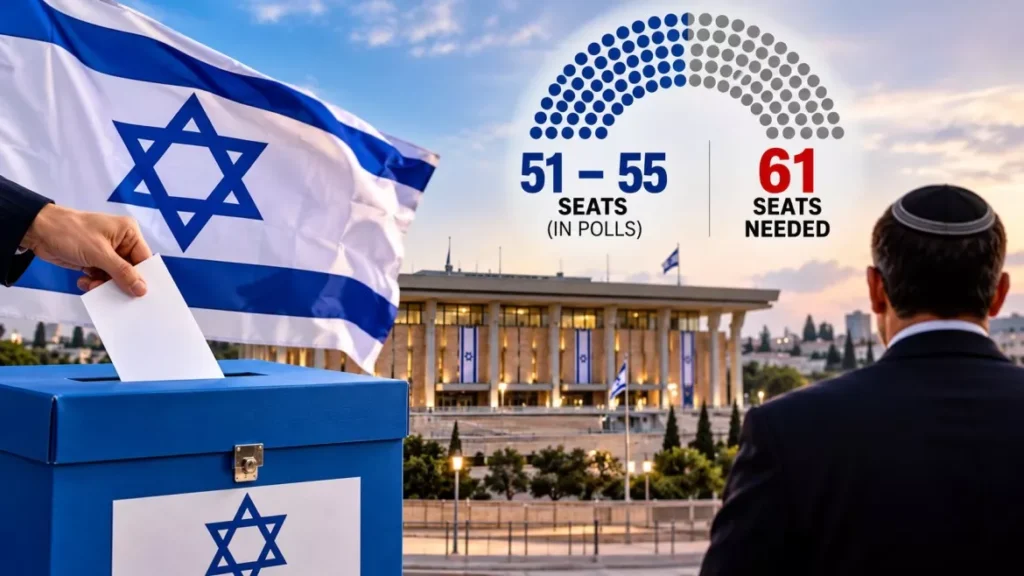

The Israel election 2026 takes place on 27 October, and no bloc is polling well enough to win outright. A government needs 61 of the Knesset’s 120 seats, and polls published between 18 and 20 October put the two main blocs between 50 and 55. Publishing new polls becomes illegal from late on 23 October.
This is a national election in Israel, and everything below applies only there. The Knesset is Israel’s single-chamber parliament, and voters choose party lists rather than individual local representatives.
What the Polls Show, and Who Conducted Them
Every published reading in the final week leaves both blocs short of 61 seats. The figures differ by pollster, which is why naming the pollster and the date matters more than any single number.
| Poll | Date published | Eisenkot-aligned bloc | Netanyahu-aligned bloc |
|---|---|---|---|
| Channel 12 | 19 October 2026 | 55 seats | 51 seats |
| Channel 13 | 19 October 2026 | 51 seats | 50 seats |
| Average of seven recent polls, compiled by The New Arab | 20 October 2026 | 51 seats | 51 seats |
| Middle East Forum “poll of polls” (a think-tank calculation, not a pollster) | 17 September 2026 | 54 seats | 53 seats |
The Channel 12 and Channel 13 figures are as reported by Haaretz on 19 October. In the seven-poll average compiled by The New Arab, Yashar — the party led by Gadi Eisenkot, a former chief of staff of the Israel Defense Forces — was the largest single party on 22 seats, with Likud, led by Prime Minister Benjamin Netanyahu, on 21.
A separate survey for the public broadcaster KAN, conducted on 18 and 19 October, found that about 30% of respondents were still undecided, while 39% said nothing could change their vote. None of these numbers is a forecast. The gap between polling and counting is routine: in Latvia’s election this month an exit poll put the leading party on 35.6% before the official count.
How the Israel Election 2026 Allocates 120 Seats
Israel uses nationwide proportional representation with a single constituency, so a party’s share of the national vote determines its seats. The rules come from the Knesset Election Law (Consolidated Version) 6729-1969 and the Basic Law: The Knesset, which requires elections to be “general, national, direct, equal, secret, and proportional”.
- Electoral threshold: a list must win at least 3.25% of total valid votes to enter the Knesset, which works out at roughly four seats.
- The quotient: total valid votes are divided by 120 to produce a quotient, and each qualifying list receives its vote total divided by that quotient, rounded down.
- Surplus votes: leftover votes are pooled under surplus-vote agreements made between pairs of parties before the election; without such an agreement, they go to the lists that came closest to another seat.
- No absentee voting: Israeli law does not recognise absentee ballots, so voters must attend a polling station in person and identify themselves.
These mechanics are set out in sections 81 to 83 of the election law, summarised in the Law Library of Congress’s guide to the 27 October vote.
Why 61 Is the Number That Decides the Government
A new Israeli government takes office only after winning a confidence vote supported by at least 61 of the 120 members. No single party has ever won 61 seats on its own, so every Israeli government has been a coalition.
That is why bloc arithmetic, rather than which party finishes first, determines who governs. A party can come first on 22 seats and still not form a government if the parties willing to sit with it total fewer than 61. The same gap between winning most seats and commanding a majority left Morocco’s prime minister-designate 101 seats short earlier this month.
The Small Parties Near the Threshold Could Settle It
Because the threshold is 3.25%, a party that falls just below it wins nothing and its votes are redistributed to others — which can move several seats between blocs. Several small parties are polling close to that line.
Reporting on the final week has focused on the party led by Ofer Winter, which Channel 13’s poll showed crossing the threshold while Channel 12’s left it below. Across recent polls, 11 of the 38 registered parties were expected to clear the threshold, with four more close to it, according to the Jewish Telegraphic Agency.
One withdrawal has added a complication. Benny Gantz announced on 19 October, eight days before the vote, that he would not contest the election, after months of polling in which his Blue and White party failed to cross the threshold. Blue and White nevertheless remains on the ballot paper on 27 October. Opposition figures welcomed the withdrawal; Likud figures warned that votes could still be split among small parties.
Where the Arab-Led Parties Sit
Several polls show that neither bloc reaches 61 without the Arab-led parties, and this is the most contested question of the campaign. The arithmetic and the politics point in different directions.
Haaretz reported on 19 October that the Eisenkot-aligned bloc led in two new polls but fell short of a majority without Arab parties. Foreign Policy reported on 20 October that the two Arab-led parties could supply the votes that give the anti-Netanyahu bloc a majority, and that several opposition figures have ruled out including them in a government.
The historical precedents differ. The government formed in 2021 included an Arab party in its coalition, though none of its members served as ministers. The governments led by Yitzhak Rabin and Shimon Peres between 1993 and 1996 relied on Arab parties’ support from outside the coalition. There is no agreement among the parties on which, if either, model would apply after this election.
When Publishing Polls Becomes Illegal
Israeli law closes down new polling before election day, and the window is now short. From 23:59 on Friday 23 October until polling stations close on 27 October, publishing or broadcasting the results of any election poll not already made public is prohibited.
The Central Elections Committee, the statutory body that runs Israeli elections, has said the restriction covers social media and direct messages to voters, not only broadcasters and newspapers. An older poll may be republished, but whoever republishes it must state prominently that the findings are out of date and cannot be used to draw conclusions about current opinion. Israel Hayom reported the committee’s warning on 20 October.
The ban previously began 24 hours before voting. It was moved to the preceding Friday on the argument that polls do not merely reflect opinion but shape it. The practical effect is that the last published polls before 27 October will be several days old on the day itself.
What Happens After 27 October
Voting ends the campaign but does not produce a government. The steps that follow are set by law and have no fixed total duration.
- Results are published: the Central Elections Committee certifies and publishes the official results.
- The president consults: within seven days of the formal results being published, President Isaac Herzog holds separate meetings with the heads of every party and then decides which member of the Knesset is given the first attempt at forming a government.
- Twenty-eight days to form a coalition: the designated candidate has 28 days, which may be extended.
- If that fails: the mandate may pass to another member of the Knesset, or the Knesset may dissolve itself and trigger another election.
- Meanwhile: under the Basic Law: The Government, the outgoing government “shall continue to perform its functions until the new Government is formed”. Israeli law does not restrict a transitional government to routine business.
Herzog has indicated a preference for a national unity government spanning both blocs, but the choice of who receives the mandate is his and he has not announced it.
What Is Agreed, What Is Claimed and What Is Unknown
As of 21 October 2026, the fixed facts are narrow and the contested ground is wide.
- Agreed: the election is on 27 October 2026; 120 seats are contested; the threshold is 3.25%; 61 seats are needed for a confidence vote; the Knesset dissolved on 17 July 2026 by a vote of 62 to 0; the polling ban starts at 23:59 on 23 October.
- Agreed and notable: this vote falls on its originally scheduled date, the latest the law allows. The outgoing Knesset is the first since 1988 to complete a full four-year term, a point made both by the Knesset’s legal adviser Sagit Afik and in the Law Library of Congress guide. It is not a snap election, though the dissolution followed a coalition dispute over military-service exemptions for ultra-Orthodox students.
- Claimed by pollsters, not established: every seat projection above. They are survey findings on the dates stated, not results.
- Disputed: whether the Arab-led parties could or would support a government, and whether polls understate support for Netanyahu’s bloc, a concern raised in Foreign Policy’s 20 October analysis on the basis that some right-wing voters distrust pollsters.
- Unknown: turnout; which small parties clear the threshold; who President Herzog will task with forming a government; and whether a government will be formed at all before the statutory windows expire.
No result exists yet, and no party has won anything. Any figure describing the outcome of this election before polls close on 27 October is a projection.
Frequently Asked Questions
When Is the Israel Election 2026?
Tuesday 27 October 2026. The Knesset dissolved on 17 July 2026 by a vote of 62 to 0, and the election falls on its originally scheduled date, the latest permitted by Israeli law.
How Many Seats Are Needed to Form a Government?
At least 61 of the Knesset’s 120 seats must support the new government in a confidence vote. No single party has ever won 61 seats alone, so coalitions are always required.
What Do the Latest Polls Say?
Polls published between 18 and 20 October 2026 put the Eisenkot-aligned bloc between 51 and 55 seats and the Netanyahu-aligned bloc between 50 and 51. All were short of 61. These are survey findings on those dates, not predictions of the result.
What Is Israel’s Electoral Threshold?
A party list must win 3.25% of total valid votes to enter the Knesset, equivalent to roughly four seats. Lists below the threshold win no seats, and their votes are redistributed among the lists that qualify.
Why Can No New Polls Be Published Before Election Day?
Israeli law prohibits publishing or broadcasting previously unpublished election poll results from 23:59 on Friday 23 October 2026 until polling stations close on 27 October. The Central Elections Committee says the ban also covers social media and direct messages to voters.
What Happens If No Bloc Wins a Majority?
President Isaac Herzog consults party leaders within seven days of the official results and designates a member of the Knesset to try to form a government, who then has 28 days with a possible extension. If that fails, the mandate can pass to someone else or the Knesset can dissolve and call another election.