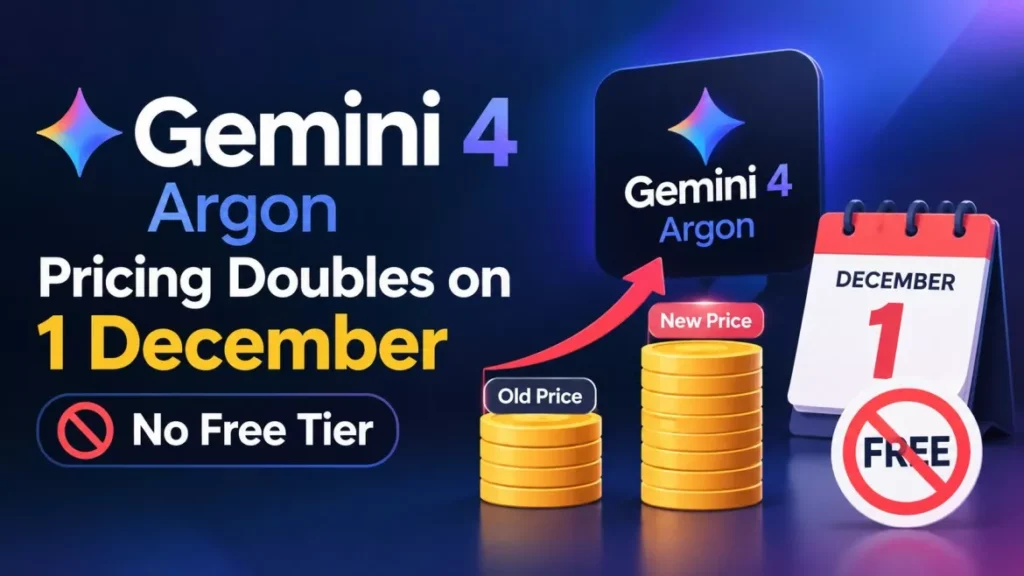

Gemini 4 Argon pricing starts at $2 per million input tokens and $10 per million output tokens, and doubles on 1 December 2026. Google made the model generally available on 13 October, replacing access that had been limited to 650 partners. There is no free API tier.
What Gemini 4 Argon Pricing Looks Like Before and After 1 December
The launch rate is an introductory offer with a fixed end date, not a standing price. Google, whose DeepMind division builds the Gemini models, says the introductory period runs through 30 November 2026, after which the published rates double.
| Rate, per million tokens | To 30 November 2026 | From 1 December 2026 |
|---|---|---|
| Input | $2.00 | $4.00 |
| Output | $10.00 | $20.00 |
| Cached input | $0.10 (95% discount) | Not confirmed by Google |
Google’s announcement states the introductory rate as “$2 per million input tokens and $10 per million output tokens” with cached input tokens at 95% off. The Rundown, a single source on this point, lists discounted Batch and Flex rates and higher Priority rates that double on the same date, and puts cached input at $0.20 from December. Google has not published the post-December cache rate itself.
What that means in money depends on the shape of the job. At list prices, a task sending one million input tokens and generating 100,000 output tokens costs $3.00 today and $6.00 from 1 December. If the input is fully cached, the same job costs $1.10 today, because the input portion falls from $2.00 to $0.10. The cache discount, not the headline rate, is where the difference sits for anyone re-sending the same context repeatedly.
Who Can Actually Use It Today
Argon is a paid product on every route, and the tier you hold decides which surfaces you get. The model identifier for developers is gemini-4-argon, and Google gives it a one-million-token unified input and output limit through the Gemini API.
| Route | Who it covers | Argon included |
|---|---|---|
| Gemini API, AI Studio, Android Studio | Developers on the paid tier | Yes |
| Gemini API free tier | Anyone | No |
| Gemini app and AI Mode in Search | Google AI Pro and Ultra subscribers | Yes |
| Google Antigravity, individual use | Google AI Ultra subscribers only | Yes |
| Gemini for business and Gemini Enterprise | Eligible business subscriptions | Yes |
Two routes sidestep the price entirely. Google has opened applications for 10,000 scientists to receive six months of free access to Antigravity’s highest usage tier, subject to eligibility, capacity and selection. Separately, vetted cybersecurity defenders can obtain access without the usual cyber guardrails through Google’s Fairwind Program, which the company is admitting to on a rolling basis.
The paid-only structure continues a pattern at Google, which tightened model limits for free Gemini users on 9 October. It also closes out the restricted launch: the model had been confined to 650 partners with no wider date announced as recently as 2 October.
Where Argon Leads, and Where It Does Not
Argon tops the benchmark Google leads with and sits mid-pack on another. The split matters because the two measure different things: professional task completion versus a composite of general capability.
| Benchmark | Argon | Named comparison | Measured by |
|---|---|---|---|
| Vals Index, 13 October 2026 | 68.90%, ranked first | Claude Sonnet 5.5 at 67.04% | Vals AI |
| Artificial Analysis Intelligence Index | 53, as reported by VentureBeat | Claude Opus 5.5 at 58 | Artificial Analysis |
| Embodied Reasoning, ERQA | 87% | All frontier models, per Google | |
| Gray Swan indirect prompt injection | 0.7% attack success over 15 adaptive attempts | None named | |
| RareBench, rare-disease diagnosis | 57% | None named | Gamow Labs, via Google |
| LabBench, wet-lab reasoning | 52.2% | None named | Gamow Labs, via Google |
Vals AI’s own leaderboard puts Argon first at 68.90%, and describes the index as benchmarking models on economically valuable tasks such as finance, software and frontier risk. One caution: Vals AI’s individual model pages carry different figures from its leaderboard for the same models, so the ranking is not stable between snapshots.
On the Artificial Analysis Intelligence Index the picture reverses. VentureBeat reports Argon scoring 53, behind Claude Opus 5.5 at 58 and level with GPT-6 Astra and Claude Fable 5.1. Checking Artificial Analysis directly confirms the rival scores of 58 for Opus 5.5 and 56 for both Claude Sonnet 5.5 and Muse Wonder Full, but Argon’s own entry was not listed, so the figure of 53 rests on VentureBeat alone.
Google’s own figures include results it has not had replicated: agentic code submissions by internal teams up more than 35%, post-submission rollbacks down by close to a third, and shortcut attempts on coding benchmarks falling to 2%. Google says violations on an adversarial safety set nearly halved against earlier Gemini models, and that external bio red teaming unlocked under 1% of the sub-tasks tested. The model was assessed under Google’s Frontier Safety Framework, with a published model card.
How the Price Compares With Rival Models
At the introductory rate Argon matches the cheaper frontier tier; from December it moves into the expensive one. These list prices are per million input and output tokens, as compiled by VentureBeat.
| Model | Input | Output |
|---|---|---|
| Gemini 4 Argon, to 30 November | $2 | $10 |
| Claude Sonnet 5.5 | $2 | $10 |
| GPT-6.1 Sol | $2 | $10 |
| Gemini 4 Argon, from 1 December | $4 | $20 |
| Claude Opus 5.5 | $4 | $20 |
| Meta Muse Wonder | $4 | $20 |
| GPT-6 Astra | $10 | $50 |
The Muse Wonder figure is independently consistent with Meta’s own launch terms, which set a $4 API price with the full model behind a $50 plan. The practical reading is that Argon is currently priced against the mid-tier models and will, in December, be priced against the top-tier ones without any announced change in capability.
What Google Has Not Said
As of 15 October 2026, Argon is generally available worldwide through the paid API, and the introductory rate has 46 days left to run. Several points remain open.
- Rate limits: Google’s developer announcement gives no published request or token rate limits for the model.
- Knowledge cutoff: not stated in either announcement.
- Post-December cache pricing: Google confirms the 95% discount for the introductory period only.
- Whether the introductory rate will be extended: Google has named 30 November as the end date and has not said whether it may move.
- Successor models: Google declined to comment to VentureBeat on reports of internal testing of versions codenamed Barium and Carbon.
Frequently Asked Questions
What Is Gemini 4 Argon Pricing Per Million Tokens?
Through 30 November 2026 it is $2 per million input tokens and $10 per million output tokens, with cached input at $0.10. From 1 December 2026 the input and output rates double to $4 and $20.
Is There a Free Way to Use Gemini 4 Argon?
Not through the API, which excludes Argon from its free tier. Google is offering six months of free Antigravity access at its highest usage tier to 10,000 selected scientists, and vetted cyber defenders can apply through the Fairwind Program.
Do I Need a Google AI Ultra Subscription?
Only for individual access to Google Antigravity. Argon appears in the Gemini app and AI Mode in Search for both Google AI Pro and Google AI Ultra subscribers.
Is Gemini 4 Argon the Best Model Available?
It depends on the benchmark. Vals AI ranked it first at 68.90% on 13 October 2026, while on the Artificial Analysis Intelligence Index VentureBeat reports it scoring 53, behind Claude Opus 5.5 at 58.
What Is the Context Limit for Gemini 4 Argon?
Google describes a one-million-token unified input and output limit through the Gemini API. It has not published separate figures for the maximum length of a single response.