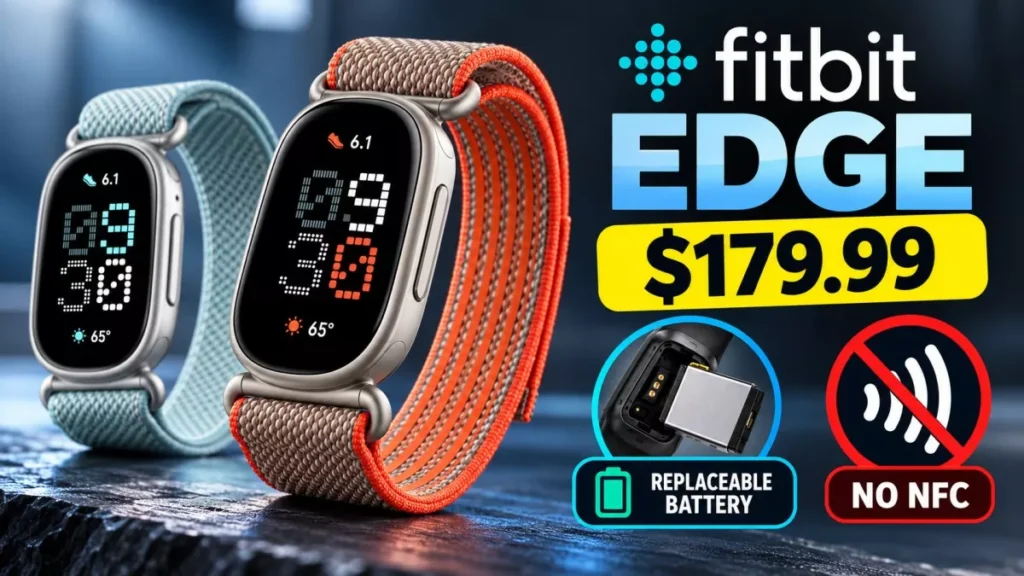

Google has launched the Fitbit Edge, a fitness tracker with a 1.34-inch AMOLED screen and a user-replaceable battery. The Fitbit Edge price is $179.99, pre-orders opened on 12 October 2026, and it reaches shelves on 27 October. It drops the NFC chip that let Charge 6 owners pay with Google Wallet.
What the Fitbit Edge Costs and When It Ships
The Fitbit Edge price starts at $179.99 for the standard model, with a Stephen Curry Special Edition at $219.99. Google opened pre-orders on its own store and through retail partners on announcement day, 12 October 2026.
| Item | Price |
|---|---|
| Fitbit Edge (United States) | $179.99 |
| Fitbit Edge (United Kingdom) | £159.99 |
| Fitbit Edge (eurozone) | €179.99 |
| Stephen Curry Special Edition | $219.99 |
That is roughly $20 above the Charge 6, which launched at about $160 in 2023. Every Edge includes three months of Google Health Premium, the subscription that unlocks the Google Health Coach.
As of 13 October 2026, the Fitbit Edge is available for pre-order and reaches general retail availability on 27 October 2026. Google has published store listings for the United States, the United Kingdom and eurozone countries including Germany, France, Italy and Spain. The company has not announced a launch date for markets without a listing.
What $179.99 Gets You
The Edge is built around the largest screen Google has put on a Fitbit tracker. These are the confirmed specifications from Google’s announcement and its published spec sheet.
- Display: A 1.34-inch always-on AMOLED panel behind Corning Gorilla Glass 3, which Google says offers 46% more viewing area than its previous trackers.
- Size and weight: 39.22 x 25.56 x 11.58mm, weighing 17.7g without a band, in a recycled aluminium case.
- Battery: A 65mAh cell rated at up to seven days, falling to about two days with the always-on display enabled.
- Charging: A magnetic USB-C charger that Google says delivers a full day of use from roughly five minutes on the cable. The cable is in the box; a 30W adapter is not.
- Sensors: Optical heart rate, red and infrared sensors for blood oxygen, electrical sensors for the ECG app, a far-field skin temperature sensor, an altimeter, accelerometer, gyroscope and ambient light sensor.
- GPS: Built-in multi-system GPS that works without a phone nearby, which Google says is up to 40% more accurate than previous generations.
- Durability: Rated 5ATM and IP68, which Google describes as water-resistant to 50 metres while noting the device is “not waterproof or dust proof”.
- Tracking: More than 50 exercise modes, with automatic recognition of up to 100 activity types.
- Compatibility: Phones running Android 11 or later and iOS 16.4 or later, plus a Google Account and the Google Health app.
What the Fitbit Edge Drops From the Charge 6
The Edge removes several things the Charge 6 could do, and Google’s announcement does not list them. This is the detail that decides whether an existing Charge 6 is worth replacing.
- Contactless payments: The Edge has no NFC chip, so Google Wallet tap-to-pay does not work. Ars Technica and 9to5Google both confirmed the omission on launch day.
- Wi-Fi: The tracker connects over Bluetooth 5.4 only, with no Wi-Fi radio.
- Microphone and speaker: Neither is fitted, so the Edge cannot take calls.
- Stress score: The EDA sensor and the EDA Scan app are gone, which removes the Stress Management Score. The specialist site The5KRunner, which published a detailed spec comparison, reports that background stress monitoring continues even though the score itself is withdrawn.
- Existing bands: The5KRunner also reports that Charge 6 straps will not fit, because the Edge uses a new attachment mechanism.
Some of this is a trade rather than a straight loss. The Charge 6 had no altimeter and no blood oxygen or skin temperature sensing; the Edge adds all three. Music controls also widen from the Charge 6’s limited set to any app on the paired phone.
Why the Replaceable Battery Matters
The Edge is the first Fitbit tracker whose battery the owner can change. Google calls it “our first repairable fitness tracker” and credits a modular internal architecture for it.
That is a real shift for a product category where a worn-out cell has normally meant a new device. Google’s own support documentation for the Charge 6 lists its battery as non-replaceable and tells owners not to attempt a repair themselves. 9to5Google reports that the Edge opens for a battery swap in the same way as the Pixel Watch 5.
What Google has not published is the part that matters for cost: there is no stated price for a replacement battery, no parts availability date, and no description of the procedure. Until those appear, the repairability claim cannot be checked against a real repair.
Which Health Features Depend on Where You Live
Several of the Edge’s headline health features are restricted by country, and Google says so only in the footnotes of its announcement.
- ECG app: Available in select countries only, and Google states it is not intended for anyone under 22.
- Skin temperature: Not available in all countries.
- Health Guardian features: Blood pressure trends, insulin resistance trends and high and low heart rate alerts also vary by region. Google describes them as general wellness features that are not for diagnosis, and says the blood pressure and insulin resistance trends should not be used by anyone who is pregnant.
Google has not published the country list for any of these features. Buyers outside the United States should check the feature availability notes on their local Google Store listing before ordering.
Fitbit Edge vs Fitbit Charge 6
The Edge is widely described as the Charge 6’s successor, though Google itself never says so in its announcement. Here is how the two compare on the points Google and launch-day reporting have confirmed.
| Feature | Fitbit Edge (2026) | Fitbit Charge 6 (2023) |
|---|---|---|
| Launch price | $179.99 | About $160 |
| Display | 1.34-inch AMOLED, 46% more viewing area | Smaller AMOLED |
| Battery life | Up to 7 days, user-replaceable | Up to 7 days, not user-replaceable |
| NFC payments | No | Yes, via Google Wallet |
| Wi-Fi | No | Yes |
| Altimeter | Yes | No |
| Blood oxygen and skin temperature | Yes | No |
| EDA stress score | No | Yes |
| GPS accuracy | Up to 40% better, per Google | Baseline |
Where the Edge Sits in Google’s Wearable Lineup
Google positions the Edge between two existing products rather than at the top of the range. Below it is the Fitbit Air, the screenless band launched in May 2026; above it is the Pixel Watch 5, which starts at about $400.
The Edge is therefore the screen-equipped middle option: more capable than a band you read through your phone, cheaper and longer-lasting than a full smartwatch, but without the payments, calls and app support a watch brings. If you are weighing the two categories, our guide to smartwatches versus fitness trackers covers the trade-offs. Google has also narrowed the Fitbit brand considerably since it confirmed the end of Fitbit-branded smartwatches in 2024, leaving trackers like the Edge and Air as the Fitbit line.
All three devices share one account, and Google says users can switch between them without resetting anything. Setup runs through the Google Health app, the renamed Fitbit app that absorbed Google Fit earlier in 2026.
What Google Has Not Said
Three questions remain open after the announcement. Google has not given a replacement battery price or parts timeline. It has not published the country lists for the ECG, skin temperature and Health Guardian features. And it has not confirmed what happens to the Charge 6, which it does not mention in the Edge announcement at all.
One further figure comes from Google rather than independent testing: the company says the Edge is 45% lighter than an Apple Watch Series 12, and its battery footnotes state that the seven-day rating comes from pre-production testing in California, with real-world life potentially lower.
Fitbit Edge FAQ
When Does the Fitbit Edge Ship?
Google says the Fitbit Edge reaches shelves on 27 October 2026. Pre-orders opened on 12 October through the Google Store and retail partners.
Does the Fitbit Edge Support Contactless Payments?
No. The Edge has no NFC hardware, so Google Wallet tap-to-pay is unavailable. Buyers who rely on paying from their wrist need a Pixel Watch or another NFC-equipped wearable.
Can You Change the Fitbit Edge Battery Yourself?
Google says yes, and describes the Edge as its first repairable fitness tracker with a modular design. It has not yet published a replacement battery price or the repair procedure.
Does the Fitbit Edge Work With an iPhone?
Yes, on iOS 16.4 or later, as well as Android 11 or later. A Google Account and the Google Health app are required on either platform.
Will Fitbit Charge 6 Straps Fit the Fitbit Edge?
Reporting from The5KRunner says they will not, because the Edge uses a redesigned band attachment. Google sells Edge bands separately.
Is a Subscription Needed to Use the Fitbit Edge?
Basic tracking works without one. Google Health Premium, included free for three months with every Edge, is required for the Google Health Coach and some other features.