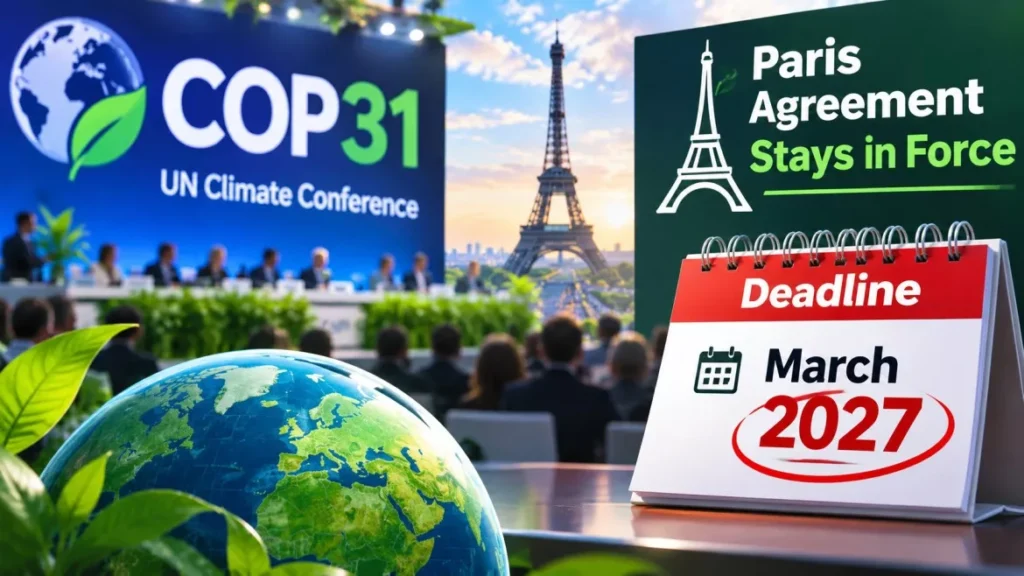

COP31, the United Nations climate conference in Antalya, Türkiye, ended on 22 November 2026 without adopting its overarching decision, the proposed Antalya Pact. Delegates ran 44 hours past the scheduled close, making it the longest COP on record. The COP31 outcome leaves separate, narrower decisions adopted and the Paris Agreement in force.
That split is the part most reports leave out. A conference that “collapses” sounds like one where nothing happened, but the failure was specific: the single political text that normally tops a COP never cleared the room, while several technical decisions did. This article sets out which is which, what wording was removed from the draft before the end, and the next dates in the process.
What COP31 Did Not Adopt
The casualty was the cover decision — the umbrella political text that frames a summit’s conclusions and that the Turkish and Australian hosts had branded the Antalya Pact. A COP operates by consensus, so a single sustained objection is enough to stop a text.
COP31 President Murat Kurum, Türkiye’s environment and urbanisation minister, closed the plenary without advancing a new draft. “I understand that there is no agreement on this text. For that reason, these decisions have not been adopted,” he told delegates, in remarks reported by Agence France-Presse. He also said the presidency had not sought to impose the text, telling the hall, according to CBS News, “In the end, we did not impose this text on anyone.”
Several outlets, including TASS and Inside Climate News, reported that this was the first time since 2009 that a COP ended without consensus on a cover decision. The summit had been run under a shared presidency, with Kurum as COP President and Australia’s Chris Bowen leading the negotiations.
What COP31 Did Adopt
Decisions outside the cover text were adopted, and this is where reporting diverges sharply. Agence France-Presse, summarising Kurum’s closing words, reported that the decisions before the plenary were not adopted. The International Institute for Sustainable Development (IISD), a research organisation that has tracked the talks since 1995, and Inside Climate News both reported that separate decisions did pass. The two accounts are reconcilable: Kurum’s statement referred to the presidency’s cover-decision package, not to every item on the agenda.
On the evidence available as of 23 November 2026, the position is as follows.
| Item | Status at close | Next step |
|---|---|---|
| Cover decision (Antalya Pact) | Not adopted — no consensus | Issues carry to COP32 |
| Just Transition Work Programme | Extended by three years, per IISD | Submissions due 15 March 2027 |
| Just transition mechanism: functions and governance | Deferred, per IISD | COP32, 2027 |
| Adaptation Fund serving the Paris Agreement exclusively | Arrangements agreed, per IISD | Applies once the first Article 6.4 share of proceeds becomes revenue |
| Climate Finance Work Programme as a standalone agenda item | Adopted at the 9 November opening plenary, per Down To Earth | Two-year programme |
| Tripling of adaptation finance | Unresolved — no figure agreed | No agreed baseline or date |
A “just transition” in this process means managing the shift away from high-carbon industries for the workers and communities that depend on them. The distinction that matters here is between the work programme, a standing forum for dialogue that was extended, and the mechanism, a new body whose powers and governance were left for later. Reports that COP31 “agreed a just transition” refer to the former.
The Lines That Left the Draft Between 16 and 22 November
The dispute that ended the summit was about words that were in an earlier draft and absent from the last one. A draft text prepared under the COP31 presidency, marked “Unedited version 16/11/2026 12:40”, contained commitments that the final version did not.
Its paragraph 66 read: “Calls for accelerated action to phase out fossil fuels, including through the immediate transition away from fossil fuels in energy systems.” Paragraph 73 stated that “tripling finance for adaptation should reach at least USD$120 billion”. Both were gone by the end, and the $120 billion floor was dropped while the call to at least triple adaptation finance by 2035 survived in the text without a figure attached.
The same 16 November draft also carried two numerical targets that were contested to the close:
- Electrification: paragraph 50 called on Parties to raise the share of electricity in total final energy consumption to 35 per cent by 2035.
- Carbon capture: paragraph 60 called for accelerating carbon capture, utilisation and storage to at least 500 million tonnes of carbon dioxide by 2035, working towards 1.3 to 2.5 billion tonnes a year by 2035.
The draft also recorded the gap it was trying to address, citing the United Nations Environment Programme’s Adaptation Gap Report 2026: adaptation finance needs in developing countries of approximately $305 billion a year by 2035, against international public adaptation finance of $28 billion to $32 billion in 2024, which the text noted was only $1 billion more than the previous year. On those figures, the draft observed, even tripling adaptation finance by 2035 would meet no more than 29 per cent of estimated needs. A separate UNEP assessment published in October had already found pledged emissions cuts falling well short of what its modelling requires.
Who Objected, and Who Is Said to Have Blocked the Text
The objections at the closing plenary are on the record. Who caused the fossil-fuel wording to disappear is not settled, and accounts differ.
Speaking for the European Union, Ireland’s climate minister Darragh O’Brien objected that the text did not mention fossil fuels. Panama, Vanuatu and Belize also rejected the pact, according to Agence France-Presse, and the Marshall Islands envoy Kathy Jetnil-Kijiner rejected it on finance and security grounds. The United Kingdom’s negotiator Kate Hughes said she was “profoundly disappointed”. Panama’s environment minister Juan Carlos Navarro told the plenary, in remarks reported by CBS News, “We cannot continue to be held hostage by petroleum producers.”
On who resisted the fossil-fuel language, the reporting does not agree:
- The New York Times, cited in subsequent coverage: a group of oil producers led by Saudi Arabia, including Russia, blocked references to fossil fuels in the final text.
- The Associated Press: named Russia and Saudi Arabia as the main forces keeping fossil fuels out.
- Politis: reported that Russia and China backed leaving fossil fuels out, while Forbes reported that China said it would accept the text.
- Inside Climate News: did not identify any country as blocking the language, reporting instead that the EU, several Latin American countries and Pacific island states said they would not accept the text as drafted.
Saudi Arabia’s negotiator Mohammad Ayoub, speaking for the Arab Group, defended keeping carbon capture references in the text. No delegation stated at the plenary that it had removed the phase-out paragraph, and the drafting history has not been published.
UN Secretary-General António Guterres said he was deeply disappointed. “There may be no consensus in the negotiating room. There is no ambiguity in the science,” he said in a statement carried by UN News.
What Still Applies After Antalya
As of 23 November 2026, the failure of the Antalya Pact changes no existing obligation for Parties to the UN Framework Convention on Climate Change. Kurum told the plenary that existing legal frameworks, including the 2015 Paris Agreement, remain in effect. A cover decision is a political statement of direction; it does not itself create treaty obligations, and its absence does not remove any.
Three things therefore stand unchanged. The Paris Agreement and its temperature goals remain in force. The first global stocktake outcome agreed at Dubai in 2023, which included transitioning away from fossil fuels in energy systems, remains the standing reference point, and nothing at Antalya replaced or strengthened it. National pledges already filed also stand: the 16 November draft recorded that 163 Parties had communicated new nationally determined contributions as at 9 November 2026, and 80 Parties had filed long-term low-emission development strategies.
What Antalya did not produce was any new delivery mechanism — no roadmap for the Dubai transition language, no figure for adaptation finance, and no agreement on carbon capture or electrification targets.
The Next Dates in the Process
Unresolved items move to the interim sessions and then to COP32. The confirmed dates are these.
- 31 December 2026: biennial transparency reports fall due, a deadline the 16 November draft referred to as an existing obligation rather than a new one.
- 15 March 2027: deadline for Parties and stakeholders to submit views on what the just transition mechanism should do and how it should operate.
- June 2027: the sixty-sixth sessions of the subsidiary bodies meet in Bonn, Germany, where the deferred technical work is due to resume.
- COP32, 2027: Addis Ababa, Ethiopia, with Ethiopia’s foreign minister Gedion Timothewos as President-designate.
The unadopted draft had proposed launching an “Antalya-to-Addis Ababa Roadmap on Adaptation and Resilience Finance” under the two presidencies, reporting to COP32. Because the cover decision was not adopted, that roadmap was not established.
Frequently Asked Questions About the COP31 Outcome
Did COP31 Reach Any Agreement at All?
Yes, but not the main one. The cover decision known as the Antalya Pact was not adopted, while separate decisions were, including a three-year extension of the Just Transition Work Programme, according to IISD.
Why Did the Antalya Pact Fail?
COP decisions require consensus, and several Parties refused to accept a text that did not mention fossil fuels. The European Union, Panama, Vanuatu, Belize and the Marshall Islands all objected at the closing plenary on 22 November 2026.
Is the Paris Agreement Still in Force After COP31?
Yes. A cover decision is a political text, not a treaty amendment, and Kurum confirmed at the close that existing frameworks including the 2015 Paris Agreement remain in effect.
What Happened to the $120 Billion Adaptation Finance Figure?
It was in the presidency’s 16 November draft, at paragraph 73, and was removed before the final version. No replacement figure was agreed, leaving the call to triple adaptation finance by 2035 without a baseline or an amount.
When and Where Is COP32?
COP32 is scheduled for 2027 in Addis Ababa, Ethiopia, with Ethiopian foreign minister Gedion Timothewos as President-designate. Interim technical talks are due in Bonn, Germany, in June 2027.