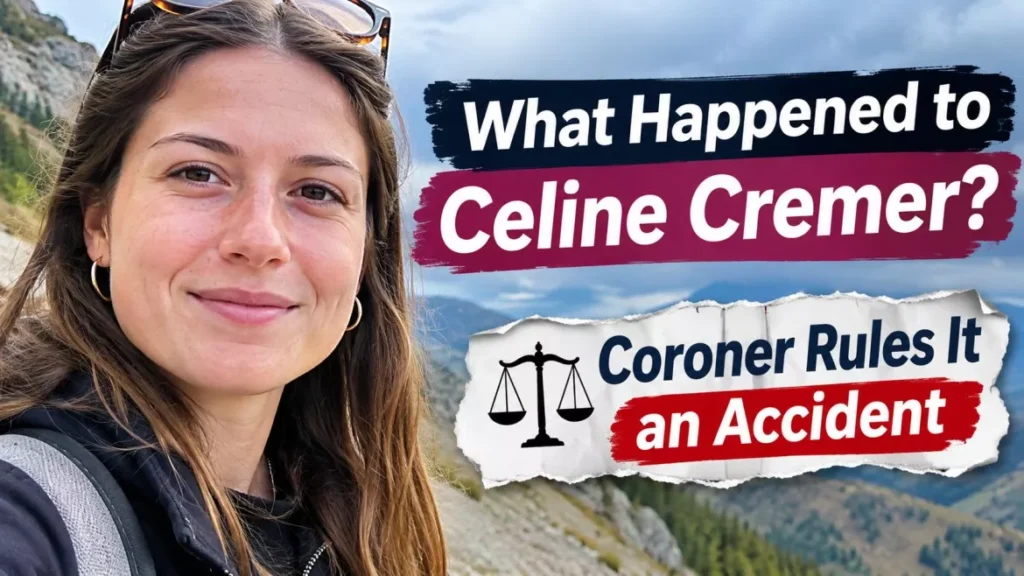

Celine Cremer died in an accident after getting lost on a bushwalk in north-west Tasmania in June 2023. Her remains were found in the Arthur River in January 2026, more than two and a half years later. A Tasmanian coroner ruled the death accidental on 28 August 2026 and excluded any involvement by another person.
How Did Celine Cremer Die?
The cause of her death was never established, and the coroner said so plainly.
Coroner Madeleine Wilson found that Cremer, a 31-year-old Belgian national, died at the Arthur River sometime between 17 and 21 June 2023. She listed three possibilities and declined to choose between them: hypothermia, trauma, or drowning — or some combination of the three.
What the coroner did settle was the manner of death. She ruled it an accident, the result of what she called a “confluence of errors” that began when Cremer walked away from the route back to her car. The coroner’s view was that Cremer most likely entered the river a short distance upstream from where her skull was later found, either slipping from a steep bank or while trying to cross.
The Wrong Track: Her Last Recorded Afternoon
Cremer completed the marked walk to Philosopher Falls, then took an unmaintained track in the opposite direction from her car.
She was last seen alive at the Waratah Roadhouse on the afternoon of 17 June 2023, four days before the winter solstice. She drove to the Philosopher Falls car park, walked the marked track to the lookout and took photographs there. Rather than returning the way she came, she set off along a poorly defined route that follows an old water race towards Magnet Dam.
| When | What is known |
|---|---|
| 17 June 2023, afternoon | Last seen alive at the Waratah Roadhouse |
| About 3:49pm | Probably left the Magnet Dam track and became lost |
| 4:18pm | Last recorded activity on her phone, in Google Maps |
| 17 to 21 June 2023 | Coroner’s finding for when she died, at the Arthur River |
| 26 June 2023 | Reported missing |
| 27 June 2023 | Her car found at the Philosopher Falls trailhead |
She became separated from the phone in dense forest after that last entry. The coroner found she had not been carrying waterproof clothing and that what she wore was insufficient for cold, wet conditions late on a winter afternoon.
Why the Official Search Never Found Her
She was off the marked track, in terrain that defeated searchers, and the river that held her remains was running too high to search.
Nine days passed before anyone reported her missing, because she had been living in Tasmania for only a few months and was preparing to move interstate. Police located her car at the trailhead on 27 June 2023 and searched on foot and by vehicle, helicopter and drone.
That search was scaled back in early July 2023, roughly two weeks after it began. Officers were working against dense scrub, snow, low cloud and high water in the Arthur River. Because Cremer had left the marked route, the ground that needed covering was not the walking track but the unmapped country beyond it.
The coroner reviewed the police response and found it adequate. Long-unsolved disappearances more often stay that way, as in the case of Austin Tice, still missing after 14 years; what changed here was who kept looking.
How Volunteers Found Her After Two Years and Seven Months
Her family hired private investigators, who trained and coordinated a volunteer search that recovered first her phone and then her remains.
The family engaged the firm IFW Global, and investigator Ken Gamble led a renewed effort in December 2025. On 13 December the volunteers recovered Cremer’s water-damaged phone, lying less than 100 metres from the point where it had last registered a position.
On 28 January 2026 an independent searcher named Jarrod Boys found human remains along the Arthur River. Police recovered further remains in the weeks that followed, along with clothing and her car key.
Tasmania Police announced on 27 February 2026 that the remains had been provisionally identified as Cremer’s, with her family’s permission. Commander Nathan Johnston said expert reports had provided “compelling evidence” that they were likely hers. Her sister told the ABC that DNA tests and dental expertise “confirmed that everything matched Celine.” Identification was ultimately established through forensic anthropology, odontology, DNA testing and Belgian dental records.
Was Anyone Else Involved in Her Death?
No. The coroner ruled out both the involvement of another person and suicide.
The question persisted because of two objects. During the private search, volunteers found a glass water bottle and plastic bags beside a fallen tree they thought might have served as a makeshift shelter; the bags had holes in them that could have been used as a poncho. Testing detected no DNA from Cremer on the bottle, which carried male DNA instead. The bags also carried male DNA and were inconclusive for female DNA.
The coroner addressed the items directly, saying she was “not satisfied that the discovery of the glass bottle and plastic bags are evidence” that Cremer had sheltered there in June 2023. In other words, the coroner’s conclusion was that the objects were probably not connected to Cremer at all. A parallel criminal investigation identified no evidence that an unknown person was involved in her death.
What Changed After the Coroner’s Findings
The findings produced two recommendations, one aimed at policing and one at the track itself.
- Private search groups: The coroner recommended that Tasmania Police review how such groups are used in missing-person cases and develop formal protocols covering eligibility, registration, information sharing and evidence handling. Deputy Commissioner Jonathan Higgins committed to that review.
- Track signage: She recommended the Waratah-Wynyard Council install signage at the start of the Magnet Dam track stating where it ends and warning that the surface is degraded, uneven and potentially hazardous. The council had already added track markers and a closure sign at the far end.
Wilson commended the IFW Global search as well planned and coordinated, and noted its volunteers had been vetted, while warning that private searches carry real risks of contaminating evidence and endangering the searchers themselves.
As of 23 November 2026, the coroner’s findings of 28 August 2026 remain the final official word on the case. No criminal proceedings arose from it, and no further searches of the Arthur River are planned.
Questions Readers Still Ask About the Case
Where Was Celine Cremer Found?
In and along the Arthur River in north-west Tasmania, downstream of Philosopher Falls, where she had walked.
Did She Drown?
Possibly, but it was never confirmed. Drowning was one of three causes the coroner could not choose between, alongside hypothermia and trauma.
Who Found Her Remains?
Jarrod Boys, an independent searcher taking part in the privately funded effort, on 28 January 2026.
How Long Was She Missing?
Two years and seven months passed between her last sighting on 17 June 2023 and the discovery of her remains on 28 January 2026.