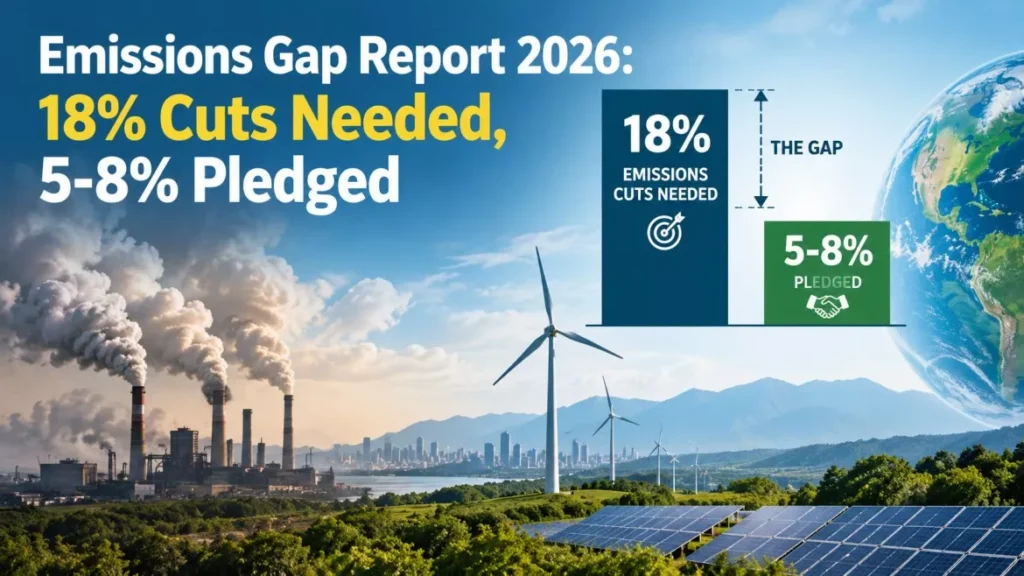

The Emissions Gap Report 2026, published by the United Nations Environment Programme on 21 October, finds that warming will exceed 1.5°C above pre-industrial levels. It says global emissions must fall 18% from 2025 levels by 2030 to limit the overshoot. Current national pledges deliver 5% to 8%.
What the Report Says About 1.5°C
The report is subtitled The Point of Return. Its central finding is that the chance of holding warming below 1.5°C with no or limited overshoot has gone, and that the question now is how high the peak goes and how long it lasts.
The United Nations Environment Programme, the UN agency that coordinates environmental work across the system, frames overshoot as temporary rather than permanent. In its lowest-overshoot pathway, peak warming reaches 1.7°C to 1.8°C around the middle of the century and stays in that range, assessed at a 66% probability. Returning below 1.5°C by 2100 is given roughly a 50% chance, and only with a large and sustained scale-up of carbon dioxide removal.
António Guterres, the United Nations Secretary-General, said “Overshoot is not surrender”, adding that the overshoot can still be kept as small and as short as possible. Inger Andersen, UNEP’s executive director, said returning to 1.5°C by the end of the century remains possible.
These are the agency’s own characterisations of its modelling. They are projections under stated assumptions, not observations.
The Cuts Required and the Cuts Pledged
The report’s most concrete contribution is a new set of benchmarks measured against 2025 emissions. Set beside what countries have actually promised, the distance is plain.
| Cut from 2025 levels | By 2030 | By 2035 | By 2040 |
|---|---|---|---|
| Needed for lowest 1.5°C overshoot | 18% | 45% | 69% |
| Needed to stay below 2°C | 11% | 24% | 37% |
| Delivered by current pledges, if fully implemented | 5% to 8% | 11% to 15% | Not stated |
The 2035 figure is the sharpest comparison. The lowest-overshoot pathway asks for a 45% cut; full delivery of every national climate plan on the table produces 11% to 15%.
These benchmarks replace the older ones drawn from the Intergovernmental Panel on Climate Change’s sixth assessment, which were measured against 2019 and called for 43% by 2030 and 60% by 2035. The report describes those pathways as outdated because emissions continued to rise after 2019. The change of baseline means the 2026 figures are not directly comparable with those in earlier editions.
On fuels, the lowest-overshoot pathway requires coal use to fall at least 55% and oil at least 15% by 2035 against 2025, rising to 75% for coal and 30% for oil by 2040. Gas falls at least 5% by 2035 and 35% by 2040.
Why This Year’s Outlook Is Worse Than Last Year’s
The deterioration is not mainly a story of faster emissions growth. The report attributes it to two specific changes.
- The United States withdrawal from the Paris Agreement: the formal exit removes projected American reductions from the global total.
- Revised historical emissions data: projections were harmonised with newer estimates of past emissions.
Together these raise projected 2035 emissions under the latest national plans by about 3 gigatonnes of carbon dioxide equivalent, and lift central end-of-century warming estimates for those scenarios by roughly 0.2°C to 0.3°C compared with the 2025 edition.
The same factors cut the other way on one measure. The gap between announced policies and pledged targets for 2030 narrowed this year, which the report characterises as policy changes rather than policy progress. A country that leaves an agreement no longer has a pledge to fall short of.
Where Emissions and National Plans Actually Stand
Global greenhouse gas emissions were 58.4 gigatonnes of carbon dioxide equivalent in 2025, about 0.16 gigatonnes below the revised 2024 figure of 58.5. The report does not call that a decline. The movement is small relative to measurement uncertainty, the 2025 data are provisional, and the authors say they cannot conclude the direction of travel for the year.
Fossil fuel carbon dioxide accounts for roughly 68% of the total. Fluorinated gas emissions rose 8.6%.
On national plans, 124 countries had submitted a third round of nationally determined contributions by 1 September 2026, covering about 75% of global emissions. At the COP30 summit the count stood at 122 countries and 63% of emissions. A nationally determined contribution is the emissions target each country sets for itself under the Paris Agreement; nothing in the agreement compels a country to meet it.
As of 21 October 2026, the report assesses warming at 2.8°C by 2100 under current policies, 2.7°C if unconditional pledges are met, 2.6°C if all pledges including conditional ones are met, and 2.1°C if countries also deliver their stated net-zero commitments. Each figure is a central estimate at 66% probability; the report puts a 10% chance of exceeding 3.4°C under current policies.
What Is Established, What Is Modelled and What Remains Uncertain
A report of this kind mixes three different sorts of statement, and they carry different weight.
- Established: the contents of the report itself, the submitted national plans and their coverage, and historical emissions estimates subject to the revisions noted above.
- Modelled: every warming figure, including 1.7°C to 1.8°C, 2.6°C and 2.8°C. These are scenario outputs from emulator models with stated probabilities, not forecasts of what will happen.
- Uncertain or provisional: the 2025 emissions total and its apparent dip, which the authors decline to interpret as a trend. Land use, land-use change and forestry figures are excluded from the country-level analysis because national inventories lag.
- Contested framing: the judgement that the 1.5°C window without overshoot is “lost” is UNEP’s own assessment. It rests on the agency’s choice of scenarios and probability thresholds, which the report sets out.
The report also notes that most G20 members’ current trajectories are misaligned with their own net-zero targets, and that even full delivery of all pledges and net-zero commitments would leave warming about 0.25°C above the lowest-overshoot pathway.
What Happens Next
The report is published ahead of COP31, the annual United Nations climate conference, which takes place in Antalya, Türkiye, in November 2026. The second Global Stocktake, the Paris Agreement’s periodic review of collective progress, begins there.
The report is an input to that process, not a decision of it. UNEP publishes the Emissions Gap Report annually in the weeks before each conference, and it carries no binding force on any government.
Frequently Asked Questions
What Is the Emissions Gap Report 2026?
It is the United Nations Environment Programme’s annual assessment of the distance between the emissions cuts countries have pledged and the cuts its scenarios say are required. The 2026 edition, subtitled The Point of Return, was published on 21 October 2026.
Does the Report Say 1.5°C Is Lost?
It says holding warming below 1.5°C with no or limited overshoot is no longer achievable, and that the breach will happen. It also sets out a pathway in which peak warming reaches 1.7°C to 1.8°C and warming returns below 1.5°C by 2100, with about a 50% chance and heavy reliance on carbon dioxide removal.
How Big Is the Emissions Gap?
The lowest 1.5°C overshoot pathway requires an 18% cut from 2025 levels by 2030 and 45% by 2035. Current pledges, if fully implemented, deliver 5% to 8% by 2030 and 11% to 15% by 2035.
Why Is the 2026 Outlook Worse Than 2025’s?
The report attributes the change mainly to the United States’ formal withdrawal from the Paris Agreement and to harmonisation with revised historical emissions data, which together add about 3 gigatonnes to projected 2035 emissions and 0.2°C to 0.3°C to central warming estimates.
Where and When Is COP31?
Antalya, Türkiye, in November 2026. The second Global Stocktake under the Paris Agreement begins at that conference.