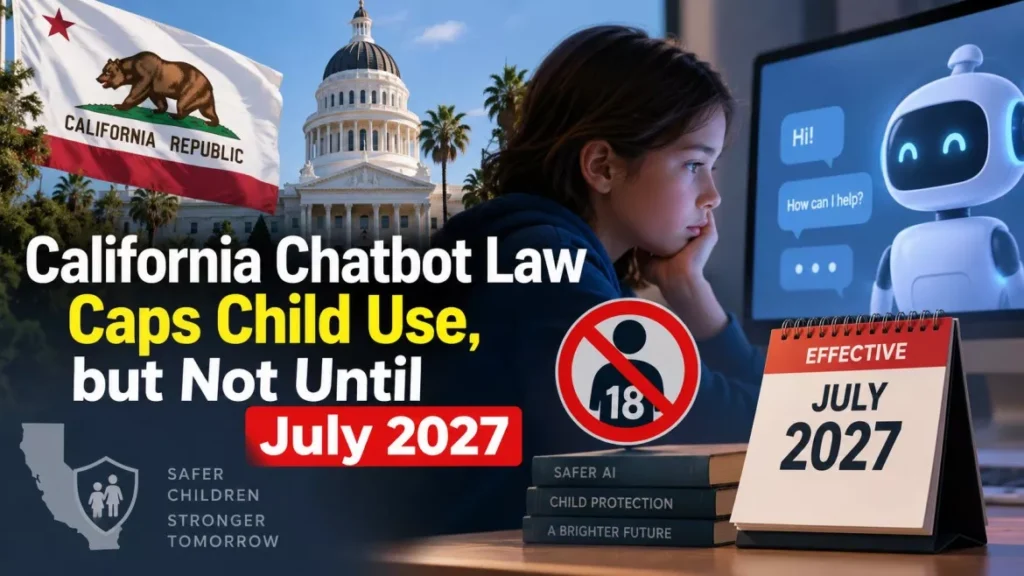

The California chatbot law signed on 10 September 2026 sets mandatory defaults for children’s accounts. Under Senate Bill 1119, known as Adam’s Law, child users get one-hour sessions, a two-hour daily cap, conversational memory switched off and push notifications switched off. Governor Gavin Newsom’s signature starts none of it until 1 July 2027.
What the California Chatbot Law Changes in a Child’s Account
The law writes four specific settings into code rather than leaving them to each company’s design choices. A child account must arrive with all four already switched on, and only a linked parent can change them.
| Setting | Required default for child users |
|---|---|
| Single session length | Capped at one hour |
| Total daily use | Capped at two hours across the operator’s chatbots |
| Persistent conversational memory | Disabled |
| Push notifications | Disabled |
The bill text requires operators to “limit the amount of time a child user can spend in a single continuous usage session with a companion chatbot to one hour”. Users aged 16 and over may keep stored past conversations, provided those are not used to build durable profiles and the operator puts guardrails around them.
Operators also have to run a documented crisis-response protocol. Where a chatbot detects an imminent threat of self-harm, the law requires it to notify a linked parent or give the user direct access to the 988 helpline or a local equivalent, and to tell child users in advance that a parent may be contacted.
When the Rules Actually Start
Nothing changes on any phone today. The package carries two separate 2027 dates and one 2029 date, and the signature on 10 September started none of them.
- 1 January 2027: Assembly Bill 1709 takes effect, barring covered platforms from serving personalised feeds and autoplay to users under 16.
- 1 July 2027: Adam’s Law becomes operative. Operators must document a risk assessment covering the design and operation of the chatbot for minors, and the four account defaults apply.
- 1 July 2027: Assembly Bill 1856’s age-signal duties land on operating system providers and app developers.
- 1 January 2029: the deadline for an operator’s first independent child safety audit, or before the chatbot is first made public, whichever falls later. Audits then repeat every two years.
As of 13 September 2026, none of these obligations is enforceable, and no covered company is required to have changed anything.
Which Products and Companies Are Covered
The law targets companion chatbots rather than every AI assistant. Under California’s companion-chatbot definition, which SB 1119 builds on, the term covers systems with a natural-language interface that give adaptive, human-like responses and can sustain a relationship across repeated conversations.
Bots built only for customer service, internal business operations, technical assistance or research sit outside that definition, according to the legislative analyses of the bill. So do video-game characters whose replies stay inside the game and cannot turn to mental health, self-harm or sexual content.
OpenAI, the San Francisco company behind ChatGPT, backed the bill before it was signed and said the law “pairs strong protections with continued access to useful AI tools”. Character.AI, which runs a companion-chatbot service, has said separately that it will stop letting under-18s chat freely with its bots by the end of November 2026. Senator Steve Padilla’s office says the law also gives families a private right of action when an operator breaks the rules, alongside oversight by the state Attorney General.
The Age Bracket Your Phone Will Report
A second bill decides how a chatbot knows a user is a child. Assembly Bill 1856 makes the operating system, not the app, the source of that answer.
Before 1 July 2027, operating system providers must offer an interface where the account holder records the primary user’s birth date or age. The system then passes a non-identifying age bracket to apps in a covered app store. There are four brackets: under 13, 13 to 16, 16 to 18, and 18 or over. Developers whose apps were last updated on or after 1 January 2026 and downloaded before 1 January 2027 must request that signal before the same July deadline.
Two limits are worth noting. Open-source operating systems are exempt, because the definition excludes software distributed under licences that let recipients copy, redistribute and modify it. And an earlier version that would have extended age checks to web browsers and websites was stripped out in the state Senate, so the final law stops at operating systems and app stores.
What Else Newsom Signed on 10 September
Adam’s Law arrived inside a package of thirteen bills. Four of them change consumer products directly.
- AB 1709: bans addictive feeds and autoplay for under-16s, with civil penalties up to $50,000 per affected minor for knowing violations and $25,000 for negligent ones, and creates a five-member e-Safety Advisory Commission at the Department of Justice.
- AB 1856: the operating system age-signal requirement described above.
- SB 1276: extends California’s child sexual exploitation statutes to cover AI-generated and digitally altered material depicting minors.
- SB 867: applies companion-chatbot rules to toys that talk back.
Newsom said in the signing announcement: “Our children’s safety deserves to be at the center of every conversation about technology.”
Why the Law Carries Adam Raine’s Name
Adam’s Law is named after Adam Raine, a California teenager whose parents brought a wrongful-death lawsuit against OpenAI. That case has not been decided, and the law makes no finding about it.
Senator Padilla, who authored the bill with Assemblymembers Buffy Wicks and Rebecca Bauer-Kahan, said on the day of signing: “We cannot make the same mistakes that were made with social media. California is filling the void created by Washington inaction, taking bold action to protect our children.” Matt and Maria Raine called the law “a very well thought out and significant step towards ensuring AI chatbot safety for our children”.
For parents deciding what to do before the rules arrive, the practical controls that exist today are the ones each platform already offers. Our guide to safeguarding children using AI tools covers those settings.
What the Law Does Not Do
The package stops well short of the bans some headlines imply. It does not remove children from chatbots or from social platforms.
- No age ban on chatbots: children may still use companion chatbots. The law changes the defaults, not eligibility.
- No account ban on social platforms: under-16s can still hold accounts under AB 1709. What they lose is the personalised feed and autoplay.
- No published federal equivalent: these are California statutes, and no matching national rule has been enacted.
- No effect on general assistants: a chatbot used for search, work tasks or customer service is not a companion chatbot under the definition the bill relies on.
California Chatbot Law: Questions Readers Are Asking
When Does the California Chatbot Law Take Effect?
Adam’s Law becomes operative on 1 July 2027. The separate ban on addictive feeds for under-16s starts earlier, on 1 January 2027.
Does Adam’s Law Ban Children From Using AI Chatbots?
No. Children can still use them. The law forces operators to ship child accounts with time limits, memory off and notifications off, and to run crisis protocols.
Can Parents Change the One-Hour and Two-Hour Limits?
Yes. The defaults are locked to the account, and a linked parent is the only person who can adjust them.
Which Chatbots Does the Law Cover?
Companion chatbots, meaning systems designed for sustained, human-like conversation. Customer-service bots, business tools and in-game characters restricted to game topics fall outside the definition.
How Will a Chatbot Know a User Is a Child?
Through an age bracket sent by the device’s operating system under AB 1856. The brackets are under 13, 13 to 16, 16 to 18, and 18 or over, and they do not identify the user.