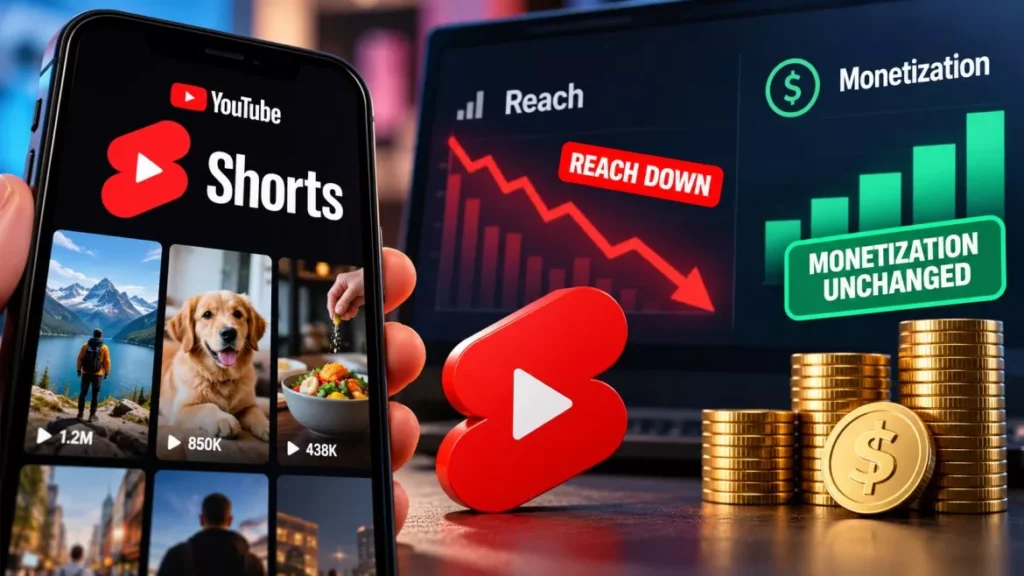

YouTube has changed its Shorts recommendation system to favour original clips and cut the reach of channels that repost other creators’ videos. Creator Liaison Rene Ritchie announced the change on 1 October 2026 in a Creator Insider video and a TeamYouTube community post. The YouTube Shorts algorithm update affects recommendations only, not monetization.
What Changed in the Shorts Recommendation System
YouTube is now ranking Shorts so that original clips surface more often and re-uploaded clips surface less often. The company said it is updating its recommendation systems to prioritise original content and reduce the reach of material taken from other creators “without adding anything of your own” — wording that appeared in both YouTube’s community post and its creator support thread.
The judgement is made at channel level, not clip by clip. YouTube said channels that primarily aggregate or re-upload other creators’ videos without significant changes will likely see less distribution in the Shorts feed and elsewhere on the platform.
In a statement reported by Android Authority, YouTube said the change “delivers a better experience for viewers while ensuring creators publishing original content have the best chance to grow and succeed”. Ritchie added that a channel which moves toward original content will have its reach re-evaluated by the recommendation system.
What YouTube Says Does Not Count as Original
YouTube named three specific things that do not turn someone else’s clip into your own work. Adding any of them leaves a Short exposed to reduced distribution:
- Voice-over narration: Describing what is already happening on screen does not qualify.
- Minor technical edits: Trimming, cropping, re-framing or similar changes do not qualify.
- Template-based bulk changes: Applying the same automated treatment across many uploads does not qualify.
What does count, in YouTube’s words, is original commentary, analysis and storytelling, along with unique editing or educational value that goes beyond the source clip. Ritchie’s framing was that creators should bring their own voice rather than a layer of processing.
Does Clipping Your Own Long-Form Videos Count?
YouTube has not addressed this, and it is the question the announcement leaves most exposed. The policy language targets videos “re-uploaded from other creators”, which on its face does not describe a creator cutting Shorts from their own back catalogue.
Android Authority reported that creators clipping their own long-form videos are unlikely to see reduced visibility, on the basis that the policy specifically names other creators’ work. Search Engine Journal noted separately that the Creator Insider video does not discuss the practice at all. Neither reading comes from a YouTube statement on the point.
Two adjacent cases are also undefined: brands cutting Shorts from their own long-form marketing videos, and channels using clips they have licensed from the original creator.
Reach, Monetization and the Creator Pool Are Three Separate Rules
Only one of the three rules that govern reused Shorts changed on 1 October 2026. The other two were already in force and are unaffected by this update.
| Rule | What it governs | Status |
|---|---|---|
| Shorts recommendation ranking | How often YouTube shows a Short in the Shorts feed and elsewhere | Changed 1 October 2026 |
| YouTube Partner Program reused-content policy | Whether borrowed content can earn ad revenue at all | Unchanged |
| Shorts Creator Pool | How Shorts revenue is divided, based on engaged views | Unchanged by this update |
The distinction matters because a channel can keep its monetization and still lose most of its audience. A reach cut does not remove a channel from the Partner Program; it reduces the views that feed the payout.
That connection becomes sharper next year. Under YouTube’s published Partner Program changes, from 1 February 2027 a channel needs 10 million qualified Shorts views over the previous 90 days to earn from the Shorts Creator Pool in a given month, and new applicants need 1,000 subscribers plus either 8,000 qualified public watch hours in 365 days or 20 million qualified Shorts views in 90 days. Missing the Creator Pool figure pauses Shorts earnings for that month but does not remove a channel from the programme or affect long-form earnings.
What YouTube Has Not Said
As of 4 October 2026, YouTube has published no rollout schedule and no way for a creator to check their own status. The gaps are specific:
- Start date: The announcement gives no date on which the ranking change begins or completes.
- Re-evaluation timeline: Ritchie said reach is re-assessed for channels that shift to original content, but not how long that takes.
- Status indicator: Nothing has been added to Account Status or YouTube Studio showing whether a channel has been classified as an aggregator.
- Threshold: YouTube has not said how much of a channel’s output must be reposted before it counts as “primarily” aggregating.
- Appeals: No appeal route has been described, because a ranking change is not an enforcement action against the channel.
What Creators Should Do Now
The practical response follows directly from what YouTube named as insufficient. Working through it in order:
- Identify the Shorts on your channel built from another creator’s footage where your only addition is a voice-over, a crop or an automated template.
- Replace that addition with commentary, analysis or storytelling, which are the three contributions YouTube explicitly accepts.
- Keep publishing original Shorts rather than waiting for a signal, since YouTube says the system re-evaluates a channel that changes direction.
- Track views by traffic source in YouTube Analytics over the coming weeks, because YouTube has given no indicator and a drop in Shorts feed traffic is the only visible evidence.
- If Shorts revenue matters to you, check your 90-day qualified Shorts view count against the 10 million figure that applies from 1 February 2027.
YouTube made a related change to how viewers organise the app in late September 2026, when it began turning custom feeds into pinned Home tabs. Our earlier report on YouTube custom feeds and the one-tab limit covers what that changed for viewers.
Frequently Asked Questions
When Does the YouTube Shorts Algorithm Update Take Effect?
YouTube announced it on 1 October 2026 but published no start date for the ranking change itself. As of 4 October 2026 there is no rollout schedule.
Will Reposting Shorts Give My Channel a Strike?
No. This is a change to how Shorts are recommended, not a Community Guidelines enforcement action, so it carries no strike or warning.
Can a Channel Get Its Reach Back?
Rene Ritchie said the recommendation system re-evaluates reach for a channel that shifts toward original content. YouTube has not said how long that re-evaluation takes.
Does Adding a Voice-Over Make a Reused Clip Original?
No. YouTube specifically named voice-over descriptions of on-screen action, alongside minor technical edits and template-based bulk changes, as additions that do not qualify.
How Can I Tell Whether My Channel Was Affected?
There is no indicator. YouTube has not added anything to Account Status or YouTube Studio that shows whether a channel is being treated as an aggregator.