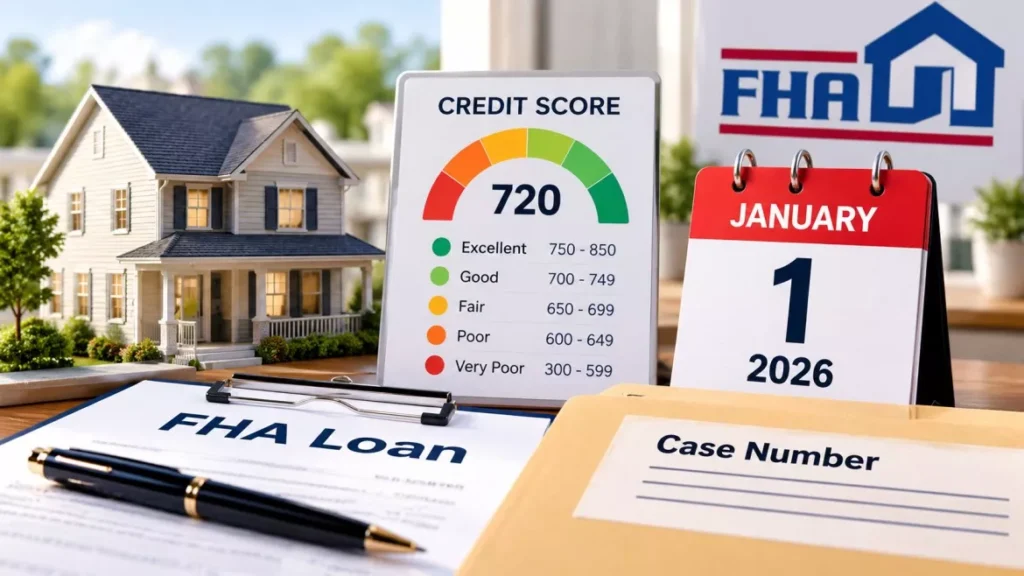

FHA credit score models expand to three from 1 January 2027, and the trigger is the case number. The Federal Housing Administration published Mortgagee Letter 2026-11 on 8 October 2026, adding VantageScore 4.0 and FICO Score 10T alongside Classic FICO. The rules apply to case numbers assigned on or after that date.
This is a United States policy change and it reaches only FHA-insured Title II forward mortgages — ordinary FHA purchase and refinance loans scored through FHA’s TOTAL Scorecard. The dollar thresholds and ratios below are FHA programme rules, not the terms any individual lender will offer, and credit score outcomes vary by borrower.
What Mortgagee Letter 2026-11 Changes
The letter revises how FHA works out a borrower’s Minimum Decision Credit Score, or MDCS, when more than one scoring model is in play. It does not retire Classic FICO and it does not change the score levels FHA requires.
In its own words, the letter “updates FHA’s Minimum Decision Credit Score (MDCS) methodology to facilitate the adoption of alternative credit score models”. It applies to all FHA-insured Title II Single Family mortgage programmes, and its provisions will be folded into Handbook 4000.1, FHA’s Single Family Housing Policy Handbook, in a later update. FHA explains the choice of models in terms of data: the new ones “leverage trended data which analyzes a consumers’ credit behavior over time” and draw on “non-traditional credit like rent and utilities”.
Three things are explicitly unchanged. FHA still requires a tri-merge credit report — one drawing on all three national credit repositories. The established MDCS thresholds of 500, 580 and 620 still apply, and they apply identically to every model. And the Home Equity Conversion Mortgage programme, FHA’s reverse mortgage, is untouched; the letter deletes the MDCS reference from its eligibility rules because HECM underwriting does not use credit scores that way.
How the Minimum Decision Credit Score Is Now Calculated
The calculation runs in three stages when more than one model is submitted. The letter’s definitions matter: a Credit Score Model Type is a scoring model such as Classic FICO, VantageScore 4.0 or FICO 10T; a Borrower-Level Score is the score finally selected for one borrower; and the MDCS is the score that governs the whole transaction.
- Pick one score per model, per borrower: within each model, if three differing scores are reported across the repositories, use the middle score; if two differ, use the lower; if only one is reported, use that one.
- Pick one score per borrower across models: the letter states that “the Borrower-Level Score is the lowest score of the selected scores from each Credit Score Model Type submitted”. Where only one model is submitted, the score chosen at stage one is the Borrower-Level Score.
- Pick one score for the transaction: the MDCS is the lowest Borrower-Level Score among all borrowers on the deal.
Where a loan has several borrowers and one or more of them has no credit score at all — non-traditional or insufficient credit — the MDCS is the lowest Borrower-Level Score among those borrowers who do have scores. A transaction is not eligible for FHA-insured financing at all if the MDCS is below 500.
One wrinkle worth noting for anyone comparing the documents: FHA’s Preparedness Guide describes the same arithmetic using different labels, saying an MDCS is determined “for each borrower and for each credit score model” and calling the middle of three the “median score”, where the Mortgagee Letter says “middle score” and reserves the term MDCS for the transaction. The sums are identical; only the vocabulary differs.
Why a Second Model Can Only Lower the Result
Because stage two takes the lowest result across models, adding a model cannot raise a borrower’s score — it can only hold it down or leave it unchanged. That is the single most consequential line in the letter, and it is stated plainly in Mortgagee Letter 2026-11 itself.
The same logic runs through the automated underwriting decision, and here the effect is sharper still. FHA’s Preparedness Guide states that “all credit score models submitted to TOTAL Scorecard must receive an Accept recommendation for the final result to be an Accept”, and that “if any one credit score model receives a Refer recommendation, the final recommendation will be a Refer”. A Refer sends the file to manual underwriting rather than rejecting it, but it changes the path the loan takes.
FHA has built in a route back. The guide says lenders “may work with credit providers to have one or more models removed and resubmit to TOTAL if desired”, and that they may change models when rescoring a transaction. It also records, without recommending it, that “lenders may prefer to submit a single credit score model for all borrowers”.
Every Borrower on the Loan Must Use the Same Models
Mixing models across borrowers is prohibited. The letter allows a lender to submit one or more model types “provided the same model type(s) are used for all Borrowers”, and gives the example directly: a lender “may not submit FICO 10T for the primary Borrower and VantageScore 4.0 for the co-Borrower”.
The paperwork follows the submission. The credit report kept in the case binder must include every model type sent in the final TOTAL submission, though it may also carry models that were not submitted. FHA’s example: if VantageScore 4.0 and FICO 10T both go to TOTAL, the retained report must show both, and may show Classic FICO as well.
What the Thresholds Still Control
The scores decide how much of a property’s value FHA will insure. Both tables below come from the sections of Handbook 4000.1 that Mortgagee Letter 2026-11 revises, and both apply from 1 January 2027 regardless of which model produced the score.
Purchase and other transactions:
| If the MDCS is | Then the transaction is |
|---|---|
| Below 500 | Not eligible for FHA-insured financing |
| Between 500 and 579 | Limited to a maximum loan-to-value ratio of 90% |
| At or above 580 | Eligible for maximum financing |
Refinances:
| If the MDCS is | Then the transaction is |
|---|---|
| Between 500 and 579 | Limited to a maximum loan-to-value ratio of 90% |
| At or above 580 | Eligible for maximum financing of 97.75% |
Loan-to-value ratio is the loan amount as a percentage of the property’s value. Borrowers with non-traditional or insufficient credit histories remain eligible for maximum financing but must be underwritten manually.
For manually underwritten loans, the score also sets the debt ratios. A file with an MDCS of 500 to 579, or no credit score, is capped at 31/43 — meaning housing costs of 31% of effective income and total fixed payments of 43% — with no compensating factors permitted, except that Energy Efficient Homes may stretch to 33/45. At 580 and above, 31/43 requires no compensating factors, while higher ratios each carry conditions: 37/47 needs one of documented cash reserves, a minimal increase in housing payment, or residual income; 40/40 requires no discretionary debt; and 40/50 needs two of documented reserves, a minimal payment increase, significant additional income not already counted, or residual income.
Who the Letter Does Not Cover
Three groups fall outside it. Reverse mortgage borrowers are unaffected, as HECM loans are not scored this way. Non-credit qualifying Streamline Refinances are exempt from the MDCS rules and from the loan-to-value limits based on them, along with a long list of other origination requirements. And the MDCS review itself does not apply to mortgages insured under Section 247 or Section 248, to Streamline Refinances, or to assumptions.
None of this changes the cost of borrowing, which is moving independently: the Freddie Mac weekly survey put the average 30-year fixed rate at 7.40% on 8 October 2026, against 6.30% a year earlier.
No Early Adoption, and What Is Still Pending
Several trade summaries have reported that lenders may adopt the new models before January. FHA’s own Preparedness Guide says the opposite: mortgagees “should continue to utilize the existing policy guidance on credit reports in the HUD Single Family Housing Policy Handbook 4000.1 until guidance is published, and the January 1, 2027, implementation is in effect”. TOTAL Scorecard begins accepting the new models with case numbers assigned on or after 1 January 2027.
Still outstanding as of 12 October 2026: the Handbook 4000.1 update that will carry the new language has not been published, and the letter supplies the revised sections as tracked redlines in an attachment in the meantime. FHA has scheduled virtual lender office hours for 16 to 20 November 2026 and 11 to 15 January 2027, running 2:30 p.m. to 3:30 p.m. Eastern, aimed at lenders and software vendors. Questions go to the FHA Resource Center, which publishes an online knowledge base and takes calls on 1-800-225-5342 between 8 a.m. and 8 p.m. Eastern on business days.
How much either new model moves an individual score is not something FHA has quantified. Both read payment behaviour over time rather than at a single moment, and both can take account of rent and utility payments — but only where those payments are actually reported to the credit repositories, which for most renters they are not. Sources differ on how far each of the two models uses rent data, and neither FICO nor VantageScore has published a borrower-level comparison against Classic FICO for FHA files. Classic FICO remains fully accepted, so the practical effect depends on which models individual lenders choose to submit. For a primer on how score bands are read, see our explainer on what counts as a good FICO score range.
FHA Credit Score Models: Questions Readers Are Asking
When Do the New FHA Credit Score Models Take Effect?
For FHA case numbers assigned on or after 1 January 2027. The date turns on when the case number is assigned, not when the application is made or the loan closes, and FHA’s guidance says lenders should keep using existing policy until then.
Which Credit Scores Will FHA Accept?
Classic FICO, VantageScore 4.0 and FICO Score 10T. Classic FICO is not being retired, and a lender may submit one model or more than one, provided it uses the same models for every borrower on the loan.
If a Lender Submits Two Models, Which Score Counts?
The lower one. Mortgagee Letter 2026-11 states that a borrower’s Borrower-Level Score is the lowest of the scores selected from each model submitted, and the transaction’s MDCS is then the lowest Borrower-Level Score among all borrowers.
Do the FHA Minimum Credit Score Requirements Change?
No. The established MDCS thresholds of 500, 580 and 620 continue to apply, and apply equally to all three models. An MDCS below 500 makes a transaction ineligible; 500 to 579 caps the loan-to-value ratio at 90%; 580 and above allows maximum financing, which is 97.75% on refinances.
Are Reverse Mortgages Affected?
No. Home Equity Conversion Mortgages are outside the change, and the letter removes the MDCS reference from HECM eligibility requirements because that programme does not rely on credit scores as an underwriting component.
Where Can Borrowers and Lenders Get Official Answers?
The FHA Resource Center is FHA’s own channel for questions on the change, with an online knowledge base, an email address at [email protected] and a telephone line on 1-800-225-5342, staffed 8 a.m. to 8 p.m. Eastern on non-holiday weekdays. FHA has also published a Preparedness Guide and a questions-and-answers document.