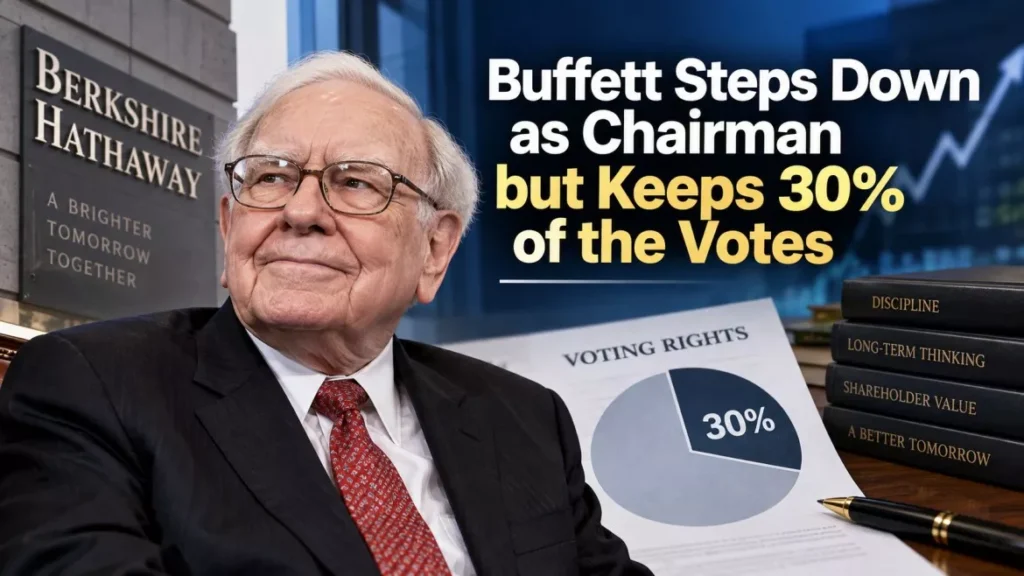

Warren Buffett steps down as chairman of Berkshire Hathaway, the US conglomerate he has led since 1965. The board named him chairman emeritus on Friday 18 September 2026 and elected his eldest son, Howard Buffett, 71, to the chair. Buffett stays on the board and keeps his shares.
Who Holds Which Role at Berkshire Now
Berkshire Hathaway has split the job Warren Buffett used to do alone into three. As of 18 September 2026, the roles at the Omaha-based company sit like this.
| Person | Role | Since | What They Do |
|---|---|---|---|
| Greg Abel, 64 | President and chief executive | 1 January 2026 | Runs the company and decides how its capital is spent |
| Howard Buffett, 71 | Non-executive chairman | 18 September 2026 | Chairs the board; no management role |
| Warren Buffett, 96 | Chairman emeritus and director | 18 September 2026 | Keeps a board seat and his shareholding |
Buffett had been chairman since 1970 and chief executive from 1965 until the end of 2025. He announced the change in a letter to shareholders, writing that “Father Time always wins”.
Buffett Gave Up the Title, Not the Votes
The chairmanship changed hands. Control of the shareholder vote did not.
Buffett still holds more than 13 per cent of Berkshire’s stock and roughly 30 per cent of its voting power, Reuters reported on 18 September 2026. Berkshire’s Class A shares carry far more votes each than the Class B shares most ordinary investors own, which is why his economic stake and his voting stake are such different numbers.
That block of votes was not transferred to Howard Buffett, to Greg Abel or to anyone else. It stays with Warren Buffett, and it shrinks each year as he gives shares away: he has donated roughly $66 billion of Berkshire stock to charity since 2006, according to the Associated Press. So the single largest voting bloc at Berkshire is still held by a 96-year-old who no longer chairs the board and does not run the company.
What a Non-Executive Chairman Can and Cannot Do
A non-executive chairman chairs the board of directors but holds no management job at the company. Howard Buffett will not set strategy, pick investments or run any of Berkshire’s businesses.
What the role does carry is board authority: chairing meetings, setting the board’s agenda, and — in the situation the job exists for — leading the directors if they ever had to replace the chief executive. His father described the assignment in insurance terms in the shareholder letter: “Think of Howard as a policy the shareholders own and hope never to claim against.”
Buffett also drew the line between the two men directly. “Greg runs the company; Howard will guard its culture and values — both worth more than anything on our balance sheet,” he wrote.
Analysts have noted the limits of the arrangement. Reuters quoted one who observed that in comparable family firms the heir is usually involved in day-to-day operations, which Howard Buffett has never been.
Who Is Howard Buffett?
Howard G. Buffett, 71, is Warren Buffett’s eldest son and has sat on Berkshire’s board since 1993 — 33 years. He has never held an operating job at the company.
- Farming and conservation: He farms, photographs wildlife and has written more than a dozen books on conservation, two of them New York Times bestsellers.
- Law enforcement: He served roughly a decade in law enforcement, including as sheriff of Macon County, Illinois.
- Public service: He has served on the Douglas County Board of Commissioners in Nebraska and on US Trade Representative committees.
- Philanthropy: He founded the Howard G. Buffett Foundation in 1999, funded by his father’s donations, working on hunger, human trafficking and conflict, latterly with a large programme in Ukraine.
Warren Buffett said publicly as far back as a 2011 CBS interview that he wanted Howard to become non-executive chairman one day, to protect the company’s values without directing strategy. Howard Buffett has described the culture he is meant to guard as keeping “things simple, to do what you need to do but don’t do a lot of things you don’t need to do, treat people fairly”. The last comparable figure in that guardian role was vice chairman Charlie Munger, who died in 2023.
What Greg Abel Controls
The decision that matters most to Berkshire shareholders is not who chairs the board — it is what Greg Abel does with the cash, and there is a great deal of it.
At 30 June 2026, Berkshire’s insurance and other businesses held $35.1 billion in cash and cash equivalents and a further $324.9 billion in short-term US Treasury bills, with another $5.5 billion of cash at the railroad, utilities and energy businesses. The figures come from Berkshire’s quarterly report filed with the Securities and Exchange Commission on 10 August 2026. Together that is about $365 billion, and it is the pile Abel can spend on acquisitions or share buybacks.
Abel joined Berkshire’s senior ranks in 2018, when he took charge of all the non-insurance businesses — BNSF Railway, the utilities, the manufacturing arms and consumer names such as Dairy Queen and See’s Candies. Reuters reported that he has so far largely followed Buffett’s playbook, including the company’s long-running stakes in Japan’s big trading houses. Buffett’s verdict in the letter was blunt: “My expectations for him were sky high from the start, and he has exceeded them.”
Abel returned the compliment, saying Warren Buffett’s impact on Berkshire “is without parallel in American business history”.
How Berkshire Shares Have Performed in 2026
Berkshire has lagged the wider US market this year, which is the backdrop to the succession rather than a reaction to it.
As of 18 September 2026, Berkshire stock was up about 1 per cent for the year while the S&P 500 had risen more than 11 per cent, CNBC reported. Share prices move daily and these readings are from that date only. Rising oil prices and investors’ preference for faster-growing companies have been cited as part of the reason, alongside the open question of how quickly Abel deploys the cash.
The longer record is the one Buffett is measured against. Over his tenure as chief executive, Berkshire compounded at 19.9 per cent a year against 10.4 per cent for the S&P 500, and the company passed a $1 trillion market value in 2024.
What Happens Next
Nothing about Berkshire’s day-to-day operations changes because of the announcement. Abel was already running the company and continues to.
Several things remain unsettled. Berkshire has not said what will happen to Warren Buffett’s voting block in the long run beyond his stated intention to keep giving shares away. The company has not set out how the board’s structure might change further, and the next scheduled occasion for shareholders to question the new arrangement is the annual meeting in Omaha in 2027. Buffett has said he intends to keep writing his yearly letter.
Frequently Asked Questions
Is Warren Buffett Still Involved in Berkshire Hathaway?
Yes. He was named chairman emeritus on 18 September 2026 and remains a member of the board of directors. Berkshire said he will continue to offer his judgment and perspective.
Who Runs Berkshire Hathaway Now?
Greg Abel, who became president and chief executive on 1 January 2026. The chairman change does not alter his authority over the company’s operations or its capital.
What Does Howard Buffett Do as Chairman?
He is a non-executive chairman, meaning he chairs the board but holds no management role. His stated task is to preserve Berkshire’s culture and values, not to set strategy or choose investments.
Does Warren Buffett Still Control Berkshire Hathaway?
He retains the largest voting bloc. Reuters reported on 18 September 2026 that he holds more than 13 per cent of the stock and about 30 per cent of the voting power, a share that falls as he donates stock to charity.
How Much Cash Does Berkshire Hathaway Have?
At 30 June 2026 its insurance and other businesses held $35.1 billion in cash and $324.9 billion in short-term US Treasury bills, with $5.5 billion more at the railroad, utilities and energy units, according to the company’s quarterly filing with the Securities and Exchange Commission.