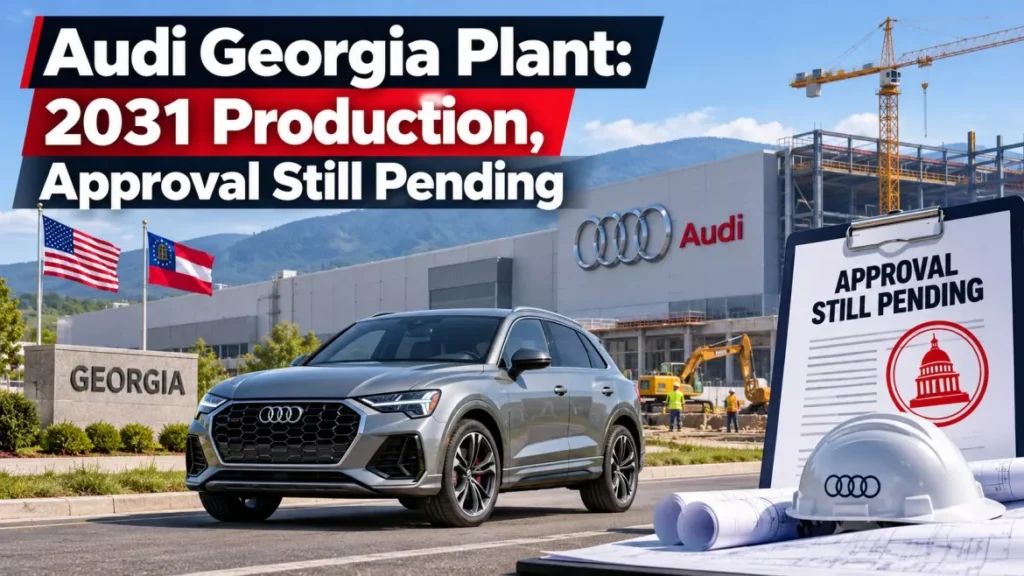

The Audi Georgia plant will be the carmaker’s first factory in the United States, built at the Middle Georgia Megasite in Peach County. Audi is committing around $4 billion and about 4,500 jobs for a site designed to produce up to 200,000 premium SUVs a year. Georgia’s governor says full production begins in 2031.
The project was announced on Saturday 24 October 2026 by Governor Brian P. Kemp and Gernot Doellner, chairman of the board of management of AUDI AG, after President Donald Trump disclosed it at a campaign rally in Perry, Georgia. Audi AG, the premium car brand owned by Germany’s Volkswagen Group, has never built vehicles in the United States.
What Audi Has Committed To
Audi’s own announcement sets out four figures, and the state of Georgia’s release matches them.
- Investment: around $4 billion, according to Audi’s announcement. Trump put the figure at $4.2 billion at the rally.
- Jobs: approximately 4,500 new roles in middle Georgia.
- Capacity: up to 200,000 vehicles a year at full production.
- Site: the Middle Georgia Megasite in Peach County, developed with Houston and Macon-Bibb counties through the Mid-Georgia Gateway Joint Development Authority.
Neither Audi’s release nor the governor’s mentions state tax credits or incentives. Georgia Quick Start, the state’s publicly funded industrial training programme, will build a tailored curriculum and a dedicated training facility, and will begin instruction at Technical College System of Georgia campuses before that building is finished.
When the Plant Starts Building Cars
The three parties who spoke about the project gave three different timelines, and none of them puts a vehicle on a transporter before the 2030s.
| Source | Stated timeline |
|---|---|
| AUDI AG press release, 25 October 2026 | Construction begins in 2027; production starts in the early 2030s |
| Office of Governor Brian P. Kemp, 24 October 2026 | Site grading in 2027; construction in 2028; full production in 2031 |
| President Donald Trump, Perry rally, 24 October 2026 | Construction begins next month |
The gap between the company’s wording and the state’s is the difference between breaking ground and moving earth: Audi says construction starts in 2027, while Kemp’s office puts grading in 2027 and construction a year later. Trump’s claim that work begins within weeks matches neither account.
As of 26 October 2026, the earliest date any party has attached to full production at the Georgia site is 2031, and that figure comes from the governor’s office rather than from Audi.
Why the Investment Is Not Final Yet
An announcement is not the same as a signed-off capital budget. Audi’s press release does not say the investment has received final corporate approval, and it does not mention the Volkswagen Group bodies that would have to grant it.
Reporting on the announcement says that approval is still outstanding. CNBC reported on 25 October 2026 that Doellner said the final decision on the investment rests with Volkswagen’s supervisory board. Christiane Benner of IG Metall, the German industrial trade union that holds seats on Volkswagen’s supervisory board, said the final decision remains subject to approval by the relevant Volkswagen bodies, according to German public broadcaster Tagesschau.
Audi has not published a date for that decision. Until it is taken, the $4 billion figure is a stated intention rather than a committed spend.
Which Models Georgia Will Build
Audi says only that the plant will make “premium SUVs tailored to North American customers”. The one model its announcement names directly is the new Audi Q9, in an image caption describing a vehicle built for American buyers.
Beyond that, accounts differ. Reuters reported a United States official listing the Q7, Q8 and Q9; Bloomberg named the Q9 and Q5. Audi has not confirmed a model line-up for the site, so the full list remains open.
Why Audi Is Building in the United States
Audi is among the carmakers most exposed to American import duties because it has no United States factory and ships every car it sells there from Europe or Mexico.
Reuters reported that United States tariffs on cars, steel, aluminium and parts cost Audi about 1.2 billion euros (roughly $1.4 billion) in 2025. Under the trade agreement between Washington and the European Union, cars imported from the EU face a baseline United States tariff of 15%, down from the 27.5% rate applied earlier. Audi declined to say whether the Georgia plan involves any tariff relief for the company.
Car trade policy is tightening in both directions. The European Union has set its own cap of 350,000 China-made cars a year, plug-in hybrids included. Audi’s largest American rivals already build where they sell: General Motors reported record revenue of $50.0 billion for its third quarter in October 2026.
Sales have been falling in the meantime. Audi deliveries dropped 7% in the first half of 2026, and Reuters reported on 25 October 2026 that its United States sales are down 16% so far this year. Building locally removes the tariff from each car made in Georgia, but only once the plant runs, which on the state’s own timeline means 2031.
What the Plan Means in Germany
The Georgia announcement lands while Volkswagen Group is shrinking at home. On 3 September 2026 its supervisory board unanimously approved Future Plan 2030, which adds around 50,000 job cuts across the group, about 8% of its global workforce at the end of last year, and halves the number of models offered by 2035. The plan targets annual sales of 9 million vehicles and a 9% operating margin by 2030, with 135 billion euros of capital spending and research budgeted from 2027 to 2031.
Reports that four German plants will close have not been confirmed as decisions. A leaked internal document reported by WirtschaftsWoche named Emden, Zwickau, Hanover and Neckarsulm, the last an Audi site, on a phase-out schedule running from 2031 to 2034. Accounts of what the September board meeting actually settled conflict: one account says the board recorded that European capacity exceeds demand by more than 500,000 units and set the end of June 2027 as the deadline for a European production plan, rather than approving closures. Volkswagen has not announced a closure decision for any of the four.
Audi’s own framing addresses that tension directly. Manfred Doess, chairman of the supervisory board of AUDI AG, said Audi’s future “will not be secured by cost reductions, increased efficiency and outstanding technology alone”.
Frequently Asked Questions
Is the Audi Georgia Plant Approved?
Not finally. Audi announced the plan on 24 October 2026, but reporting by CNBC and comments by IG Metall indicate the final investment decision still requires approval from Volkswagen Group bodies. No date for that decision has been published.
When Will the Audi Georgia Plant Open?
Georgia’s governor’s office says site grading begins in 2027, construction in 2028 and full production in 2031. Audi’s own release says construction starts in 2027 and production in the early 2030s.
How Many Jobs Will the Audi Georgia Plant Create?
Approximately 4,500, according to both Audi and the Georgia governor’s office. None of those jobs exists yet, and hiring follows construction rather than the announcement.
Which Models Will Audi Build in Georgia?
Audi describes premium SUVs for North American customers and names the new Audi Q9 in its announcement. Reuters and Bloomberg have reported differing wider line-ups, and Audi has not confirmed one.
Why Is Audi Building a Factory in the United States?
Audi imports all United States-market vehicles from Europe or Mexico and says localised production supports its growth plans in America. Reuters reported that tariffs cost the company about 1.2 billion euros in 2025.