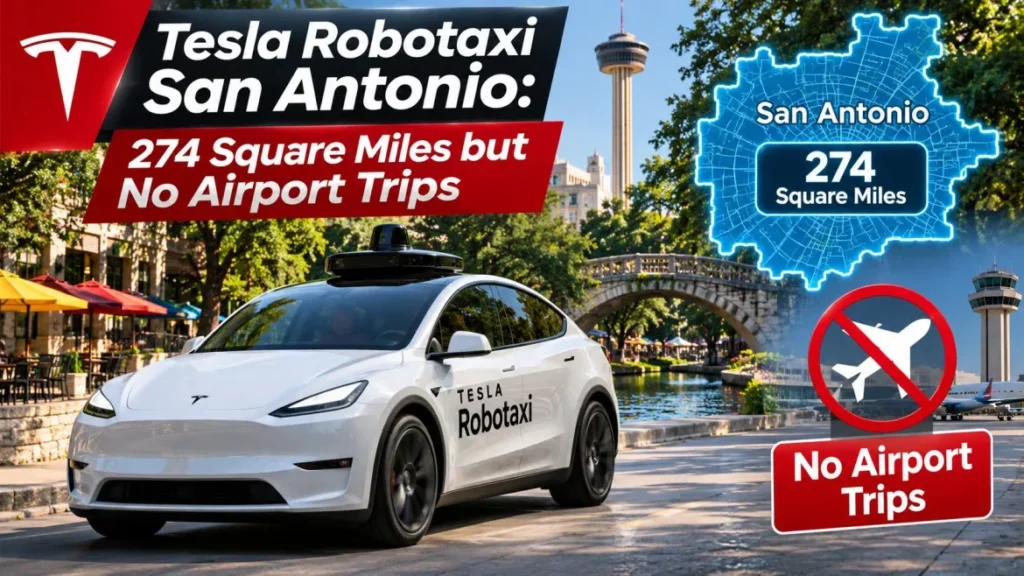

Tesla Robotaxi San Antonio opened on 9 November 2026, with the first driverless trips at 5 a.m. local time. The service area measures about 274 square miles, the largest zone Tesla has opened on day one. San Antonio International Airport sits inside that boundary but is not served.
What Tesla Opened, and What Is Driving
The San Antonio launch runs without a human in the driver’s seat. Teslarati, which covered the launch, reports the service operates with no safety driver in the vehicle, the same arrangement Tesla began in Fort Worth a week earlier on 2 November.
The cars are modified Tesla Model Y vehicles. The two-seat Cybercab, Tesla’s purpose-built driverless vehicle, remains largely confined to Austin; we looked at how few of them were running in our report on the Tesla Cybercab investigation.
Tesla announced the opening through its official Robotaxi account the day before, posting a map of the zone and the line “First rides at 5am local time!” as quoted by Teslarati. Tesla did not publish a square-mile figure itself. The 274-square-mile measurement comes from Robotaxi Tracker, an independent project that maps the zones; a widely shared post by Tesla investor Sawyer Merritt put it at roughly 275, and several outlets used that number.
Rides are booked through the Tesla Robotaxi app. Tesla has not published operating hours for San Antonio. In Austin, service now runs about 20 hours a day after an extension to 2 a.m., according to Not a Tesla App.
How Much of the Map You Can Actually Book
A geofence drawn on a map is not the same as the area where the app will accept a trip, and in every Tesla city measured so far the bookable area has been smaller. Koby Pierce, a Tesla enthusiast, tested this by running the Robotaxi app in emulators and requesting pickups and drop-offs across each zone, recording which points the app accepted. Not a Tesla App published his results on 5 November 2026.
| City | Advertised zone | Bookable area | Share of zone |
|---|---|---|---|
| Austin | 273 sq miles | 160 sq miles | 59% |
| Houston | 255 sq miles | 188 sq miles | 74% |
| Fort Worth | 144 sq miles | 105 sq miles | 73% |
| Dallas | 81 sq miles | 63 sq miles | 78% |
Across those four Texas markets the bookable areas ran 22% to 41% smaller than the advertised zones. The pattern is less severe than it looks for residents: in Austin the usable area still covered about 675,000 of roughly 809,000 people, or 83%, and in Dallas about 337,000 of 381,000, or 89%. The unbookable parts tend to be thinly populated edges.
No equivalent measurement exists for San Antonio yet. Electrek projected a usable area “closer to 160 to 210 square miles” and was explicit that this is its own estimate rather than a measurement. Pierce’s figures also predate Tesla’s 9 November expansion of the Austin zone, so the Austin row above describes the smaller zone as it stood on 5 November.
The practical consequence for a rider is simple: a pickup or drop-off pin near the edge of the published map may be refused, and the app is the only way to find out.
Why Sources Disagree on Whether This Is City Eight or Nine
Coverage of the launch split between calling San Antonio Tesla’s eighth city and its ninth region, and both are defensible.
Eight is the count of cities where Tesla runs unsupervised rides with nobody in the driver’s seat: Austin, Houston, Dallas, Fort Worth and San Antonio in Texas, plus Miami, Orlando and Tampa in Florida. Nine adds the San Francisco Bay Area, where Tesla operates with a safety person aboard rather than fully driverless. Not a Tesla App used both numbers in the same article, titling it the ninth region while the text called San Antonio the eighth unsupervised city.
San Antonio is Tesla’s fifth Texas city. Las Vegas, Phoenix and Jacksonville remain on the announced list of markets still to come. Our earlier report on the Tesla Robotaxi Houston expansion covered the previous step in this sequence.
Tesla and Waymo in the Same City
San Antonio now has two driverless services, and they are close to opposites: Tesla has far more map, Waymo has far more cars and will take you to the airport.
| Tesla Robotaxi | Waymo | |
|---|---|---|
| San Antonio service area | About 274 sq miles | About 59 sq miles |
| Open to | Robotaxi app users | Anyone with the Waymo app |
| Airport rides | No | Yes |
| Vehicles nationally | 666 | Over 4,000 |
Waymo, the driverless unit of Google’s parent company Alphabet, opened San Antonio to the general public on 14 October 2026. Its announcement says “anyone in San Antonio, San Diego, and Tampa can download the Waymo app and hail a fully autonomous ride”, with trips available “including the San Antonio International Airport”. Waymo began driverless rides in the city in February 2026. The service area and vehicle counts above are Robotaxi Tracker’s figures as reported by Electrek.
Airport access is usually the single most valuable permission a ride service can hold, because it requires an agreement with the airport operator rather than just a working vehicle. Waymo has it in San Antonio and Tesla does not, despite drawing the airport inside its zone. Waymo is expanding internationally on the same model, as we covered in Waymo’s Madrid launch.
What Texas Requires Before a Driverless Car Can Charge a Fare
Texas is where both companies have scaled fastest, and since May it has required state permission. Under Senate Bill 2807, passed in 2025, the Texas Department of Motor Vehicles states that “All companies operating automated vehicles commercially on or after May 28, 2026, are required to maintain an active authorization with TxDMV”.
The requirements are lighter than the phrase suggests. There is no fee; the department’s page says “No fees are required for an authorization to operate automated vehicles”. An applicant certifies that the Texas Department of Public Safety has a copy of its plan for how police, firefighters and paramedics should interact with the vehicle, and acknowledges that each vehicle carries liability coverage or self-insurance at or above the applicable legal minimum. Authorizations last until revoked, and holders must report material changes within 30 days.
Because the process rests on the company’s own certifications rather than a state driving test, a new city inside Texas does not require fresh approval. That is part of why Tesla has been able to add four Texas cities since October.
What Tesla Has Not Said
Tesla has not disclosed how many vehicles serve San Antonio. Electrek reported that as of the morning of 9 November, Robotaxi Tracker had logged no Tesla Robotaxis in the city at all, which is a tracker’s observation rather than a statement from Tesla, and absence from a tracker is not proof of absence from the road.
Tesla has also not said when airport trips will begin, what the operating hours are, whether Cybercabs will serve the city, or how the roughly 274-square-mile zone translates into bookable pickup and drop-off points. The company has not responded publicly to the measurements showing bookable areas are smaller than advertised.
As of 11 November 2026, the service is live in San Antonio with no safety driver, the airport is excluded, and Tesla’s Austin zone has grown to about 443 square miles according to Robotaxi Tracker, though a Teslarati post the same day listed 435. Tesla has not published a figure for either.
Tesla Robotaxi San Antonio Questions Answered
Is Tesla Robotaxi San Antonio Fully Driverless?
Yes. Teslarati reports the San Antonio service runs with no safety driver in the vehicle, matching the unsupervised service Tesla started in Fort Worth on 2 November 2026.
Can a Tesla Robotaxi Take Me to San Antonio Airport?
No. San Antonio International Airport falls inside Tesla’s service boundary, but Tesla is not offering airport pickups or drop-offs, and it has given no date for starting. Waymo does serve the airport.
How Big Is the Tesla Robotaxi San Antonio Zone?
Robotaxi Tracker measured it at about 274 square miles, and some reports cite roughly 275. Tesla posted a map without publishing a figure. It is Tesla’s largest service area at launch so far.
Can I Be Picked Up Anywhere Inside the Zone?
Not necessarily. In the four Texas cities independently tested before this launch, the area where the app accepted trips was 22% to 41% smaller than the published zone. No measurement for San Antonio has been published yet.
Which Cities Does Tesla Robotaxi Serve Now?
Eight cities with unsupervised rides: Austin, Houston, Dallas, Fort Worth and San Antonio in Texas, and Miami, Orlando and Tampa in Florida. A ninth zone in the San Francisco Bay Area operates with a safety person on board.