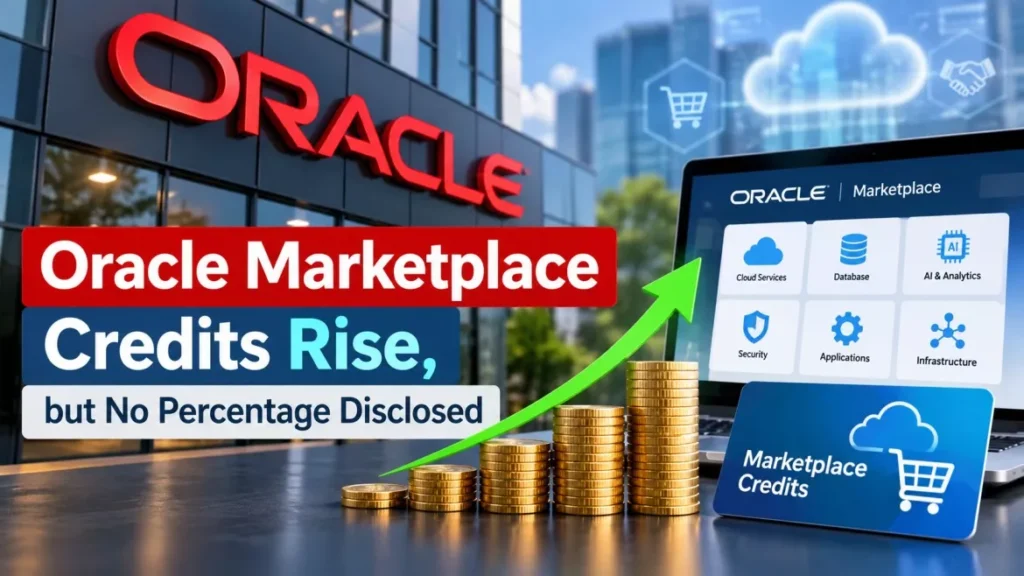

Oracle Marketplace can now absorb a larger share of a customer’s prepaid Universal Credits, Oracle said on 23 October 2026. The company did not disclose the new share, an effective date, or how eligibility is decided. It also pledged $1 billion over four years to its partner network.
Both announcements were made at Oracle AI World in Las Vegas. They apply to Oracle’s enterprise customers and partners worldwide, though several of the purchasing changes are limited to named countries, and the rest are governed by eligibility rules Oracle has not published.
What Oracle Announced on 23 October
Two separate releases went out the same morning, timed at 8:00am Eastern time from Las Vegas.
The first was a $1 billion commitment to its partner ecosystem over the next four years. The second set out changes to Oracle Marketplace, the storefront through which Oracle customers buy software and services from third-party vendors as well as from Oracle.
Oracle Corporation is the American enterprise software and cloud company whose products include the Oracle database, Fusion Applications and Oracle Cloud Infrastructure.
What Changes for Oracle Customers
The change with the most direct effect on budgets concerns Universal Credits. Universal Credits are the prepaid consumption commitment an Oracle cloud customer buys up front and then draws down as it uses services.
- A larger share of credits can go to Marketplace purchases: Oracle has increased the portion of a customer’s eligible Universal Credits commitment that can be applied to qualifying Marketplace purchases. In practice this lets a customer buy third-party software out of money already committed to Oracle, rather than raising a separate purchase order.
- Top-ups: eligible customers get another route to replenish a credit balance for qualifying purchases.
- Metered billing: eligible paid listings can be sold on usage-based pricing, so spending tracks consumption rather than a fixed licence count.
- Multi-Party Private Offers: a vendor, an authorised reseller and a customer can settle one customised transaction, with the customer buying through its preferred participating reseller.
- Private Offers Co-Sell: connects eligible independent software vendors with Oracle’s own sales staff on qualified customer opportunities.
An independent software vendor, or ISV, is a company that sells its own software product rather than reselling someone else’s.
Where the Marketplace Changes Apply
Availability is uneven, and only one of these items carries a date.
| Change | Where it applies | Timing stated |
|---|---|---|
| Marketplace purchasing expansion | India and Japan | None given |
| Multi-Party Private Offers | United States, Spain, Brazil | Described as now available |
| Multi-Party Private Offers, further rollout | Additional European Union countries | Planned by the end of 2026 |
| Larger Universal Credits share, top-ups, metered billing, Co-Sell | Not restricted by country in the announcement | None given |
| Industry-aligned Marketplace listings | Health, retail and hospitality | None given |
What Oracle Did Not Disclose
The announcement is specific about direction and vague about magnitude. Four things a buyer would need in order to plan are absent.
- The percentage: Oracle said the applicable portion of Universal Credits has increased but gave no old or new figure, so the size of the change cannot be assessed.
- The effective dates: no start date was given for the credits change, the top-ups, metered billing or the India and Japan expansion. The only date in either release is the end of 2026, for further European Union availability.
- The eligibility rules: the releases repeatedly qualify terms as applying to eligible customers, eligible ISVs, eligible paid listings and qualifying purchases, without defining any of them. Oracle states that all benefits and incentives are subject to applicable programme terms and eligibility requirements.
- The yearly split of the $1 billion: the commitment runs four years, and Oracle did not identify precise start and end dates or how the money divides across them.
This is not unique to Oracle. Meta’s enterprise platform launched in September 2026 with no prices or dates attached either.
As of 26 October 2026, Oracle had published no percentage for the Universal Credits change. Customers wanting terms that apply to their own contract would need to take it up with Oracle or their Oracle PartnerNetwork reseller, because the published release does not contain them.
Where the $1 Billion Goes
Oracle listed six categories of spending, aimed at partners rather than at customers directly.
- Training and certification: building partner skills on Oracle products.
- Technical enablement: support for partners building on Oracle technology.
- Development, testing and demonstration environments: systems partners use to build and show solutions.
- Cloud migration funding: money toward moving customer workloads onto Oracle Cloud Infrastructure.
- Go-to-market collaboration: joint selling and marketing.
- Commercialisation through Oracle Marketplace: helping partners sell through the storefront.
The partners covered are systems integrators, independent software vendors, cloud and managed service providers, value-added distributors, resellers and advisory firms.
Mark Hura, president of Oracle Global Field Operations, said partners “extend our sales reach, expand our delivery capacity”. Leah Yomtovian, senior vice president for partner, sales and operations strategy, said partners “have different business models, capabilities, and growth ambitions”.
Why Oracle Is Spending on Partners Now
Oracle has booked far more future cloud work than it has delivered, and it needs people to deliver it. Its backlog stood at $664 billion at the end of its first quarter of fiscal 2027, with first-quarter capital expenditure of $28.5 billion.
Delivery capacity, not demand, is the constraint that partner funding addresses. The spending also runs alongside cost reduction elsewhere in the company: Oracle’s restructuring charges reached $2.8 billion, with a filing citing AI adoption.
The $1 billion is separate from the more than $1.5 billion that systems integrators and consultancies committed to Oracle’s AI Data Platform in October 2025. Oracle AI World runs from 25 to 28 October 2026, with the main keynote on Monday 26 October, so further announcements may follow this week.
Frequently Asked Questions
What Changed About Oracle Marketplace Universal Credits?
Oracle increased the portion of a customer’s eligible Universal Credits commitment that can be applied to qualifying Marketplace purchases. It did not publish the old or new percentage, or an effective date.
Which Countries Does the Oracle Marketplace Expansion Cover?
Marketplace purchasing is expanding to India and Japan, with no start date given. Multi-Party Private Offers are described as available in the United States, Spain and Brazil, with additional European Union countries planned by the end of 2026.
How Much Is Oracle Spending on Partners?
$1 billion over four years, announced on 23 October 2026. Oracle did not state precise start and end dates for the period or how the money splits by year.
Does the $1 Billion Reduce What Customers Pay Oracle?
Oracle has not said so. The commitment funds partner training, enablement, environments, cloud migration, joint selling and Marketplace commercialisation, and all benefits are subject to programme terms and eligibility requirements Oracle has not published.
What Is Metered Billing on Oracle Marketplace?
It allows eligible paid listings to be sold on usage-based pricing, so a customer’s spending tracks consumption instead of a fixed number of licences. Oracle gave no start date for it.