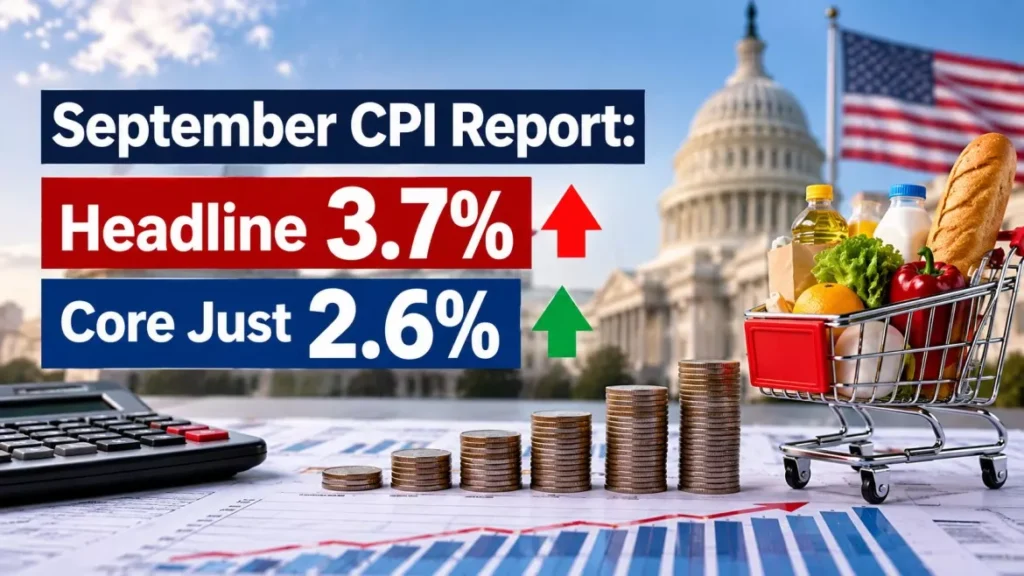

The September CPI report put United States inflation at 3.7% over 12 months, up from 3.4% in August. The Bureau of Labor Statistics published the figures on 14 October 2026, with the all items index rising 0.6% for the month. Core inflation, which excludes food and energy, ran at 2.6%.
What the September CPI Report Showed
Energy did almost all of the damage, and most other categories were close to flat. The table below is drawn from the Bureau of Labor Statistics consumer price index news release for September 2026, published on 14 October. Monthly changes are seasonally adjusted and 12-month changes are not, and all of it applies to the United States only.
| Category | September 2026, month on month | 12 months to September 2026 |
|---|---|---|
| All items | +0.6% | +3.7% |
| All items less food and energy (core) | +0.3% | +2.6% |
| Energy | +5.2% | +20.4% |
| Gasoline, all types | +9.1% | +34.2% |
| Fuel oil | +15.3% | +74.2% |
| Electricity | +0.2% | +4.4% |
| Shelter | +0.4% | +3.2% |
| Food | Unchanged | +2.5% |
| Food at home | -0.1% | +1.8% |
| Airline fares | +1.2% | +22.4% |
| Used cars and trucks | +0.7% | -1.5% |
| New vehicles | +0.2% | +0.6% |
| Medical care | +0.1% | +1.5% |
Both readings came in above forecast. CBS News reported that economists polled by FactSet had expected 3.6% on the headline measure and 2.5% on core.
Why Gasoline Did Most of the Work
Gasoline alone accounted for more than half of the increase in consumer prices from August to September. Pump prices are the single most visible number in the index, and they are being set outside the United States economy.
CBS News attributes the energy surge to the war in Iran and to Russia’s war in Ukraine, which between them have curtailed crude supply. Brent crude rose more than 14% during September, taking its third-quarter gain to about 42%, and West Texas Intermediate was trading above $96 a barrel on the morning of 15 October 2026, with shipping restrictions in the Strait of Hormuz cited as a key factor.
At the pump, AAA’s national average stood at $4.33 a gallon as cited by CBS News on 14 October 2026, against $2.98 before the war began. That is an average across the country; regional prices differ sharply, as our earlier survey of the regional spread in United States gas prices set out.
The Wholesale Figures Arrived a Day Later
Producer prices rose faster still. The September producer price index, published on 15 October 2026, rose 1.3% from August and 6.3% over 12 months, the largest annual increase since 2022.
The producer price index measures what producers receive for their output, before anything reaches a shop shelf, so it is often read as a signal of where consumer prices may go next. Energy accounted for more than 80% of the September increase, with the energy component up 10.8% in the month. Economists surveyed by The Wall Street Journal had expected about 0.6% monthly and 5.5% annually.
What a 3.7% Headline and a 2.6% Core Mean for the Fed
The two readings point in different directions, which is the whole difficulty facing the Federal Open Market Committee. A central bank cannot increase the supply of crude oil by raising interest rates, so an energy shock is the kind of price rise policy is least able to address.
Core inflation at 2.6% is close to the Federal Reserve’s 2% objective. Headline inflation at 3.7% is not, and it is what households actually pay. The Federal Reserve raised its target range for the federal funds rate by a quarter point on 16 September 2026, to between 3.75% and 4.00%, effective the following day, in a unanimous 12-0 vote under Chair Kevin Warsh. It was the first increase since 2023, and most participants judged that a further increase would likely be appropriate by year end. Our report on that September decision covers the projections in full, and the August CPI report set the stage for it.
Named analysts read the September data as reinforcing the hiking case rather than settling it. Stephen Brown, chief North America economist at Capital Economics, said the data “could prompt the Fed to pull the trigger on another hike this month.” David Royal, chief finance and investment officer at Thrivent, said the report “shows that inflation is still well above the Fed’s target.” Adam Crisafulli of Vital Knowledge said: “The CPI was clearly hot, and there aren’t many ways to sugarcoat it.”
The Odds for 27 and 28 October Are Not Settled
Published probabilities for the October meeting disagreed with each other within hours of the release. These numbers are derived from federal funds futures prices and move continuously through the trading day, so any single reading is a snapshot rather than a forecast.
- Capital Economics, 14 October 2026: Stephen Brown said markets put the chance of a hike at the October meeting at 50%, up from 20% before the data.
- CME FedWatch, as reported on 15 October 2026: about 24.9% for a quarter-point rise on 28 October.
- FXStreet, after the initial spike: 31.6% for October.
- December meeting: FinanceFeeds put the probability at 89.7%, while CNBC reported odds of better than 96% for a rise before the end of the year.
As of 16 October 2026, no decision has been taken. Nothing in the data obliges the committee to act at either meeting, and the Federal Reserve has issued no statement about October beyond its September guidance.
What Higher Policy Rates Reach, and What They Do Not
The federal funds rate is the rate at which United States banks lend to one another overnight, and it feeds through to consumer products at different speeds and to different degrees. Credit card rates and savings rates tend to move fairly quickly; fixed mortgage rates track longer-term bond yields instead, and can move in the opposite direction to the policy rate.
The readings below each carry their own survey and date, because they are not comparable with one another and because they change weekly.
- 30-year fixed mortgage: NerdWallet reported an average of 7.32% APR on the morning of 15 October 2026, using Zillow data, while Money’s daily average was 7.37% on 12 October 2026.
- Credit cards, variable rate: Bankrate’s national average was 19.65% as of 7 October 2026, and Forbes Advisor’s weekly average was 24.95% as of 12 October 2026. The two use different methodologies.
- Credit cards, accounts carrying a balance: Federal Reserve data cited by Forbes Advisor showed 22.36% as of August 2026.
Every one of those is an average. An individual rate depends on credit history, loan size, term, lender and state, so none of these figures describes what any particular household is charged.
What Comes Next on the Calendar
Two decisions remain in 2026. The Federal Open Market Committee meets on 27 and 28 October and again on 8 and 9 December, according to the Federal Reserve’s published meeting calendar.
The December meeting carries a Summary of Economic Projections, the quarterly document in which each participant submits their own view of where rates, growth, unemployment and inflation are heading. The October meeting does not. The minutes of the September meeting were released on 7 October 2026.
Frequently Asked Questions
What Did the September CPI Report Say?
United States consumer prices rose 0.6% in September 2026 and 3.7% over the 12 months to September. Core prices, excluding food and energy, rose 0.3% in the month and 2.6% over the year.
Why Is United States Inflation Rising Again?
Energy. The energy index was 20.4% higher than a year earlier and gasoline 34.2% higher, which CBS News attributes to the war in Iran and Russia’s war in Ukraine constraining crude supply.
What Is the Difference Between Headline and Core Inflation?
Headline covers every item in the basket. Core excludes food and energy, the two most volatile categories, so it is used to read the underlying trend. In September 2026 the gap between them was 1.1 percentage points.
What Is the Federal Reserve’s Interest Rate Now?
The target range for the federal funds rate is 3.75% to 4.00%, set on 16 September 2026 and effective from 17 September. That was the first increase since 2023.
When Is the Next Federal Reserve Decision?
The Federal Open Market Committee meets on 27 and 28 October 2026, and then on 8 and 9 December 2026. No outcome has been announced for either, and published market probabilities for October ranged from about 25% to 50% in the days after the CPI release.