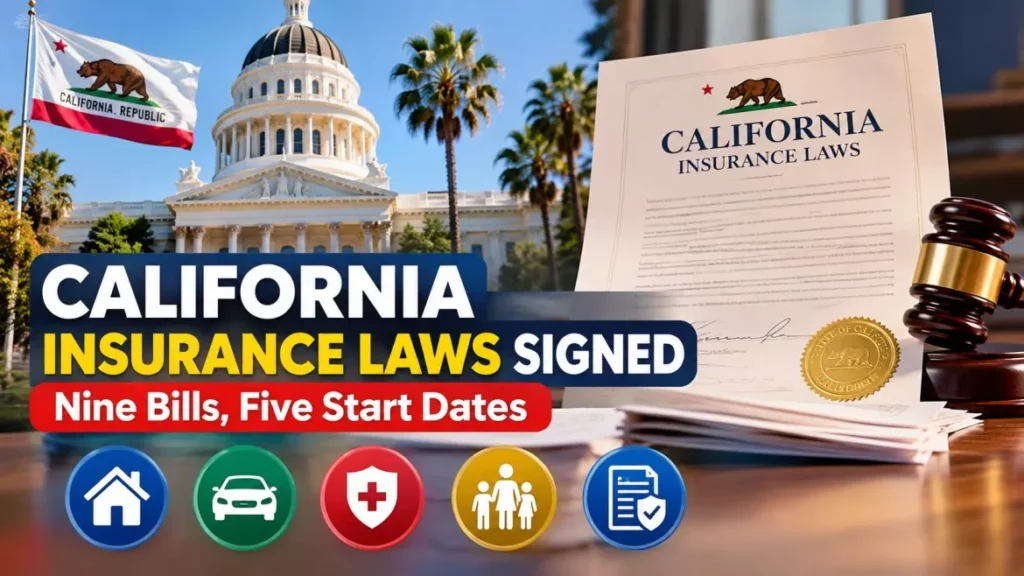

Nine California insurance laws have been signed, and they do not all start on the same day. The California Department of Insurance announced the package on 30 September 2026, with provisions phasing in on five separate dates between 1 January 2027 and 1 July 2029. The laws apply in California only.
What Was Signed, and When It Was Announced
The package is nine bills sponsored or backed by the state insurance commissioner, announced together but signed at different times. As of 3 October 2026, all nine are law in California and none of the provisions has yet taken effect.
The California Department of Insurance, the state agency that regulates insurers and licenses agents in California, set out the full list in a release dated 30 September 2026. Two of the nine were announced separately and earlier: Senate Bill 876 in a departmental release dated 28 September 2026, and Assembly Bill 1795 on 15 September 2026, according to the Governor’s office and to Insurance Journal.
Insurance Commissioner Ricardo Lara, who sponsored or backed the bills, said in the 30 September release: “When Californians pay their premiums, they deserve more than a policy. They deserve protection when disaster strikes.” The same release states that Lara has sponsored 102 bills since 2019, of which 69 have been signed into law.
All Nine Bills and When Each Takes Effect
Five different commencement dates apply across the package, and several bills phase in over more than one of them. Dates below are as stated in the Department of Insurance release of 30 September 2026.
| Bill | Short name | What it covers | Effective date |
|---|---|---|---|
| SB 876 | Disaster Recovery Reform Act | Claims handling during declared emergencies | 1 January 2027; further provisions 1 January 2028 |
| AB 1795 | Smoke Damage Recovery Act | Investigating and restoring smoke-damaged homes | Some provisions 1 January 2027; the rest 1 January 2028 and 1 July 2029 |
| AB 1680 | Make It FAIR Act | Oversight of the California FAIR Plan | Not stated in the Department’s release |
| SB 354 | Insurance Information and Privacy Protection Act | Consumer data privacy rules for insurers | 1 July 2028; licensee compliance 1 January 2029 |
| SB 1209 | Insurance Examination Compliance and Accountability Act | Enforcement when insurers fail corrective actions | 1 January 2027 |
| SB 1206 | Insurance Omnibus Bill | Licensing, public adjuster rules, workers’ compensation fraud reporting | 1 January 2027 |
| AB 1798 | Safeguarding Genetic Information Act | Genetic test results in life and disability underwriting | 1 January 2027 |
| AB 2011 | Behavioral Health Parity Protection Act | Mental health parity in health cover | 1 January 2027 |
| SB 1023 | No short name given | Coverage of HIV pre-exposure prophylaxis | 1 January 2027 |
Six of the nine begin on 1 January 2027. The latest provision in the package, part of AB 1795, does not arrive until 1 July 2029, which is two and a half years after the first.
What Changes for Disaster Claims Under SB 876
SB 876 rewrites how insurers must handle claims after a declared emergency, and the Department describes it as the biggest change to California’s claims-handling rules in more than three decades. It was authored by Senate Insurance Committee Chair Steve Padilla and sponsored by Commissioner Lara. The Department’s release lists six components.
- Advance planning: Insurers must prepare disaster recovery plans and submit them for departmental review before using them in an emergency.
- Doubled penalties: Penalties for breaching fair claims settlement practices are doubled during a state-declared emergency.
- Direct restitution: Where an insurer engages in unfair settlement practices, policyholders receive compensation directly.
- Adjuster handovers: When the adjuster on a claim changes, the insurer must provide a status update within 15 days.
- Coverage offers: Insurers must offer extended replacement cost cover and additional living expenses cover.
- Building codes: Cover for code upgrades is calculated against the regulations in force at the time of rebuilding, not when the policy was written.
Two terms there are worth defining. “Extended replacement cost” is cover that pays above the stated dwelling limit, by a set percentage, when rebuilding costs more than the policy anticipated. “Additional living expenses” cover pays for somewhere to live while a damaged home is uninhabitable.
Padilla said in the Department’s release: “When disaster strikes, families shouldn’t have to face a second disaster in the claims process.” Lara said: “No family who has lost everything should have to fight their insurance company to get the benefits they paid for.”
The Smoke Damage Rules Were Signed Separately
AB 1795 deals with a problem SB 876 does not touch: damage that is not visible. The Department describes it as establishing the first science-based standards in the United States for investigating and restoring smoke-damaged homes, and it requires the Department of Insurance and the California Governor’s Office of Emergency Services to conduct contamination studies.
Reporting by Insurance Journal and Claims Journal on 15 September 2026 described three operative mechanisms: a presumption that smoke damage found within a wildfire impact area was caused by that wildfire, a requirement that insurers pay for necessary testing and sampling, and a bar on insurers ending additional living expenses payments until a home is restored and safe to occupy.
Because the bill phases in across 1 January 2027, 1 January 2028 and 1 July 2029, a claim made in one year may fall under different rules from a claim made two years later. The Department’s release does not say which provision lands on which date.
Four of the Nine Have Nothing to Do With Fire
Most coverage framed this as a wildfire package, but almost half of it concerns other lines of insurance entirely. Readers checking whether a law touches them should look at the line of cover, not the headline.
- AB 1798: Bars life insurers and disability insurers in California from using genetic test results in underwriting decisions from 1 January 2027.
- AB 2011: Writes federal mental health parity regulation into California state law, so that behavioural health benefits are treated on the same terms as other medical benefits, from 1 January 2027.
- SB 1023: Expands access to HIV pre-exposure prophylaxis through both medical and prescription drug benefits from 1 January 2027.
- SB 354: Replaces privacy rules the Department describes as more than 40 years old, with the main provisions from 1 July 2028 and licensee compliance from 1 January 2029.
The Complaint Review That Preceded the Laws
The Department has published figures from its own review of wildfire claims, and they are the clearest measure of what prompted the legislation. Its review of more than 2,000 complaints arising from recent Los Angeles-area wildfires produced more than $338 million in additional payments to policyholders, of which more than $50 million related specifically to smoke damage claims.
Those are cumulative totals published by the regulator as of its late-September 2026 releases, not an annual rate, and they describe money recovered through complaint handling rather than through the new laws, which were not yet in force.
What the Package Does Not Change
Several of the pressures Californian homeowners have faced this year sit outside this legislation. None of the nine bills sets premium levels, and none requires an insurer to write or keep writing a policy.
The California home insurance market has continued to tighten on both fronts: State Farm capped new California home policies at 7,500 a month and Farmers Insurance is applying a 1.5% increase at each renewal. Rate changes in California are handled through the Department’s rate approval process, which is separate from these bills.
The laws also stop at the state line. Rules on non-renewal notice, smoke damage and claim handling differ by state, and other states have moved in different directions, with Washington’s own wildfire insurance protections expiring on 30 September. Policyholders outside California are not covered by any of the nine bills, and terms within California still vary by insurer, policy and individual circumstances.
Policyholders wanting the authoritative text and the current status of any of these bills can find both on the California Department of Insurance website and in the California Legislative Information database, which publishes each bill’s final text and chaptering date.
Frequently Asked Questions
When Do the New California Insurance Laws Take Effect?
Six of the nine begin on 1 January 2027. Other provisions start on 1 January 2028, 1 July 2028, 1 January 2029 and 1 July 2029. The Department of Insurance did not state an effective date for AB 1680.
What Does SB 876 Do?
SB 876, the Disaster Recovery Reform Act, doubles penalties for unfair claims settlement practices during a California-declared emergency, requires restitution directly to policyholders, requires a status update within 15 days when a claim’s adjuster changes, and requires insurers to offer extended replacement cost and additional living expenses cover. It takes effect on 1 January 2027, with further provisions on 1 January 2028.
Do the California Insurance Laws Lower Premiums?
No. None of the nine bills sets or caps premium levels. California premium changes are decided through the Department of Insurance’s separate rate approval process.
Does AB 1795 Mean Smoke Damage Is Automatically Covered?
Not automatically. As reported by Insurance Journal on 15 September 2026, the law creates a presumption that smoke damage found within a wildfire impact area came from that wildfire, requires insurers to pay for testing and sampling, and bars insurers from ending additional living expenses payments until a home is safe to occupy. Individual claims still depend on the policy and the facts.
Do These Laws Apply Outside California?
No. All nine are California state laws and bind insurers only as to California business. Claim-handling and non-renewal rules differ in every other state and country.
Can an Insurer Still Decline to Renew a California Policy?
Yes. Nothing in this package requires an insurer to write or renew a policy. AB 1680 addresses oversight of the California FAIR Plan, the state’s insurer of last resort for property cover, rather than private insurers’ decisions to write business.