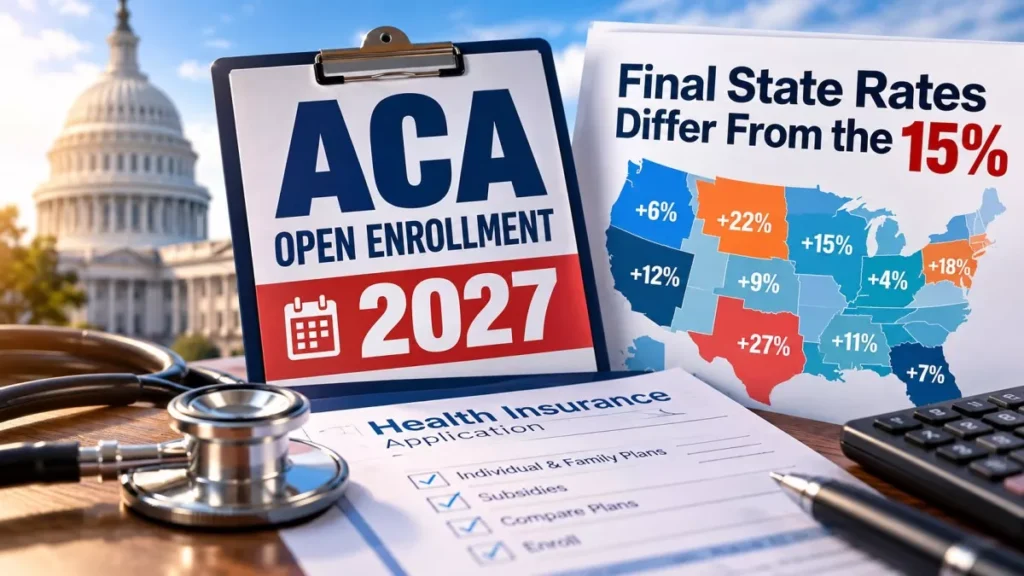

ACA open enrollment 2027 starts on 1 November 2026 and runs to 15 January 2027 in most United States marketplaces. Insurers proposed a median premium increase of about 15%, but state regulators have been cutting those requests: New York approved 6% against a 20.6% filing. Deadlines and approved rates vary by state.
This applies only to the United States individual health insurance market established under the Affordable Care Act. It does not cover employer plans, Medicare or Medicaid. The Affordable Care Act is the 2010 federal law that created the subsidised marketplaces known as exchanges.
The Dates for 2027 Coverage
Open enrollment is the annual window in which people can start, renew or switch an individual marketplace plan without needing a qualifying life event. The federal marketplace dates are set out below.
| Date | What it is |
|---|---|
| 1 November 2026 | Open enrollment begins in most states |
| 15 December 2026 | Last day to enrol or change plans for coverage starting 1 January 2027 |
| 15 January 2027 | Open enrollment ends in most states |
| 1 February 2027 | Coverage start date for those who enrol between 16 December and 15 January |
According to HealthCare.gov’s published dates, coverage “can start as soon as January 1” for anyone who enrols by 15 December and pays a first premium.
Several states run their own marketplaces and set different windows. The District of Columbia and Illinois extend to 31 January 2027 and Virginia to 29 January 2027. Idaho, Connecticut and Massachusetts do not open on 1 November. Oregon is moving off HealthCare.gov to a state platform called Explore Health, with a soft launch from 15 October 2026 affecting roughly 106,000 residents.
Why the 15% Median Is Not What States Approved
The widely reported 15% figure is a median of what insurers asked for, not what regulators allowed. KFF, the health policy research organisation, analysed filings from 276 insurers across all 50 states and the District of Columbia and found a median proposed increase of about 15% in its analysis published on 8 July 2026 and updated on 3 August 2026.
Those were requests. In most states an insurance regulator reviews the filing and can reduce it. Through September 2026 states published their approved figures, and the spread is wide. The individual-market averages below are the approved numbers, each as announced on the date shown.
| State | Approved individual-market average | Announced |
|---|---|---|
| New York | 6.0% (20.6% requested) | 4 September 2026 |
| Colorado | 10% | 22 September 2026 |
| Connecticut | 11.3% | 11 September 2026 |
| Maryland | 14.6% | 25 September 2026 |
| Pennsylvania | 15.97% | 18 September 2026 |
| Washington | 22.2% (22.4% requested) | 9 September 2026 |
| New Mexico | 24.4% | 1 September 2026 |
New York’s Department of Financial Services said its reduction saved consumers $324 million in the individual market, and a further $1.25 billion in the small group market, where a 23.7% request was cut to 8%. About 860,000 New Yorkers are in the plans affected.
Even within one state the approved figure is an average across insurers, not a number any individual pays. In New York, CDPHP requested 1.4% and was approved for no change, Emblem requested 26.8% and was approved for no change, Fidelis requested 28.4% and was granted 8%, and Excellus requested 17.2% and was granted 12.2%. A household’s own change depends on its insurer, plan, county, age and household size.
The Colorado, Pennsylvania, Washington and New Mexico figures were published by those states’ insurance regulators; the Maryland figure was reported by Maryland Matters on 25 September 2026 and the Connecticut figure by Becker’s Payer Issues. Several states had not published final 2027 rates as of 29 September 2026.
What Insurers Say Is Driving the Increases
KFF reviewed detailed filings from 16 states and the District of Columbia to identify the reasons insurers gave. Rising prices for medical services are the largest single factor named.
- Health service prices: Higher costs charged by hospitals, physicians and drug makers.
- General inflation and labour costs: Wage pressure and staffing shortages across health care.
- Expiry of enhanced premium tax credits: The larger federal subsidies introduced in 2021 lapsed at the end of 2025.
- Risk pool morbidity: Insurers argue that healthier enrollees dropped coverage after subsidies shrank, leaving a sicker average customer. KFF reported insurers attributing roughly 4 percentage points of the 2027 proposals to this effect and to continued enrolment contraction.
KFF described the 15% median as the second-highest requested rate change since 2018, following a median finalised increase of 20% for 2026. Proposed changes ranged from -1% to 54%, with 63% of filings between 10% and 25%.
Which Insurers Are Leaving the Marketplace
Carrier withdrawals are a separate pressure from price. Insurers are exiting marketplaces in 24 states for 2027, and hundreds of thousands of enrollees hold plans that terminate at the end of 2026.
- Cigna: Leaving all 11 states where it sells marketplace plans, affecting about 369,000 enrollees. Its marketplace enrolment had fallen from 446,000 the previous year.
- Molina Healthcare: Reducing its marketplace presence from 14 states to six.
- CareSource: Leaving Indiana, Ohio and West Virginia, covering close to 90,000 enrollees.
- PacificSource and Providence: Both leaving, together covering nearly 96,000 enrollees in Oregon and neighbouring states.
Cigna said in April 2026 that it was leaving the individual market to focus on segments with more growth potential. Where a plan is discontinued, the marketplace may assign the enrollee to a different plan automatically; the official notice from the insurer and the marketplace sets out what happens and by when.
Who Loses Subsidy Eligibility in 2027
Eligibility for federal marketplace subsidies narrows for some lawfully present immigrants from the 2027 plan year. Subsidy eligibility is restricted to three groups:
- Lawful permanent residents, commonly called green card holders.
- Cuban-Haitian entrants.
- Migrants under a Compact of Free Association, covering citizens of the Marshall Islands, Micronesia and Palau.
Other lawfully present categories — including refugees, people granted asylum, holders of Temporary Protected Status, and people on work or student visas — no longer qualify for the federal premium tax credit. They may still buy a marketplace plan, but at the unsubsidised price. Healthinsurance.org cites an estimate that about one million people become uninsured by 2035 as a result; that is a projection, not a recorded outcome.
Subsidies are calculated against the second-lowest-cost silver plan in each area, known as the benchmark plan. When benchmark premiums rise, the subsidy amount rises with them, which can leave a subsidised enrollee’s net payment closer to flat than the headline rate increase suggests. That mechanism does not help anyone who is not eligible for a subsidy.
Other Cost Changes for 2027
- Out-of-pocket maximum: The annual limit for an individual rises to $12,000, from $10,600 in 2026. Individual plans may set lower limits.
- Health savings account contributions: The limit rises to $4,500 for individual coverage, from $4,400, and to $9,000 for family coverage, from $8,750.
- Catastrophic plans: Eligibility reverts to the rules in force before September 2025. People aged 30 and over again need a hardship or affordability exemption certificate, after a court stay in July 2026 reversed a rule that had widened access.
- State subsidies: Virginia launches a Premium Savings programme on 1 November 2026 for households between 138% and 250% of the federal poverty level — $22,025 to $39,900 for an individual and $45,540 to $82,500 for a family of four. Rhode Island is also introducing state-funded support.
Where the Official Information Is
Rates, plan availability and deadlines differ by state, by county and by insurer, and the figures above are averages rather than quotes for any household. The authoritative sources are:
- HealthCare.gov: The federal marketplace, covering most states, with plan comparison and the official deadline calendar.
- State-based marketplaces: The 20 or so states and the District of Columbia that run their own exchange publish their own dates and plan lists.
- State insurance departments: Each publishes the approved rate filings for its own market.
- The insurer’s own notice: Renewal and discontinuation letters state what happens to an existing plan and the date it takes effect.
As of 29 September 2026, open enrollment for 2027 coverage had not yet opened, final rates were still being published by some states, and the changes described here apply to the United States only. Other 2027 changes to United States health coverage are running in parallel, including a $9.8 billion subsidy ending for Medicare Part D drug plans and state-level coverage decisions such as the end of GLP-1 weight-loss cover in Massachusetts.
Frequently Asked Questions
When Does ACA Open Enrollment 2027 Start and End?
In most United States marketplaces it runs from 1 November 2026 to 15 January 2027. The deadline for coverage beginning 1 January 2027 is 15 December 2026. Some state-run marketplaces, including the District of Columbia, Illinois and Virginia, run later.
How Much Are ACA Premiums Going Up in 2027?
Insurers proposed a median increase of about 15%, according to KFF’s analysis of 276 insurers published in July 2026. Approved state averages announced through September 2026 ranged from 6% in New York to 24.4% in New Mexico, and an individual household’s change depends on its insurer, plan and location.
Why Are 2027 ACA Premiums Rising?
Insurers cite rising prices for health services, general inflation and labour costs, the expiry of enhanced premium tax credits at the end of 2025, and a sicker risk pool after healthier enrollees dropped coverage.
Which Insurers Are Leaving the ACA Marketplace for 2027?
Cigna is leaving all 11 states where it sold marketplace plans, affecting about 369,000 enrollees. Molina Healthcare is dropping from 14 states to six, and CareSource is leaving Indiana, Ohio and West Virginia. Exits affect 24 states in total.
Who Stops Qualifying for Marketplace Subsidies in 2027?
From the 2027 plan year, federal premium tax credits are limited to lawful permanent residents, Cuban-Haitian entrants and Compact of Free Association migrants. Refugees, asylees, Temporary Protected Status holders and visa holders no longer qualify, though they may still buy unsubsidised marketplace coverage.