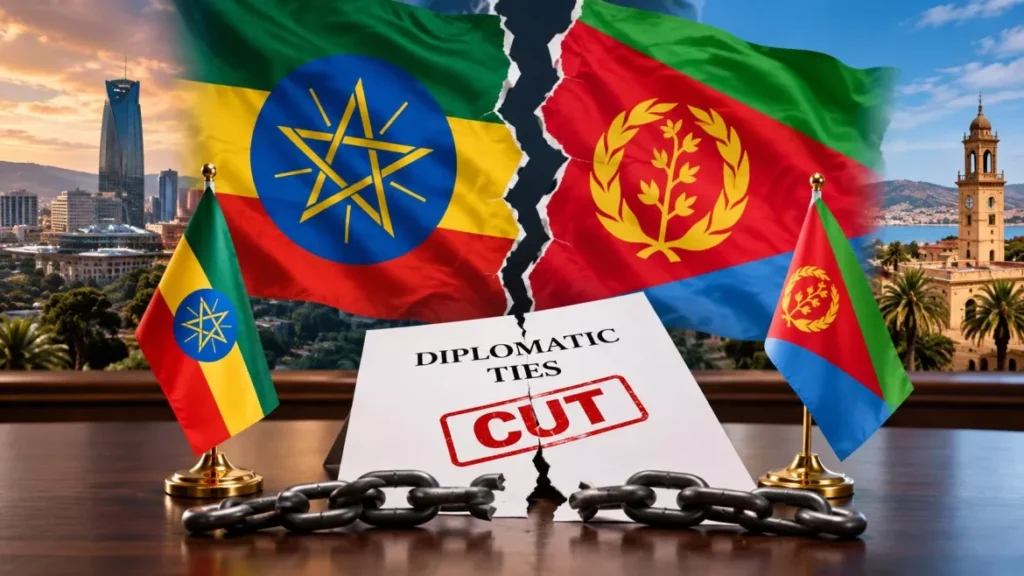

Ethiopia Eritrea diplomatic ties were severed on 1 October 2026, with each government acting within hours of the other. Ethiopia closed its embassy in Asmara and gave 10 Eritrean diplomats 48 hours to leave; Eritrea then cut relations entirely. Neither foreign ministry set out what the diplomats are alleged to have done.
What Each Government Announced, and When
The rupture happened in a single day through two separate announcements. The sequence below is drawn from the two foreign ministries’ statements as reported by Al Jazeera, Al-Monitor and the Ethiopian News Agency.
- Thursday 1 October 2026, Addis Ababa: Ethiopia’s Ministry of Foreign Affairs announced the closure of the Ethiopian embassy in Asmara and declared 10 Eritrean diplomats in Addis Ababa persona non grata, among them the charge d’affaires and staff accredited to the African Union.
- The same statement: The 10 were given 48 hours to leave Ethiopia.
- The same day: Ethiopia also declared one Egyptian diplomat persona non grata.
- Later on 1 October 2026, Asmara: Eritrea’s Ministry of Foreign Affairs said it would sever all diplomatic ties with Ethiopia.
- Late on 1 October 2026: The African Union Commission issued a statement urging restraint on Ethiopia, Eritrea and Egypt.
As of 3 October 2026, neither country has an operating embassy in the other’s capital, and no mediation process has been announced. “Persona non grata” is the formal term under the Vienna Convention on Diplomatic Relations, the 1961 treaty governing embassies, by which a host state declares a foreign diplomat unwelcome and requires them to leave; the host does not have to give reasons.
What Ethiopia Alleges, and What It Did Not Specify
Ethiopia’s stated reason was hostility by Eritrea, described in general terms. Its foreign ministry said the decisions were taken in response to Eritrea’s “direct and indirect acts of hostility and belligerence against Ethiopia,” and said the 10 diplomats had been involved in activities that “pose a direct threat to Ethiopia’s national security” in breach of the Vienna Convention.
The statement did not say what those activities were. Reporting by the Ethiopian News Agency, carried by allAfrica, noted that the ministry “did not specify the alleged activities or provide details of the incidents underlying the decisions.” No charges have been filed and no evidence has been published.
Separately, Ethiopia’s army chief has accused Eritrea, Sudan and Egypt of backing the armed groups fighting federal forces. Those are allegations by the Ethiopian military, not findings by any court or independent body.
Ethiopia’s ministry also kept conciliatory language in the same statement, saying the country continued to value its “strong historical, cultural, and people-to-people ties with Eritrea” and had prioritised peaceful coexistence and regional integration.
What Eritrea Says in Reply
Eritrea rejected the accusations and turned them around. Its foreign ministry said that “Eritrea has no option but to reciprocate in kind and sever all diplomatic ties with Ethiopia with all the negative corollaries that this entails,” in a statement posted on X and reported by Al Jazeera. It called Ethiopia’s accusations “astounding.”
Asmara’s counter-case has two parts. It says “it is Ethiopia which has been pursuing an agenda of incessant hostility,” and it accuses Addis Ababa of waging war to obtain access to the Red Sea. It also says Ethiopia hosts, trains and arms Eritrean opposition groups.
Eritrea’s government has not published evidence for those claims either, and Ethiopia denies them. The Eritrean Ministry of Information posted the ministry’s full press release on its state website, which was not reachable from outside the country at the time of writing.
Egypt Was Expelled on the Same Day
A third country was drawn into the same exchange. Ethiopia declared one Egyptian diplomat persona non grata on 1 October 2026, and Egypt reciprocated by declaring an Ethiopian embassy counsellor persona non grata.
Egypt’s foreign ministry called Ethiopia’s move “unfortunate” and said it was unjustified, adding that Cairo had “consistently rejected interference in the internal affairs of other countries”. Sudan and Egypt have both denied supporting the armed groups, as has Eritrea.
The Fighting That Preceded the Rupture
The diplomatic break followed roughly ten days of the heaviest fighting in northern Ethiopia since the 2020 to 2022 civil war. A coalition calling itself the Ethiopian Peoples’ Forces Alliance for Survival announced itself on 20 September 2026 and launched a large offensive on 23 September across Tigray, Afar and Amhara.
The composition of that coalition is itself disputed. Al Jazeera, citing the Armed Conflict Location & Event Data Project, a conflict monitor known as ACLED, reported that seven groups were named — including the Tigray People’s Liberation Front, the Amhara Fano National Movement and the Oromo Liberation Army — but that the Gumuz Peoples’ Democratic Movement denied joining, the Ogaden National Liberation Front was split, and only three of the groups were actively fighting federal forces as of 26 September 2026. The Sidama National Liberation Front was reported to have joined on 25 September.
On the ground, government-aligned forces claimed the capture of Alamata in southern Tigray on 28 September 2026 and the recapture of Sekota in the Wag Hemra zone on 27 September, according to Al Jazeera. ACLED recorded between 15 and 17 drone strikes on Alamata on 22 September 2026, including on schools and hospitals.
What Is Agreed, What Is Claimed, and What Is Unverified
Separating the three matters in this story, because much of what is circulating is a claim by one party. The table below reflects the position as of 3 October 2026.
| Status | Item |
|---|---|
| Agreed by both governments | Ethiopia closed its embassy in Asmara and expelled 10 Eritrean diplomats with a 48-hour deadline on 1 October 2026; Eritrea severed all diplomatic ties the same day. |
| Agreed | Eritrea was not a party to the November 2022 agreement that ended the previous war in Tigray. |
| Claimed by Ethiopia, denied | That Eritrea, Sudan and Egypt are backing the armed opposition alliance. All three deny it. |
| Claimed by Eritrea, denied | That Ethiopia is waging war for Red Sea access and arms Eritrean opposition groups. |
| Unverified | Reports of opposition drone strikes on targets in Addis Ababa, attributed to an opposition alliance representative. |
| Unverified | That Eritrean soldiers crossed into the Afar region, a claim made by a regional administrator. |
| Unverified | Territorial gains claimed by each side beyond the towns named above. |
No independent body has confirmed a casualty toll for the fighting that began on 23 September 2026. Estimates of the dead in the 2020 to 2022 war run into the hundreds of thousands, but there is no agreed official figure for it either.
Red Sea Access, the Dispute Underneath
Ethiopia is landlocked, and that is the long-running grievance beneath the current one. Ethiopia lost its coastline when Eritrea became independent in 1993 and has since argued that maritime access matters to its economy and security. Prime Minister Abiy Ahmed has repeatedly said Ethiopia has a right to sea access.
Eritrea reads those statements as a territorial threat. Reporting by Al Jazeera and Al-Monitor describes Asmara’s position as a fear that Ethiopia will try to take its Assab port by force. Ethiopia has previously said publicly that it does not intend to go to war over the issue.
None of this is settled. The border between the two countries, the subject of the 1998 to 2000 war, and the status of Assab are matters on which the two governments disagree, and no current process is adjudicating either.
What the African Union Said, and the Humanitarian Picture
The African Union asked all three governments to step back without taking a side. The African Union Commission said late on 1 October 2026 that it was “closely following with concern” developments involving the three member states, urged “maximum restraint,” and said it stood “ready, in consultation with the countries concerned, to support efforts towards de-escalation, dialogue and the peaceful resolution of differences.”
The United Nations has focused on access rather than attribution. The UN Office for the Coordination of Humanitarian Affairs said in a briefing on 25 September 2026 that the escalation “risks adding to already substantial humanitarian needs,” particularly for people already displaced by the earlier Tigray conflict. It reported a drone strike on a food assistance truck in north-western Tigray, road closures disrupting aid movements, armed groups seizing humanitarian vehicles in parts of Amhara, and phone and internet disruption in Tigray.
On displacement, the office said tens of thousands of people had fled their homes in the Afar region, citing preliminary findings from a government-led assessment, and that no verified figures were available for Tigray or Amhara. Aid operations in Tigray were described as near a standstill. Sudan’s own conflict next door remains unresolved, with a ceasefire plan there rejected by the army.
Frequently Asked Questions
Why Were Ethiopia Eritrea Diplomatic Ties Cut?
Ethiopia’s foreign ministry said on 1 October 2026 that it was acting against Eritrea’s “direct and indirect acts of hostility and belligerence,” and expelled 10 Eritrean diplomats. Eritrea then severed all ties, calling Ethiopia’s accusations astounding and saying Ethiopia is the hostile party. Neither ministry published details of the alleged conduct.
Are Ethiopia and Eritrea at War?
Neither government has declared war on the other as of 3 October 2026. The fighting in northern Ethiopia is between Ethiopian federal forces and a coalition of Ethiopian armed opposition groups; Ethiopia accuses Eritrea of backing them, and Eritrea denies it.
How Many Diplomats Were Expelled?
Ethiopia expelled 10 Eritrean diplomats, giving them 48 hours to leave, and separately expelled one Egyptian diplomat. Egypt expelled an Ethiopian embassy counsellor in response.
What Happened to the 2018 Peace Agreement?
Ethiopia and Eritrea normalised relations in 2018 under Abiy Ahmed, who was awarded the Nobel Peace Prize the following year, and Ethiopia reopened its embassy in Asmara. That embassy is the one Ethiopia closed on 1 October 2026.
Is Eritrea Part of the 2022 Tigray Peace Deal?
No. Eritrean forces fought alongside Ethiopia’s federal government during the 2020 to 2022 war, but Eritrea was not a party to the agreement that ended that fighting in November 2022.
What Has the African Union Done?
The African Union Commission issued a statement late on 1 October 2026 urging maximum restraint by Ethiopia, Eritrea and Egypt and offering to support de-escalation talks. It did not apportion blame and no mediation has been announced.