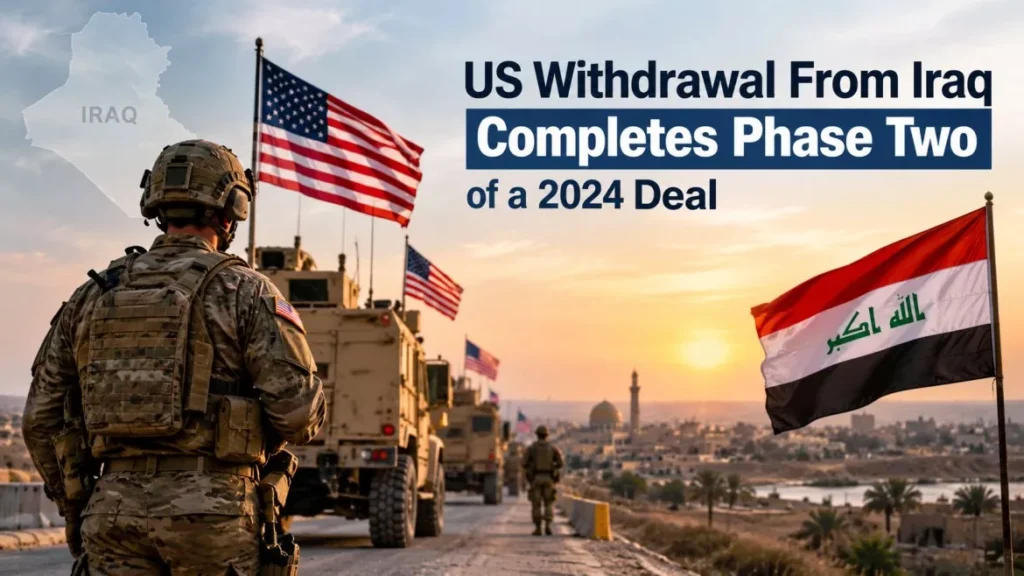

The US withdrawal from Iraq reaches its deadline on 30 September 2026, when the Global Coalition to Defeat ISIS ends its military mission there. Iraq’s government says all coalition bases in federal Iraq were handed over in January, leaving only the Kurdistan Region. Baghdad and Washington agreed the date in a September 2024 joint statement.
This concerns Iraq and the United States, and the wider coalition of states that joined the campaign against Islamic State. What ends is a specific multinational military mission. It is not a rupture in relations between the two governments, and both have said security cooperation continues in another form.
What Ends on 30 September and What Does Not
The thing that ends is the military mission of the Global Coalition to Defeat ISIS in Iraq, the multinational campaign formed in 2014 after Islamic State seized territory across Iraq and Syria. Several other arrangements are unaffected by the date.
- Ends: The coalition’s military mission in Iraq, including the presence of coalition combat and training units and the logistics platform used to support operations in Syria.
- Continues: Bilateral security partnerships between Iraq and individual coalition countries, which the 2024 joint statement named as the successor arrangement.
- Continues: The US-Iraq Strategic Framework Agreement, the 2008 treaty-level accord that governs political, economic and security ties.
- Continues: Diplomatic representation. The withdrawal covers military forces under the coalition mission, not embassies or diplomatic staff.
- Unresolved: Whether any US military personnel remain in Iraq outside the coalition structure. No figure has been announced.
Iraq’s government has framed the change as a transition rather than a severance. In its 2024 statement it committed to moving security relations with coalition countries onto a bilateral footing governed by political, economic and cultural ties.
The Two-Stage Agreement Behind the Date
The 30 September 2026 deadline is the second half of a schedule set nearly two years ago. The governments of the United States and Iraq issued a joint statement on 27 September 2024 setting out two stages.
| Stage | What it covered | End date |
|---|---|---|
| Stage one | The coalition’s military mission in federal Iraq | No later than end of September 2025 |
| Stage two | The coalition mission operating in Syria from a platform in Iraq | September 2026 |
The joint statement published by Iraq’s Ministry of Foreign Affairs described stage one as “concluding the Coalition’s military mission in Iraq over the next twelve months, and no later than the end of September 2025”, and said the mission “operating in Syria from a platform determined in the HMC will continue until September 2026”. The HMC is the Higher Military Commission, the joint US-Iraqi body created to manage the transition.
The same statement said the commission would set procedures “to ensure the physical protection of Coalition advisors” during the handover, and framed the whole process as “transitioning to bilateral security partnerships in a manner that supports Iraqi forces”.
Which Bases Have Already Been Handed Over
Most of the handover happened earlier in 2026, not this week. Iraqi authorities announced in January 2026 that the coalition had completed the evacuation of all military bases and leadership headquarters in federal Iraq, with those sites passing to the full control of Iraqi security forces.
Ain al-Asad air base in Anbar Province, the largest and most prominent of them, was vacated at that point. That announcement explicitly did not cover the semi-autonomous Kurdistan Region in the north, where coalition forces continued to operate from sites including Harir air base in Erbil province.
The National reported on 29 September 2026 that the hundreds of US troops remaining in the Kurdistan Region would have left by the deadline. Iraqi authorities have said no coalition combat or training units are expected to remain in the country after 30 September.
What Iraq’s Government Has Said
Iraqi Prime Minister Ali al-Zaidi set the date publicly on 12 August 2026, after meeting the commander of United States Central Command, Brad Cooper. A statement from his office said that “September 30 will be the fixed and final date” for ending the coalition’s military mission and completing the departure of its forces.
The statement added that “October 1 will mark a new day in the trajectory of the Iraqi state, as Iraq will be free of any foreign military presence”. Al-Zaidi had pressed for the deadline during a visit to Washington in July 2026.
His government has tied the withdrawal to a second objective: bringing non-state armed groups under state control. Iraq has pressed those groups to surrender weapons to the state by the same date, arguing that exclusive state control of weapons is a precondition for the next phase of the country’s development. Al Jazeera has reported that some Shia armed groups have defied the disarmament orders.
How the Withdrawal Is Being Read Inside Iraq and in Tehran
Assessments of the withdrawal differ sharply, and none of the following is an agreed reading of events. Each is the view of the person or body named.
- Iran’s parliament: Amir Hayat Moqaddam of the National Security Commission said Iran welcomes the withdrawal of American troops from Iraq.
- Iran-aligned armed groups: Abu Mojtaba al-Yasiri, described as a commander in the Islamic Resistance in Iraq, called the departure “a historic victory for the Iraqi Islamic resistance groups”.
- Iraqi security analysts: Jasim al-Bahadli argued Iran gains strategically because the exit removes a military presence that had acted as a counterweight to Tehran’s influence.
- Sunni figures: Abdulrahman al-Zobaie, a tribal leader in Fallujah, said “we believe Iraq is still not fully ready to take over the security file”. The politician Atheel al-Nujaifi warned that Islamic State “is not dead, and its cells are not as dormant as we reassure ourselves”.
- Kurdish officials: One told The National that “the political, security and military situation in Iraq has not yet reached a level of stability that would justify such a withdrawal”. The Kurdish commander Sirwan Barzani has reported movement by Islamic State sleeper cells since the withdrawal was announced.
The Iraqi government’s own position is that its forces are ready. It has not published an assessment supporting or contradicting the warnings above, and no independent body has verified the claims about sleeper-cell activity.
Islamic State has continued to mount attacks at a low level through 2026. The group claimed a roadside bomb attack on an Iraqi military patrol near the Tigris on 4 May 2026, which injured one soldier, and Iraqi forces have conducted repeated air strikes on suspected hideouts in Nineveh and Kirkuk governorates during the year.
What Is Still Undecided
Several questions remain open as of 29 September 2026, and the answers are not in any published agreement.
- Residual US presence: Whether US troops will remain in federal Iraq outside the coalition, how many and where, has not been announced.
- Terms of the bilateral framework: The 2024 statement named bilateral security partnerships as the successor arrangement but did not set out their scope, duration or force levels. Those details have not been published.
- Support for operations in Syria: The Iraq-based platform that supported coalition operations in Syria closes with the mission. What replaces it has not been set out.
- Islamic State detainees: More than 5,700 Islamic State prisoners were transferred from Syria to Iraqi custody during 2026, according to a Congressional Research Service report updated in June 2026. Arrangements for continued cooperation on holding them have not been detailed publicly.
- Disarmament: Whether armed groups outside state control will surrender weapons by the deadline is unresolved.
The Scale of What Is Ending
The United States first deployed forces to Iraq in the 2003 invasion. The Associated Press reported on 29 September 2026 that about 4,500 Americans died over the more than two decades of military presence that followed. That figure has not been independently confirmed here against an official casualty register.
The coalition mission itself is younger. It was created in 2014, when Islamic State captured large areas of northern and western Iraq, and its purpose was to support Iraqi forces in retaking that territory rather than to occupy the country. Iraq declared military victory over the group’s territorial control in December 2017; the mission continued in an advisory and enabling role after that.
Seven US service members were killed in Iraq during the 2026 conflict involving Iran, according to the Associated Press, the most recent an army sergeant killed by a drone detonation near Erbil in July 2026. The regional picture around Iraq remains unsettled, with US and Iranian officials giving differing accounts of talks held at the United Nations in September 2026 and shipping through the Strait of Hormuz still far below normal levels.
Frequently Asked Questions
When Does the US Withdrawal From Iraq Take Effect?
30 September 2026 is the date the Global Coalition to Defeat ISIS ends its military mission in Iraq. Iraq’s prime minister called it “fixed and final” in a statement on 12 August 2026.
Are All American Forces Leaving Iraq?
Coalition combat and training units are leaving, and Iraqi authorities say none are expected to remain after 30 September 2026. Whether any US personnel stay in Iraq outside the coalition structure has not been announced by either government.
Why Is the US Withdrawal From Iraq Happening Now?
The United States and Iraq agreed the timetable in a joint statement on 27 September 2024. It set two stages: the coalition mission in federal Iraq ending by September 2025, and the Syria-support mission based in Iraq ending in September 2026.
Does the Withdrawal End US-Iraq Security Cooperation?
No. The 2024 joint statement described the transition as moving to bilateral security partnerships, and the US-Iraq Strategic Framework Agreement remains in force. The terms of those bilateral arrangements have not been published.
What Do Critics Say About the Timing?
Kurdish officials and some Sunni politicians quoted by The National and the Associated Press say Iraq is not yet stable enough and that Islamic State cells remain active. Iran’s parliament and Iran-aligned armed groups have welcomed the departure. Iraq’s government maintains its forces are ready.