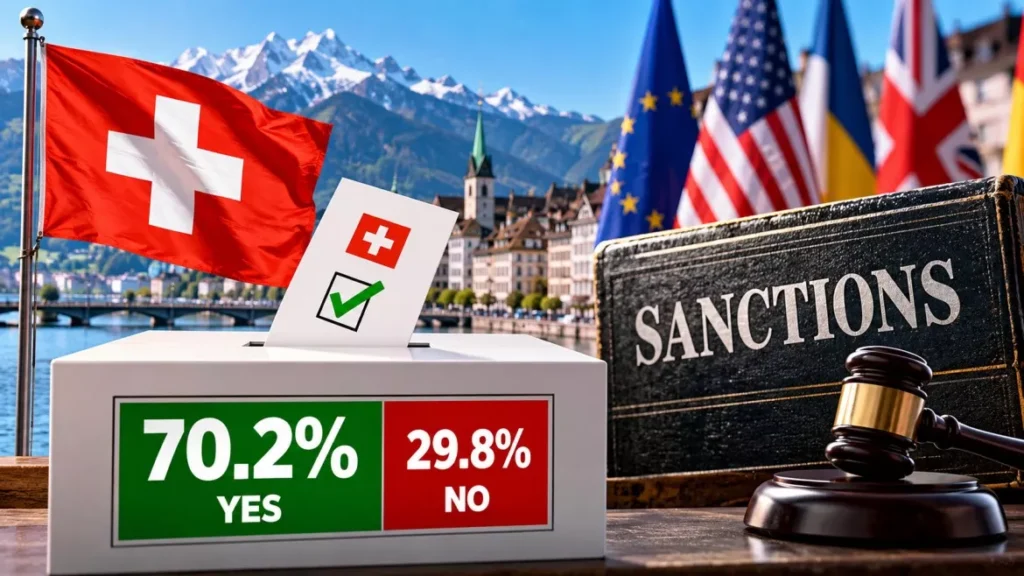

The Swiss neutrality vote ended in defeat for the initiative on Sunday 27 September 2026, with 70.2% voting No. All 26 cantons rejected it, on turnout of about 47%, according to Swiss public broadcaster SRF. The proposal would have barred Switzerland from imposing sanctions the United Nations had not approved.
The Swiss Neutrality Vote in Numbers
The margin was wider than campaign polling had suggested, and the defeat was uniform across the country. These are the headline figures from the count.
| Measure | Result |
|---|---|
| No | 70.2% |
| Yes | 29.8% |
| Cantons in favour | 0 of 26 |
| Communes in favour | 149 of 2,105 |
| Turnout | about 47% |
Al Jazeera reported the figure as about 70% against, citing final results from the Federal Statistical Office. SRF put the count at 70.2% No to 29.8% Yes. Switzerland’s system requires a double majority for a constitutional initiative — a majority of voters and a majority of cantons — and this proposal secured neither.
How the Cantons Split
No canton came close to approving the text, but the spread between them was wide. Basel-Stadt gave the firmest No; Ticino, the Italian-speaking canton on the southern border, came nearest to a Yes and still rejected it.
- Basel-Stadt: 79.9% No, the strongest rejection of any canton.
- Ticino: 51.8% No, the narrowest margin in the country.
- All other cantons: No majorities between those two figures.
Only 149 of Switzerland’s 2,105 communes returned a Yes majority, about 7% of them, on SRF’s tally of the results.
What the Initiative Would Have Changed
The initiative was a federal popular initiative titled “Safeguard Swiss neutrality”, which would have written a fixed definition of neutrality into the federal constitution. A popular initiative in Switzerland is a citizens’ proposal that reaches a national ballot once it collects enough valid signatures.
The federal government’s own summary of the initiative said the text sought to enshrine neutrality as “perpetual and armed”. In practice it would have replaced a policy the government interprets case by case with a constitutional rule.
| Question | Current practice | Under the initiative |
|---|---|---|
| Military alliances | No membership, but peacetime cooperation permitted | Membership and cooperation barred unless Switzerland is attacked or under imminent threat of attack |
| Sanctions on a country at war | Government may adopt them, including measures mirroring the European Union | Only sanctions mandated by the United Nations |
| Where the rule sits | Policy, set by the Federal Council and parliament | Federal constitution |
The Federal Council, Switzerland’s seven-member executive, opposed the initiative, saying it rejected a rigid interpretation of neutrality and preferred to keep established practice. Parliament and every major party except the Swiss People’s Party also campaigned against it.
Why Sanctions Were the Argument That Mattered
The sanctions clause is what gave the vote its international weight. Switzerland has largely adopted European Union sanctions against Russia since the full-scale invasion of Ukraine in February 2022, a decision that drew criticism both from Moscow and from supporters of stricter neutrality at home.
Had the initiative passed, Switzerland could only have imposed sanctions mandated by the United Nations. Russia holds a permanent seat on the United Nations Security Council and therefore a veto, so measures aimed at Russia would not clear that body. Critics of the text said this was its practical effect; its backers framed the proposal as keeping Switzerland out of other countries’ wars, campaigning under the slogan “No to war”.
Voting arithmetic in the Security Council shapes several current disputes, including the Iran referral that passed by 23 votes to 3 earlier this month.
Who Ran the Campaign, and What It Cost
The initiative was organised by the group Pro Schweiz and backed by the Swiss People’s Party, the largest party in the federal parliament. Its most prominent figure was Christoph Blocher, the 85-year-old former party leader and industrialist.
Reported spending figures differ, and they measure different things. Euronews put Blocher’s personal contribution at 3.8 million Swiss francs — about $4.8 million — and described it as the largest individual contribution to a Swiss referendum campaign. SWI swissinfo.ch reported approximately 3.9 million francs. Speaking to SRF, Urs Bieri of the polling institute gfs.bern said the campaign as a whole spent more than 5.5 million francs, and argued the result showed that money alone does not carry an initiative without the coalitions and momentum to go with it.
What the Result Leaves in Place, and What It Did Not Decide
As of Sunday 27 September 2026, the Swiss constitution is unchanged. Neutrality remains a policy the Federal Council and parliament interpret, not a fixed constitutional formula, and the government keeps the two powers the initiative would have removed: the ability to adopt sanctions without a United Nations mandate, and the ability to cooperate with military alliances in peacetime. Switzerland participates in the European Sky Shield Initiative, a joint European air-defence procurement programme, and is not a member of NATO.
Foreign Minister Ignazio Cassis told reporters that Switzerland was neutral yesterday, is neutral today and will remain so, framing the result as continuity rather than change. Susanne Vincenz-Stauffacher, a parliamentarian who opposed the text, said a rigid definition would no longer have allowed an adequate response to a given situation.
Several questions were not on the ballot and remain open. The vote did not decide whether Switzerland joins any alliance, does not alter its relationship with the European Union, and sets no rule for future sanctions decisions, which stay with the government case by case. The Swiss People’s Party has accepted the defeat and said it has no further action planned for now.
The Other Question on the Same Ballot
Voters decided a second federal initiative the same day, on food supply. The text, on food security through more sustainable domestic production, more plant-based food and clean drinking water, would have required Switzerland to cover 70% of domestic food consumption from Swiss production and to shift farming towards plant-based output.
It was rejected by 72.5% to 27.5%, with no canton in favour. Schwyz recorded the strongest No at 81% and Geneva the weakest at 62.6%.
Frequently Asked Questions
What Was the Result of the Swiss Neutrality Vote?
The initiative was rejected on 27 September 2026 by 70.2% to 29.8%, with all 26 cantons voting No and turnout of about 47%, according to SRF.
What Would the Neutrality Initiative Have Banned?
It would have written “perpetual and armed” neutrality into the Swiss constitution, barred membership of and cooperation with military alliances unless Switzerland were attacked, and limited sanctions to those mandated by the United Nations.
Does Switzerland Still Apply Sanctions on Russia?
Yes. The result leaves the Federal Council’s existing power intact, and Switzerland has largely mirrored European Union sanctions against Russia since February 2022. Any future change would be a government decision, not a constitutional one.
Is Switzerland Joining NATO?
No. NATO membership was not on the ballot and Switzerland is not a member. It does take part in the European Sky Shield Initiative, a joint air-defence procurement programme.
Who Was Behind the Initiative?
The group Pro Schweiz launched it, with the backing of the Swiss People’s Party. Christoph Blocher, the party’s former leader, was its most prominent financial backer.