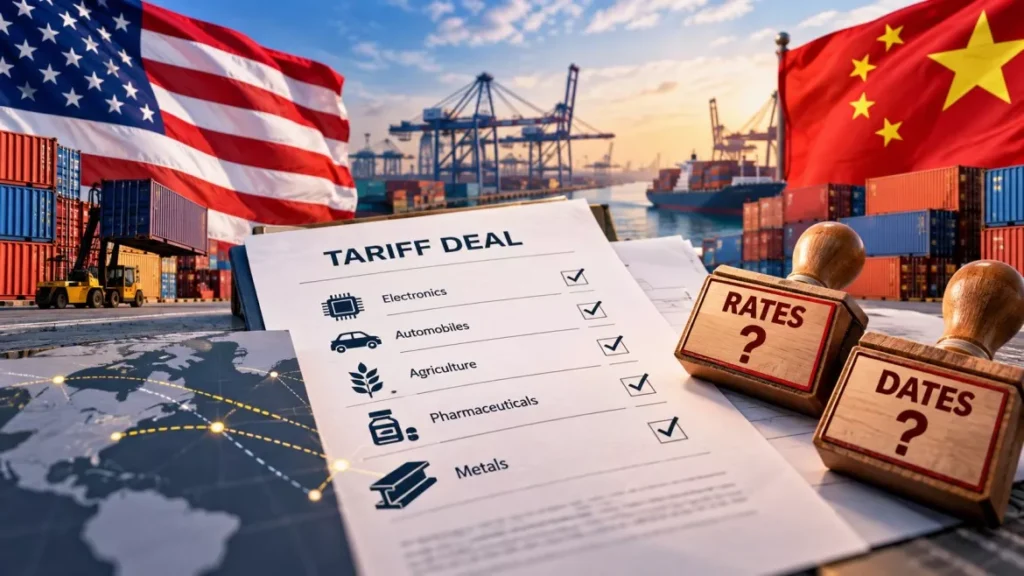

The US China tariff deal announced after Xi Jinping’s state visit covers $30 billion of goods in each direction. The White House published the goods lists on 26 September 2026 but named no tariff rate and no start date. Trade Representative Jamieson Greer said more detail would follow on Monday.
What the White House Text Actually Says
The operative sentence is narrower than the headlines it produced. The two governments “reached consensus on recommendations for more favorable tariff treatment for $30 billion of non-sensitive goods in each direction”, according to the White House fact sheet issued after the visit.
A recommendation is not a tariff schedule. The document does not give a percentage, an effective date, or the tariff codes that customs authorities would need to apply a change. Greer, the United States Trade Representative, told CNBC on 25 September 2026 that more details were coming, and the administration had not published them as of 27 September.
Which Goods Are on Each List
The fact sheet names broad product families rather than tariff lines. These are the categories each side put forward.
| Direction | Goods named |
|---|---|
| US exports into China | Agricultural goods, fish and seafood, logs and wood products, cosmetics, medical devices |
| Chinese exports into the US | Small appliances, toys, holiday decorations, children’s car seats |
Both lists are consumer-facing rather than strategic, which is what “non-sensitive” signals: semiconductors, advanced manufacturing equipment and defence-adjacent goods are absent from both. The American list leans toward farm and resource exports; the Chinese list is dominated by household goods that arrive in volume before the end-of-year retail season.
Tariffs are paid by the importer of record in the destination country, not by the exporting country, so any reduction reaches shoppers only if importers and retailers pass it along. The same mechanism was visible in Canada’s counter-tariff programme, where the cost fell on Canadian importers.
Where Beijing’s Account and Washington’s Differ
China published its own summary of the summit through Xinhua, the state news agency, on 26 September 2026, listing eight outcomes. The two texts overlap on the trade mechanism, the $30 billion figure, the truce extension and the technology dialogue, and diverge elsewhere.
- In the American text only: the named goods categories, the coal commitment, concerns over rare earths and critical-minerals supply chains, and discussion of Russia and North Korea.
- In the Chinese text only: a military memorandum of understanding on crisis communication, and cooperation on searching for the remains of American service personnel in China.
- In both: the bilateral economic and trade consultation mechanism, the $30 billion tariff item, the truce extension, and an artificial intelligence dialogue with a further round in November.
The coal line is the sharpest gap. The White House says “China will import at least 10 million metric tons of coal from the United States in 2027 and again 2028”. Beijing’s list of eight outcomes does not mention coal at all. That is an American account of a Chinese commitment, and it has not been confirmed in Chinese official text.
The Tariffs That Are in Force Right Now
Nothing announced this week has changed what importers pay today. As of 27 September 2026, the truce terms still apply: United States tariffs on Chinese goods stand at 30%, and Chinese tariffs on American goods at 10%.
Those rates sit far below the escalation peak of April 2025, when American duties reached 145% and Chinese duties up to 125%. Treasury Secretary Scott Bessent said on 24 September 2026, as Xi arrived, that the truce had been extended by two months. It had been due to lapse on 10 November 2026 and now runs to 10 January 2027, preserving both the lower tariffs and the limits on China’s rare-earth export controls.
The Machinery the Summit Created
The durable outcome may be institutional rather than numerical. The White House says the visit “operationalized the cornerstone government-to-government mechanisms of the U.S.-China Board of Trade”, the standing body that produced the $30 billion recommendation and that is meant to handle future reductions and disputes.
The second mechanism is a technology channel. The fact sheet says the two governments “established the U.S.-China Super Intelligence (SI) Dialogue to exchange views on risks and benefits”, with the next exchange due by November 2026. The naming is deliberate: the White House noted both sides settled on “super intelligence” rather than “artificial intelligence”. It follows the separate US-China AI hotline proposal reported earlier in September.
What Is Still Unresolved
Several things the summit was expected to address were not settled in either text.
- Rare earths: the American side recorded continuing supply-chain concerns; the truce extension holds existing export-control limits in place but no new arrangement was announced.
- The tariff rates themselves: neither the reduction percentages nor the customs codes have been published.
- The truce beyond January: 10 January 2027 is an extension, not a settlement, and the underlying tariff levels revert unless renewed again.
- The coal purchase: confirmed by Washington, absent from Beijing’s account.
The next fixed dates are the promised American detail release, the Super Intelligence Dialogue round by November 2026, the APEC summit in Shenzhen in November and the G20 in Miami in December, both of which Beijing’s list says the two sides agreed to support.
US China Tariff Deal: Frequently Asked Questions
Have Tariffs Actually Been Cut?
Not yet. The White House fact sheet of 26 September 2026 describes consensus on recommendations for more favourable treatment of $30 billion of goods each way. No new rate or effective date had been published as of 27 September 2026.
Which Products Are Covered?
On the American export side: agricultural goods, fish and seafood, logs and wood products, cosmetics and medical devices. On the Chinese export side: small appliances, toys, holiday decorations and children’s car seats. The fact sheet names categories, not tariff codes.
What Tariff Rates Apply Between the US and China Today?
Under the truce as of 27 September 2026, the United States applies 30% to Chinese goods and China applies 10% to American goods. Those figures are unchanged by this week’s announcement.
When Does the Trade Truce Expire?
10 January 2027. Treasury Secretary Scott Bessent said on 24 September 2026 that the previous 10 November 2026 deadline had been pushed back by two months.
Did China Agree to Buy American Coal?
The White House says China will import at least 10 million metric tons of United States coal in 2027 and again in 2028. China’s own summary of the summit, published by Xinhua on 26 September 2026, does not mention coal.
What Is the US-China Super Intelligence Dialogue?
A new bilateral channel for discussing the risks and benefits of advanced AI systems, including communication over incidents. The White House says the next exchange is due by November 2026.