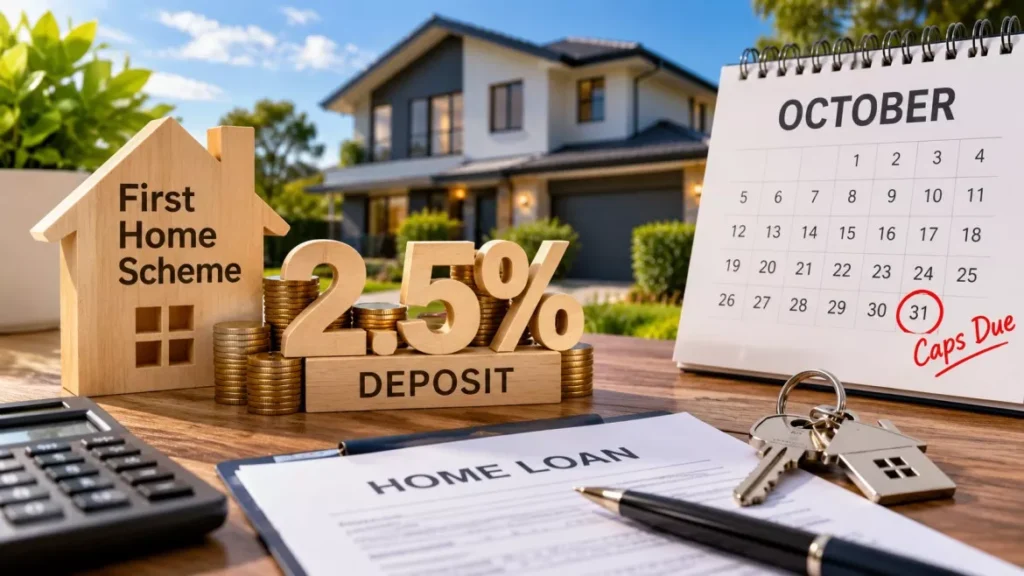

The UK government will launch the Your First Home scheme, an equity loan for first-time buyers in England who have a 2.5% deposit. Prime Minister Andy Burnham announced it on 26 September 2026 at the Labour conference in Liverpool. Chancellor John Healey will set the eligibility caps at the 28 October Budget.
What the Government Has Actually Confirmed
The published announcement is short, and it commits to five things. Everything else was left to the Budget.
- The deposit: buyers need 2.5% of the purchase price.
- The loan: the government provides an equity loan worth 20% of the property’s value. An equity loan is money advanced against a share of the home rather than a conventional mortgage, and it carries no monthly interest during an introductory period.
- The property: it must be a new-build bought from a developer signed up to the scheme.
- The developer’s side of the bargain: the Ministry of Housing, Communities and Local Government says “developers will be expected to make a contribution when signing up to the scheme to help cover costs”.
- The limits, in principle: the scheme “will also set a household income cap with local property price caps to further ensure support is targeted at those who need it, the detail of which will be set out at Budget”, according to the government’s announcement.
As of 27 September 2026, no scheme guidance has been published on GOV.UK. The government says the scheme will be funded by reprioritising existing departmental budgets, and that pre-registration will open by the end of 2026. It applies to England only; housing policy is devolved, so Scotland, Wales and Northern Ireland run their own programmes and are not covered.
What Has Been Reported but Not Confirmed
Several numbers circulating on Saturday come from news agency reporting, not from the government’s own release. They matter, and buyers should treat them as provisional until the Budget.
| Term | Status | What has been said |
|---|---|---|
| Maximum property price | Not in the government release | Reuters reported a £600,000 ceiling, the same cap the old Help to Buy scheme used |
| Length of the interest-free period | Not in the government release | Reuters reported five years; the release says only “an initial interest free period” |
| When the loan must be repaid | Not in the government release | Reuters reported repayment in full on sale, within 25 years, or in line with the main mortgage |
| Size of the main mortgage | Not in the government release | Reuters reported 75% of value; the confirmed percentages leave 77.5% to be covered |
| Household income cap | Confirmed in principle, figure unset | To be set at the Budget |
| Local property price caps | Confirmed in principle, figures unset | To be set at the Budget |
The mortgage figure is worth pausing on. A 2.5% deposit and a 20% equity loan together cover 22.5% of the price, which leaves 77.5% for the mortgage. A 75% mortgage would leave a 2.5% shortfall. The government has not published which figure is right, and the difference decides whether a buyer needs to find more cash.
How a 20% Equity Loan Changes What You Owe
An equity loan is not a second mortgage with a fixed balance. Under Help to Buy, the scheme this one revives, the amount repaid was a percentage of the property’s value on the day it was repaid, not the number of pounds originally advanced.
That cuts both ways. If a home bought for £250,000 with a 20% loan later sells for £300,000, the 20% share is worth £60,000 rather than the £50,000 advanced. If it sells for £220,000, the share is worth £44,000. The government has not yet published whether Your First Home will use the same rule, and that is one of the terms the Budget has to settle.
On the two percentages that are confirmed, the arithmetic at different price points looks like this.
| Purchase price | 2.5% deposit | 20% equity loan | Balance to finance |
|---|---|---|---|
| £200,000 | £5,000 | £40,000 | £155,000 |
| £250,000 | £6,250 | £50,000 | £193,750 |
| £300,000 | £7,500 | £60,000 | £232,500 |
| £400,000 | £10,000 | £80,000 | £310,000 |
These are illustrations calculated from the confirmed 2.5% and 20% figures, not quoted offers. The government’s own claim is that using the scheme “could save hundreds of pounds per month compared to a 95% mortgage”, because the borrower carries a smaller interest-bearing debt during the interest-free window.
Your First Home Is Not the Same as First Homes
England already runs a scheme called First Homes, and the two are easy to confuse. First Homes sells new-build properties at a discount of at least 30% off market value, with that discount permanently attached to the property and passed on to the next buyer. It carries an income limit of £80,000, or £90,000 in London.
Your First Home is a different instrument: there is no discount, the buyer pays full price, and the government takes a repayable stake instead. Nothing in Saturday’s announcement said what happens to First Homes.
What Help to Buy Did Before It Closed
Help to Buy: Equity Loan ran from 2013 and closed to new applicants in 2022. It asked for a 5% deposit against a government loan of up to 20%, or up to 40% in London.
Press Association reporting on Saturday put its record at more than 300,000 buyers and roughly 15% of new-build sales between 2013 and 2023, with an estimated £25 billion of social value against about £3 billion of net public cost. Your First Home halves the deposit requirement to 2.5% while keeping the 20% loan.
What Builders and the Opposition Said
Reaction split along predictable lines, and the housebuilding industry welcomed it first.
Neil Jefferson, chief executive of the Home Builders Federation, said the group welcomed “the Government’s announcement today and its recognition of the significant challenges facing first-time buyers”. Angela Rayner, the Housing Secretary, said “we’ve seen too many people priced out and giving up on the dream of ever having a home to call their own”. Burnham framed the announcement the same way, saying too many young people were “giving up hope of ever having a home to call their own”.
Katie Lam, the Conservative shadow housing secretary, called the policy a “colossal admission of failure” and said the government was “making homes harder to build, then asking buyers to borrow more to pay for them”. Charlie Lamdin of the estate agency platform BestAgent described it as “shameless populist vote-grabbing” and warned that buyers entering with a 2.5% deposit risk negative equity, the position where a property is worth less than the debt secured on it.
Your First Home Scheme: Frequently Asked Questions
When Does the Your First Home Scheme Start?
The government says pre-registration will open by the end of 2026, with full terms set out at the Budget on 28 October 2026. No date has been given for when purchases can complete.
Where Does the Scheme Apply?
England only. Housing is a devolved matter, so buyers in Scotland, Wales and Northern Ireland are not covered and would need to look at their own administrations’ programmes.
Is There an Income Limit?
The government has confirmed there will be a household income cap and local property price caps, but has not published the figures. Those are due at the 28 October Budget.
Does the Scheme Cover Older Houses?
No. The announcement limits it to new-build homes bought from a developer that has signed up to the scheme.
How Much Does the Government Loan Cost?
The equity loan carries no interest during an initial period. The government has not said how long that period lasts or what rate applies afterwards; Reuters reported five years, which matches the old Help to Buy terms.