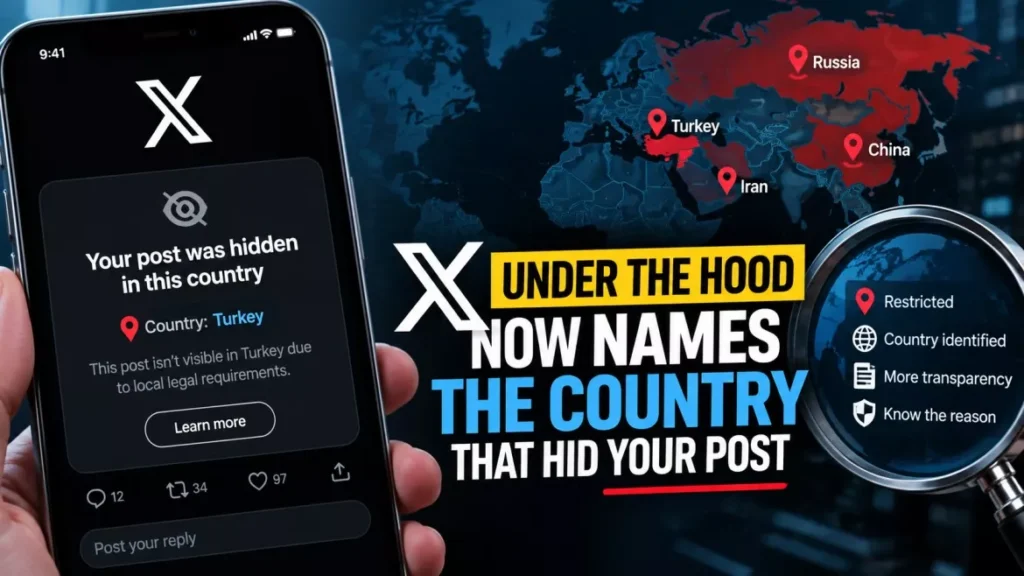

X Under the Hood, the transparency page on Elon Musk’s social network, now tells users when a government forced their posts out of sight. The expansion was announced on 19 September 2026 and reports which posts were withheld in a country and which country demanded it. The page remains a pilot with eligibility limits.
What X Under the Hood Now Shows
The new entries cover legal compliance rather than rule enforcement. Where X has downranked an account or withheld a post to satisfy a local law or a government demand, the report now records three things it did not record before:
- That the restriction happened: whether visibility was reduced for legal compliance rather than for breaking X’s own rules.
- Which posts: the specific posts withheld in a country following a legal demand.
- Which country: the government that made the request.
X’s Open Source account, which made the announcement, said: “We’ve expanded Under The Hood after seeing people’s appreciation of more transparency into government-required content filtering.” The company has not said how many accounts the new entries will apply to, or how far back the records reach.
How to Check Your Own Account
The report is a file you download, not a notification that arrives.
- Open the Under the Hood page at x.com/i/under_the_hood, or find Under the Hood in the app’s settings.
- Request the aggregate report for your account.
- Download the file, which arrives as JSON, a plain-text data format.
- Read the entries for labels applied to your account or your posts, and for any legal-compliance restrictions with a country attached.
The report covers the past calendar month only. Engadget noted that the JSON export is dense and unintuitive for a general reader; X has not published a plain-language version of the report.
Who Can Use It
As of 22 September 2026, Under the Hood is still a pilot, and two conditions decide whether it opens for you.
- Account age: the account must be more than one year old.
- Activity: the account must have posted at least ten times in the previous month.
X has not said when the pilot will widen or whether the requirements will be dropped. Accounts that fail either test see nothing, which is not the same as an account with nothing to see.
What the Report Cannot Tell You
This is the limitation that matters most, and X has not addressed it. The tool can only disclose what the ordering government allows X to disclose. Where a country’s law makes blocking orders secret, a restriction can exist without appearing anywhere in the report.
India is the documented case. Reporting by Medianama sets out that Rule 16 of India’s Information Technology (Procedure and Safeguards for Blocking for Access of Information by Public) Rules, 2009 requires that “strict confidentiality shall be maintained regarding all the requests and complaints received and actions taken thereof.” Orders issued under Section 69A of the Information Technology Act, 2000 fall under that rule. Naming the accounts actioned, or even confirming an order exists, would breach it. Medianama reported that no India filter appears in X’s public repository, and that the Indian government said on 18 August 2026 that X “will have to comply with Indian law”.
The practical consequence for a user anywhere is simple: an empty Under the Hood report is evidence that X recorded no disclosable restriction, not proof that no government acted. The same logic applies to any jurisdiction with a confidentiality rule attached to takedown orders. Platform disclosures carry limits of this kind routinely, as our report on the Meta Oversight Board deepfake ruling set out in a different context.
The Brazil Filter Anyone Can Read
Where the law permits disclosure, X has gone further than a report entry. Its public algorithm repository contains a filter file for Brazil’s 2026 election that anyone can open and read.
The file cites its legal basis directly: Art. 28 § 1º-A of Electoral Resolution No. 23.610, which requires providers using a recommendation system to exclude from results the channels and profiles reported to Brazil’s Electoral Court. The filter holds a static list of several hundred candidate account IDs reported to the court. Posts from those accounts are removed from recommendations, with an exception written into the regulation for paid promotion. The code also flags accounts the maintainers believe are not the real candidates and therefore did not filter.
That file is the clearest illustration of the gap. Brazil’s order is readable line by line. An order from a country with a secrecy rule produces no file and no report entry.
Where Under the Hood Came From
The page launched on 13 August 2026, when X open-sourced the ranking code behind the For You timeline in a repository published under the Apache 2.0 licence. TechCrunch reported that the release made the public codebase ten to fifteen times larger than before, and quoted Keith Coleman, X’s vice-president of product, saying users “can see the systems that filter out potentially problematic, rule-violating content” and can run some of them outside the company.
Parts stay closed. According to the same report, X withheld the systems that use Grok to predict rule violations, on the grounds that publishing them would help spammers evade enforcement, and it does not publish per-post scoring parameters. Those exclusions were set at launch and the 19 September expansion did not change them.
Frequently Asked Questions
Where Do I Find X Under the Hood?
It is at x.com/i/under_the_hood, and also reachable from the Under the Hood entry in the app’s settings. The report downloads as a JSON file covering the past calendar month.
Who Is Eligible for the Tool?
The pilot is open to accounts more than one year old that have posted at least ten times in the previous month. X has not said when it will widen access.
Does It Name the Government That Ordered a Takedown?
Yes, where X is permitted to disclose it. Since 19 September 2026 the report lists the posts withheld in a country under a legal demand and identifies the country that made the request.
Will It Show Every Restriction on My Account?
No. Where a country’s law requires blocking orders to stay confidential, X cannot record them in the report. An empty report means no disclosable restriction was logged, not that no government acted.
Can I See the Code Behind These Restrictions?
Sometimes. X publishes its For You ranking code, including a readable filter implementing Brazil’s 2026 election rules. It does not publish the Grok-based rule-violation systems or per-post scoring parameters.