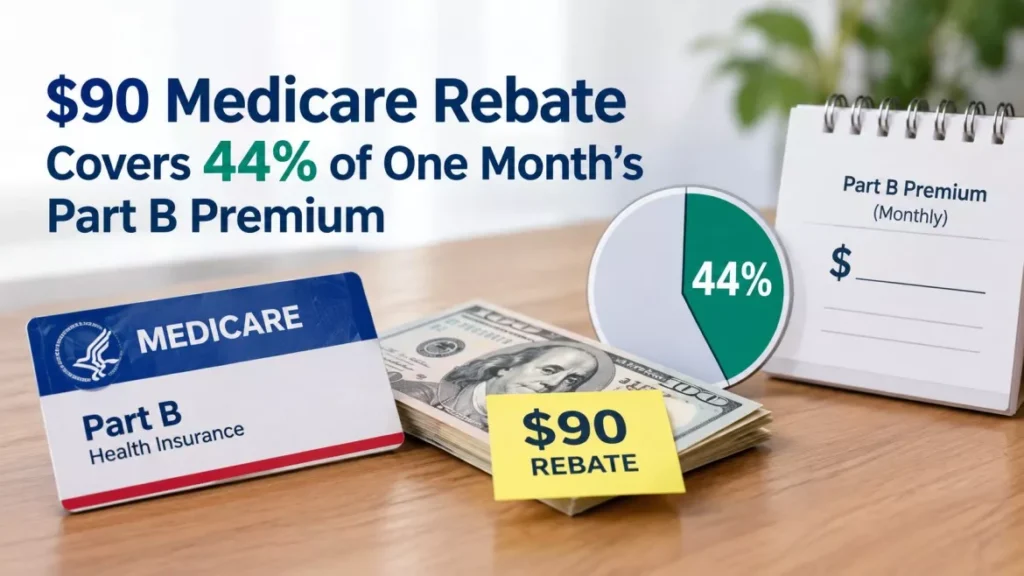

The $90 Medicare rebate is reaching 20.8 million people enrolled in Original Medicare Part B in the United States. The Centers for Medicare and Medicaid Services began direct deposits on or around 8 October 2026, with paper Treasury cheques following later in the month. It is a one-time payment, not a recurring one.
What the Payment Is and Where the Money Comes From
It is a single $90 payment described by the agency as a premium rebate, drawn from the Medicare Improvement Fund. The programme costs about $2 billion, according to Associated Press reporting published on 7 October 2026.
The Centers for Medicare and Medicaid Services, the United States federal agency that administers Medicare, says the fund was created by Section 7002 of the Supplemental Appropriations Act of 2008 “to make improvements under the original fee-for-service program”. The Associated Press reported that the fund had previously been drawn on for about $20 billion under the Affordable Care Act, and that this is the first time it has been used to pay beneficiaries directly.
The word rebate is doing some work here. The payment is not a refund of premiums anyone overpaid, and it does not change the premium itself. President Donald Trump announced the payments; the schedule falls ahead of United States midterm elections on 3 November.
Who Qualifies, and the Wording CMS Has Left Open
Eligibility is automatic. No application is required, and the agency’s own frequently asked questions page sets out the conditions.
- Enrolment: the person must be enrolled in Original Medicare Part B.
- Residence: the person must live in the United States.
- Medicaid premium assistance: the person must not be receiving it.
- Income-related surcharge: the person must not be paying an Income-Related Monthly Adjustment Amount, the higher premium charged above certain income levels.
- Medicare Advantage: excluded outright. The agency’s page states that “Beneficiaries enrolled in Medicare Advantage are not eligible.”
There is an unresolved detail that the secondary coverage has smoothed over. Every consumer explainer renders the last two conditions as a pair that must both be satisfied, but the agency’s own page joins them with “or” rather than “and”. On the broader “or” reading, someone paying the income surcharge could still qualify provided they receive no Medicaid premium assistance. The agency has not published a clarification, and anyone who wants their own status confirmed should call 1-800-MEDICARE on 1-800-633-4227 rather than rely on a published summary.
Terms differ by individual circumstance, and enrolment in Part B on its own does not establish eligibility.
How the $90 Compares With the Premium It Offsets
The agency labels the paper cheques “Medicare Improvement Fund Payment; $90 Payment to Offset October Premium”, which invites the comparison.
| Item (United States, 2026) | Amount |
|---|---|
| One-time rebate | $90 |
| Standard monthly Part B premium | $202.90 |
| Share of one month’s standard premium the rebate covers | About 44% |
| Annual Part B deductible | $283 |
| Standard monthly premium in 2025 | $185.00 |
The premium and deductible figures come from the agency’s 2026 Parts A and B fact sheet published on 14 November 2025. The 44% share is arithmetic on those two published numbers, not a figure the agency has stated.
The standard premium is what someone pays if no income surcharge applies. Above a modified adjusted gross income of $109,000 for an individual or $218,000 for a couple filing jointly, the surcharge raises the monthly total, and those payers are among the people the rebate does not reach. The standard premium for 2027 has not been announced; the Medicare trustees projected $209.50 in their June 2026 report, which remains a projection. Our report on the 2027 Social Security increase covers that open question.
When and How the Money Arrives
The sequence the agency published runs as follows.
- On or around 8 October 2026: most eligible beneficiaries receive the $90 by direct deposit from the Social Security Administration.
- Mid-October 2026: an email or letter from the President follows the payment.
- From 15 October 2026: beneficiaries can check payment status by calling the Social Security Administration on 1-800-772-1213.
- Later in October 2026: beneficiaries without direct deposit are mailed a paper Treasury cheque to the address registered with Medicare.
As of 19 October 2026, the paper cheque phase is still running and the agency has published no deadline, and no remedy for anyone who does not receive a payment they believe they are owed. The status line is the official channel for that question.
Who the Rebate Does Not Reach
Fewer than one in three Medicare beneficiaries qualify, which is the single most searched aspect of the payment.
- Medicare Advantage enrollees: about 35 million people, more than half of the 64.2 million Medicare beneficiaries, according to KFF figures cited by the Associated Press.
- Recipients of Medicaid premium assistance: about 12 million lower-income older adults and people with disabilities.
- Income-surcharge payers: not separately counted in the reporting reviewed here.
- Beneficiaries living outside the United States: excluded by the residence condition.
Enrolment counts vary by source. The Associated Press, citing KFF, puts total Medicare enrolment at 64.2 million, while other summaries give Part B enrolment as between about 62.9 million and 64.7 million. Those are different measures of a moving population, so the eligible share is approximate either way. Medicare Advantage enrolment itself is shifting, as our report on Medicare Advantage changes for 2027 sets out.
What Has Been Said About It
The payment has been defended and attacked in the same terms, and both positions are on the record.
Allison Schuster, a White House spokeswoman, said the administration “is enabling Americans to take control of their health by putting money directly back in the hands of Medicare patients”. Juliette Cubanski, director of KFF’s programme on Medicare policy, noted that the payment is automatic and added that “this might be helpful for people but it might not go very far”. Ron Wyden, the Oregon senator who is the senior Democrat on the Senate Finance Committee, called it “another desperate attempt by a failed president” to address voter frustration.
No agency has set out whether a further payment is planned, and the fund’s balance after this programme has not been published.
Frequently Asked Questions
Who Gets the $90 Medicare Rebate?
People enrolled in Original Medicare Part B who live in the United States, do not receive Medicaid premium assistance and do not pay the income-related surcharge. The agency puts the eligible group at 20.8 million and states that Medicare Advantage enrollees are not eligible.
Do I Need to Apply for It?
No. The payment is automatic for eligible beneficiaries. Eligibility can be confirmed by calling 1-800-MEDICARE on 1-800-633-4227, and payment status by calling the Social Security Administration on 1-800-772-1213 from 15 October 2026.
Is the $90 Medicare Rebate Paid Every Month?
No. It is a single payment made in October 2026. No further payment has been announced.
Why Are Medicare Advantage Enrollees Excluded?
The agency’s published condition limits the rebate to Original Medicare Part B. It has not published a detailed rationale. Medicare Advantage covers about 35 million people, more than half of all United States Medicare beneficiaries.
Does the Rebate Change the Part B Premium?
No. The standard monthly Part B premium for 2026 remains $202.90, and the 2027 figure has not yet been announced. The $90 is a one-time payment that does not alter the premium itself.