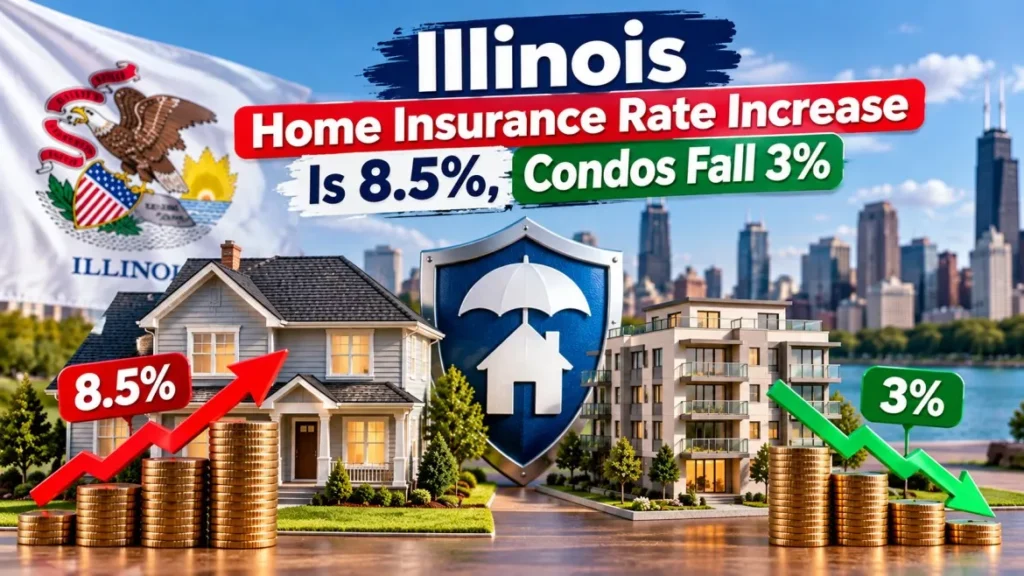

The Illinois home insurance rate increase filed by State Farm averages 8.5% for homeowners. It applied to new policies from 1 October 2026 and reaches renewals from 1 December 2026. Renters face a 5.8% rise, and condominium unitowners receive a 3% cut.
What the Illinois Home Insurance Rate Increase Actually Covers
The single figure reported as “8%” is a whole-program average that no individual policyholder pays. The filing by State Farm Fire and Casualty Company sets a different change for each line of property cover, and one of them is a reduction.
As of 9 October 2026, the filing is listed as “Filed” with the Illinois Department of Insurance, the state agency that supervises insurers in Illinois. In Illinois that status records receipt, not approval. Trade publication Insurance Business, which read the filing, reports its tracking number as SFMA-135045614 and the date it was marked filed as 5 October 2026.
The filing sets out both the rate change its actuaries calculated as needed, called the indicated change, and the smaller change the company chose to take, called the selected change.
| Line of cover | Indicated change | Selected change |
|---|---|---|
| Whole program | +12.5% | +7.9% |
| Standard homeowners | +13.1% | +8.5% |
| Renters | +13.9% | +5.8% |
| Condominium unitowners | +0.2% | -3.0% |
These are statewide averages for each line, not the change on any one policy. An individual premium moves with the home’s replacement cost, its location, its roof, the deductibles chosen and the discounts applied, so a household can see more or less than the line average.
State Farm described the change in a statement as applying to “non-tenant homeowner’s rates for Illinois customers”, meaning people who own and insure the residence rather than tenants. The insurer is a mutual company headquartered in Bloomington, Illinois, and is the state’s largest home insurer.
When the Higher Premium Reaches a Bill
The increase takes effect on two separate dates, and existing customers are on the later one.
- 1 October 2026: The new rates applied to new business, meaning policies written from that date.
- 1 December 2026: The new rates begin applying to renewals, so an existing policy changes at its own renewal date on or after that day.
State Farm has said it will mail affected policyholders a letter about the change roughly two months before their renewal date. That notice is the company’s own practice rather than a legal requirement at this size of increase, for the reason set out further down.
According to the filing as reported by Insurance Business, the change reaches 1,483,264 policies and adds $190.3 million in written premium, which works out at roughly $128 per policy a year, or about $10 a month on average. Those figures come from one trade publication’s reading of the filing rather than from a company announcement.
Why State Farm Says the Rates Must Rise
The company attributes the increase to storm losses and the cost of repairs rather than to any single event. Its filing states the rate need is “primarily driven by expected catastrophe losses”.
In its public statement the insurer pointed to “the effects of severe weather trends that are more frequent and severe”, and said it has paid out $1.22 in claims and expenses for every $1 in premium collected the past three years in Illinois. Local coverage notes that Illinois saw a record number of tornadoes and a derecho, a fast-moving line of damaging thunderstorm winds, during the summer of 2026.
The filing’s own loss history shows how uneven the record has been. The combined ratio, which measures claims and expenses as a share of premiums collected, runs above 100% when a line of business loses money on underwriting.
- 2023: 130.7% for Illinois homeowners.
- 2024: 126.6%.
- 2025: 109.1%, the best of the three.
- 2011 to 2025 average: 114.6%.
Expected catastrophe losses account for 55.2% of standard homeowners premium in the filing, with other losses a further 27.9%, according to Insurance Business. The 2025 figure of 109.1% was an improvement on the two years before it, and the increase has still been filed.
Roof Discounts Shrink and a Shingle Surcharge Appears
The filing changes more than the headline percentage. Two roof-related adjustments sit alongside it, and both can move a premium independently of the statewide average.
Homes roofed with 3-tab asphalt shingles, the flat single-layer type common on older houses, face a new 5% wind and hail surcharge. Separately, the discount for impact-resistant roofing now tapers as the roof ages: for the highest-rated class, Insurance Business reports the discount falling from 50% to 34% over fifteen years.
A household with an ageing impact-resistant roof or 3-tab shingles can therefore see a bill move by more than 8.5%, while the statewide average stays where the filing puts it. Neither change appears in most of the coverage of the increase.
What Illinois Regulators Can Do About It
At present the Illinois Department of Insurance cannot block this filing. Illinois operates a use-and-file system, under which an insurer may put new rates into effect when it files them, without the department approving them first.
That is changing, but not yet. Governor JB Pritzker signed two measures on 4 August 2026: House Bill 4273, covering homeowners insurance, and Senate Bill 714, covering motor insurance. Insurance Journal and law-firm summaries of the enrolled bills put their effective date at 1 July 2027, so neither applies to this filing.
From that date, according to Insurance Journal’s account of HB 4273, the department will have 60 days from a filing to tell an insurer that an actuarial review has found it deficient; the insurer may request a hearing, the rates stay in force while it runs, and if the department’s finding stands the insurer must rebate the premium it collected. The same law bars insurers from recovering out-of-state catastrophe losses from Illinois policyholders, and requires them to use Illinois-specific claims data where credible data exists.
HB 4273 also adds an advance-notice rule, and its threshold matters here: insurers must give at least 60 days’ notice before raising a renewal premium by 10% or more. At 8.5%, the homeowners increase in this filing would sit below that trigger even after the law starts.
Announcing the signing, Pritzker said the measures would let the department object to rates that are “excessive, inadequate, or unfairly discriminatory”, and described them as commonsense reforms that “will bring greater transparency and accountability to the insurance industry”. Department of Insurance director Gillespie said the department “stands ready to implement the provisions of these bills”. The National Association of Mutual Insurance Companies, a trade body for mutual insurers, opposed both bills, arguing they would reduce competition and raise prices.
Policyholders who want to read the justification themselves can request rate filings through the department’s public filing records. A similar shift to prior approval is under way elsewhere: New York has proposed requiring state sign-off before any motor insurance increase, as covered in our report on New York auto insurance rates.
How It Compares With the 27.2% Increase of 2025
This year’s increase is roughly a third the size of last year’s, and it carries no new deductible condition.
In July 2025 State Farm raised Illinois homeowners rates by an average of 27.2%, reaching about 1.49 million policyholders, with new business changing from 15 July and renewals from 15 August. That increase also introduced a minimum wind and hail deductible of 1% of the dwelling’s insured value, which on a home insured for $500,000 means $5,000 payable before storm damage is covered. Pritzker called that increase “unfair and arbitrary” at the time, and the department asked the company for more information.
The 2026 filing adds no comparable deductible condition. It is the second consecutive year of increases on the same book, and it arrives in the window between the signing of the new review law and the date it starts.
Other large insurers have been moving in both directions this year. State Farm has asked California regulators to let it write new home policies again, detailed in our report on State Farm California home insurance, while Farmers Insurance California rates rose by a statewide average of 1.5% from September 2026.
Frequently Asked Questions
Does the Illinois Home Insurance Rate Increase Apply to Renters?
Renters are a separate line in the filing with its own figure, a statewide average rise of 5.8%. The 8.5% applies to standard homeowners policies in Illinois.
Will Condominium Owners in Illinois Pay More?
No. The filing sets a 3% reduction for condominium unitowners policies in Illinois, against an indicated need of 0.2%.
When Does the New Rate Appear on a Renewal Bill?
Renewals dated on or after 1 December 2026 carry the new rates. Policies written as new business have carried them since 1 October 2026.
Did the Illinois Department of Insurance Approve the Increase?
No. Illinois is a use-and-file state, and the filing was marked “Filed” on 5 October 2026, which records receipt rather than approval. The law giving the department power to object to rates and order rebates takes effect on 1 July 2027.
Is 8.5% What Every Illinois Homeowner Will Pay?
No. It is a statewide average for the homeowners line, and an individual change depends on the property, its roof, the cover chosen and the discounts applied.