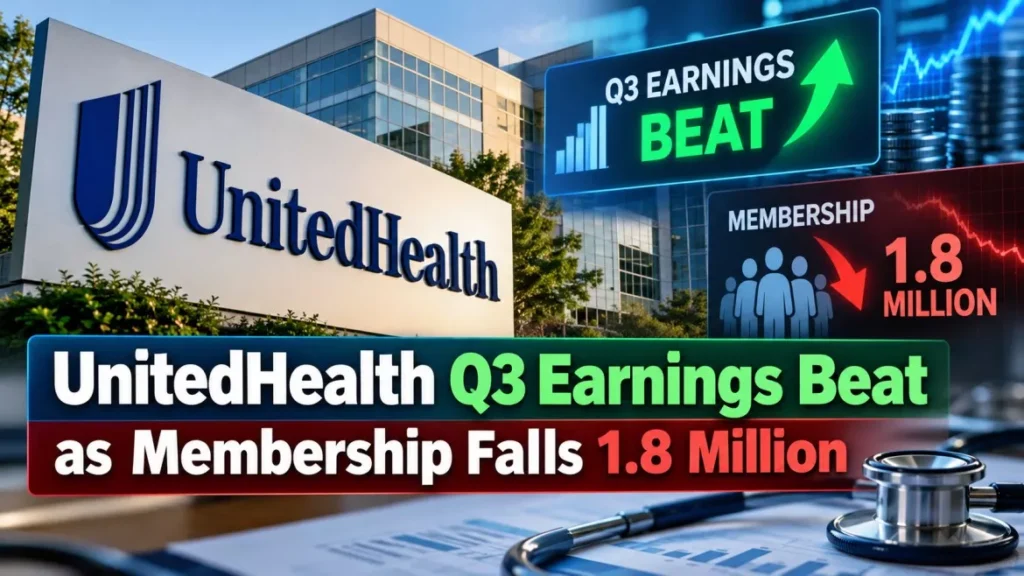

UnitedHealth Q3 earnings beat analyst forecasts, even as the insurer covered 1.8 million fewer people than a year earlier. Medical membership at its UnitedHealthcare arm fell to 48.3 million from 50.1 million, with Medicare Advantage down to 7.6 million from 8.4 million. The United States insurer published the figures on 13 October 2026.
What UnitedHealth Reported for the Third Quarter
Profit rose sharply on slightly lower revenue. Adjusted earnings of $4.69 a share came in above the $4.12 average analyst estimate compiled by Zacks. All figures below cover the three months to 30 September 2026, in United States dollars, with the same quarter of 2025 alongside.
| Measure | Q3 2026 | Q3 2025 |
|---|---|---|
| Revenues | $112.7 billion | $113.2 billion |
| Earnings from operations | $6.6 billion | $4.3 billion |
| Diluted earnings per share | $4.56 | $2.59 |
| Adjusted earnings per share | $4.69 | $2.92 |
| Medical care ratio | 88.4% | 89.9% |
| Operating cost ratio | 12.8% | 13.5% |
| UnitedHealthcare revenues | $86.3 billion | $87.1 billion |
| Optum revenues | $66.9 billion | $69.2 billion |
| People served, medical | 48.3 million | 50.1 million |
The company also lifted its full-year 2026 outlook to at least $19.50 in diluted earnings per share and at least $20.50 adjusted, the third increase it has made this year. Adjusted earnings per share strip out items such as amortisation of acquired intangible assets, so the adjusted and reported numbers are not interchangeable.
Where the 1.8 Million Members Went
Almost half of the decline came out of Medicare Advantage, the privately run version of the United States federal health programme for people aged 65 and over and for some younger people with disabilities.
- Medicare Advantage: 7.6 million members, down from 8.4 million a year earlier. The earnings release says seniors served through Medicare Advantage “have contracted by 935,000 since year-end 2025.”
- Medicare and Retirement revenue: $42.4 billion, down from $43.4 billion, which the company attributes to changes in membership and product mix.
- Employer and individual: revenue rose to $20.2 billion from $19.9 billion.
- Community and State: revenue of $23.7 billion, against $23.8 billion. This is the Medicaid business, which serves people on low incomes.
The contraction is deliberate. UnitedHealthcare raised premiums, reduced benefits and withdrew from plans it judged unprofitable, and Healthcare Dive reported from the earnings call that management expects to lose more than one million Medicare plan enrollees across 2026.
Why the Medical Care Ratio Fell to 88.4%
Part of the improvement came from money set aside in earlier periods, not from this quarter’s cost of care. The medical care ratio is the share of premium revenue an insurer spends on medical claims, so a lower ratio means more of each premium dollar stays with the insurer.
The quarter included $610 million of net favourable prior period reserve development relating to 2026 dates of service, according to the earnings release filed with the Securities and Exchange Commission. Reserve development is what happens when claims for earlier months settle for less than the insurer had provisioned; releasing that provision flatters the current quarter.
Beyond the reserves, the company credits medical cost management, benefit design changes and pricing discipline. Days claims payable, a measure of how long the insurer takes to settle claims, stood at 47.0, against 46.2 a year earlier.
What the Company Said About 2027 Plans and Networks
UnitedHealthcare is steering its Medicare business towards narrower networks and towards plans built for specific populations. A narrower network means fewer doctors and hospitals are treated as in-network, which lowers the insurer’s cost and limits member choice.
On the call, management said it is prioritising HMO products and special needs plans, known as D-SNPs for people eligible for both Medicare and Medicaid and C-SNPs for people with particular chronic conditions, as the route to 2027 growth. Bobby Hunter, president of UnitedHealthcare’s insurance division, said the company expects Medicare Advantage margins near the top of its 2% to 4% range.
The release states that at least 69% of members will be in Medicare Advantage plans rated four stars or better for 2027, which it describes as in line with expectations. Becker’s Payer Issues reported that this compares with 81% for 2026. Star Ratings are the quality scores the Centers for Medicare and Medicaid Services assigns to each plan, and they feed into how much the government pays insurers.
What It Changes for People Choosing Coverage Now
The results landed two days before the window in which Medicare beneficiaries can change plans. The Medicare annual enrollment period runs from 15 October to 7 December each year, and choices made in it take effect on 1 January.
Separately from the earnings report, UnitedHealthcare is discontinuing Medicare Advantage plans covering about 390,000 members for 2027, a figure the company confirmed to Bloomberg. Anyone in a plan that is not being renewed receives an Annual Notice of Change letter from the insurer, and plan-by-plan details for 2027 are published on the official Medicare Plan Finder at medicare.gov. Terms, networks and out-of-pocket limits differ by plan and by county, so a national figure says nothing about an individual plan. Our earlier report on the 2027 Medicare Advantage changes sets out the sector-wide picture.
The Costs That Are Still Rising
Executives described cost pressure as persistent rather than resolved. Tim Noel, chief executive of UnitedHealthcare, told the call that “costs remain stubbornly high across the entire healthcare landscape.”
Management put the commercial medical cost trend above 11%, attributing it to arbitration awards under the No Surprises Act, specialty drug prices and clinician pricing. The No Surprises Act is the United States law that routes out-of-network billing disputes to arbitration rather than to the patient. Medicaid margins are expected to come in moderately better than minus 1%, with 2026 described as the low point. Drug costs face a separate change in Medicare Part D from 2027.
What UnitedHealth Has Not Said
- Full 2027 guidance: no 2027 earnings or medical care ratio figures have been issued. Management described the lower end of its 13% to 16% long-term growth target as a reasonable starting point for 2027.
- 2027 membership: the company has not published an enrollment assumption for next year.
- Where the exits land: the 390,000 figure has not been broken out by state or county in the earnings materials.
- Whether the reserve releases repeat: prior period development is a one-off by nature and the company gives no forecast for it.
Frequently Asked Questions
How Much Did UnitedHealth Earn in the Third Quarter of 2026?
Revenues were $112.7 billion and earnings from operations were $6.6 billion, giving diluted earnings of $4.56 a share and adjusted earnings of $4.69 a share for the three months to 30 September 2026.
How Many People Does UnitedHealthcare Cover?
48.3 million on a medical basis at 30 September 2026, against 50.1 million a year earlier. Medicare Advantage accounted for 7.6 million of that, down from 8.4 million.
What Is a Medical Care Ratio?
It is the proportion of premium income an insurer pays out in medical claims. UnitedHealth’s came in at 88.4% for the quarter, against 89.9% a year earlier.
Is UnitedHealthcare Ending Medicare Advantage Plans in 2027?
Yes. The company has confirmed it is discontinuing plans covering about 390,000 members and has cut hundreds of plan offerings, while expanding special needs plans. Affected members are notified individually by letter.
When Can Medicare Members Change Plans for 2027?
The annual enrollment period runs from 15 October to 7 December 2026 in the United States, and any change made in that window starts on 1 January 2027.