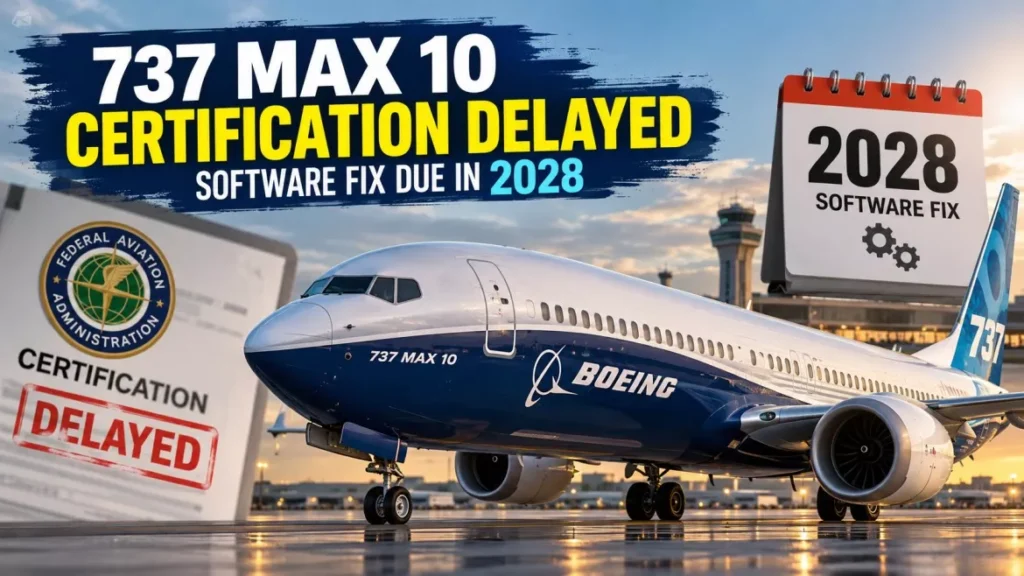

Boeing’s 737 MAX 10 certification has been delayed by the United States Federal Aviation Administration. Administrator Bryan Bedford said on 28 September 2026 that approval will be withheld until the agency resolves a flight-guidance software flaw. Boeing does not expect a permanent fix before 2028.
What the FAA Said on 28 September
The FAA has not decided whether the software flaw is a “safety of flight” issue, and it will not certify the aircraft until it does. Bedford made the remarks at an event at Ronald Reagan Washington National Airport, saying the agency would hold approval until it is satisfied “we don’t have an issue here.”
The agency also said it will convene a Corrective Action Review Board to examine Boeing’s findings and the fix the manufacturer proposes, and that it “will take immediate action if it identifies a safety concern.” A Corrective Action Review Board is an internal FAA panel that assesses whether a manufacturer’s response to a reported defect is adequate.
The FAA regulates aircraft certification in the United States only. Other regulators, including the European Union Aviation Safety Agency, certify the same aircraft separately, and the FAA’s decision does not by itself bind them.
What the Software Flaw Actually Does
The flaw sits in flight management computer software versions 14 and 14.1, and it can drop the aircraft out of automated vertical navigation during a go-around. The flight management computer is the box that holds the programmed route; vertical navigation, known as VNAV, is the autopilot mode that flies the programmed climb and descent profile without the pilots setting each altitude by hand.
The sequence that triggers it is specific. According to accounts published by Aviation Week and Airways, it occurs when the crew is flying a precision approach with the autopilot engaged, initiates a missed approach — the standard manoeuvre for breaking off a landing and climbing away — and then changes the preprogrammed flight plan. VNAV can then disengage and revert to a simpler pitch mode such as level change or vertical speed, which the pilots must manage manually.
That happens close to the ground, at a point in the flight where workload is already high. Boeing’s position is that it is not a safety issue: the company said “pilots are trained to safely land an airplane without automated VNAV,” and no accident or incident has been attributed to the behaviour.
Why the Permanent Fix Is Not Due Until 2028
Boeing first assessed the behaviour in February 2025 and concluded it was not a safety concern, then reopened the question this year after operators reported more cases. The company convened a formal safety review board, notified every 737 operator in late August 2026, and began work on a permanent software update under FAA oversight.
That update is not expected until 2028, though Boeing has said it is trying to pull the date forward. In the meantime the company is working with airlines on interim procedures for re-engaging automated vertical navigation if the mode drops out.
- February 2025: Boeing assesses the flight management computer behaviour and determines it is not a safety concern.
- Through 2026: Operators report further cases, prompting Boeing to convene a formal safety review board.
- 28 July 2026: The 737-10 completes its final certification flight, closing a test campaign Boeing put at 976 flights and more than 2,060 flight hours.
- August 2026: The 737-7, the smallest MAX variant, is certified by the FAA with software version 14 installed.
- Late August 2026: Boeing notifies all 737 operators of the issue.
- 28 September 2026: The FAA says certification of the 737-10 will wait on its software review.
- 2028: Boeing’s current expectation for the permanent software fix.
The gap between those last two dates is the part airlines have to plan around. The FAA has not said that certification must wait for the permanent fix, and it has not set a date of its own.
Are Aircraft Already in Service Affected?
The 737 MAX aircraft already carrying passengers are not running the affected software. Alaska Airlines, American Airlines, Southwest Airlines and United Airlines each confirmed their existing MAX fleets are unaffected, according to reporting by Airways.
The complication is on the delivery line rather than in service. The 737-7 was certified in August 2026 with version 14 already installed, and the 737-10 flew its certification campaign on version 14.1. Southwest and United have asked Boeing to pause deliveries of aircraft carrying the affected versions and said they would accept earlier software loads instead.
Which Airlines Are Waiting for the 737 MAX 10
The 737-10 is the largest MAX variant and the one Boeing has sold most heavily into fleet-renewal plans, with more than 1,400 firm orders as of February 2026. None has been delivered. The variant accounted for roughly 31% of Boeing’s undelivered 737 orders at the end of June 2026.
| Customer | Firm 737-10 orders | Stated delivery expectation |
|---|---|---|
| Alaska Airlines | 105, plus options on 35 more | First aircraft spring 2027; 22 in 2027 and 30 in 2028 |
| United Airlines | 165 | Deliveries from 2027 |
| Ryanair | 150 | Not publicly dated |
Alaska’s order, announced on 7 January 2026, was the largest in the airline’s history and covered 105 737-10s plus options on 35 more alongside five 787-10s. The airline said as recently as the week before the FAA’s announcement that it expected certification by the end of September 2026 and a passenger debut between April and mid-May 2027.
The aircraft competes directly with the Airbus A321neo, which has been in service since 2016 — a gap that has shaped how the two manufacturers’ narrowbody order books have moved, as our earlier comparison of Boeing and Airbus set out.
How Investors Reacted
Boeing shares fell 6.18% on 28 September 2026, closing at $185.82, down $12.25 on the day. Volume reached 11.7 million shares against a three-month average of 5.95 million.
Share prices move daily and the figures above are a single day’s reading. Boeing has not issued guidance revising its delivery expectations since the FAA’s announcement.
What Happens Next
As of 29 September 2026, the Boeing 737-10 is not certified in the United States, the FAA has set no date for a decision, and Boeing’s permanent software fix is not expected before 2028. Three things remain undecided.
- Whether the flaw is a safety of flight issue: The FAA has explicitly not concluded this, and its Corrective Action Review Board has not reported.
- Whether certification must wait for the permanent fix: Neither the FAA nor Boeing has said it must, and the 737-7 was certified with the same generation of software.
- Whether 2027 delivery slots hold: Airlines including Alaska have published 2027 dates, but none has been revised or confirmed since 28 September.
Airlines and passengers looking for the authoritative position should follow the FAA’s own certification announcements and the individual carriers’ investor communications rather than order-book estimates.
Frequently Asked Questions
Is the Boeing 737 MAX 10 Certified?
No. As of 29 September 2026 the 737-10 has not been certified by the United States Federal Aviation Administration, and the agency has not given a date for its decision.
Why Was 737 MAX 10 Certification Delayed?
The FAA is reviewing a flaw in flight management computer software versions 14 and 14.1 that can disengage automated vertical navigation during a missed approach when the crew changes the programmed flight plan.
Are 737 MAX Aircraft Currently Flying Affected?
Alaska, American, Southwest and United have each said their in-service 737 MAX fleets do not carry the affected software versions, according to reporting by Airways. The issue concerns aircraft awaiting delivery.
When Will Boeing Fix the Software?
Boeing has said a permanent fix is not expected until 2028 and that it is working to bring that date forward. Interim procedures are being issued to airlines in the meantime.
Has the FAA Said the 737 MAX Is Unsafe?
No. FAA Administrator Bryan Bedford said on 28 September 2026 that the agency has not concluded whether the issue is a safety of flight concern, and that certification will wait until it is satisfied there is no issue.