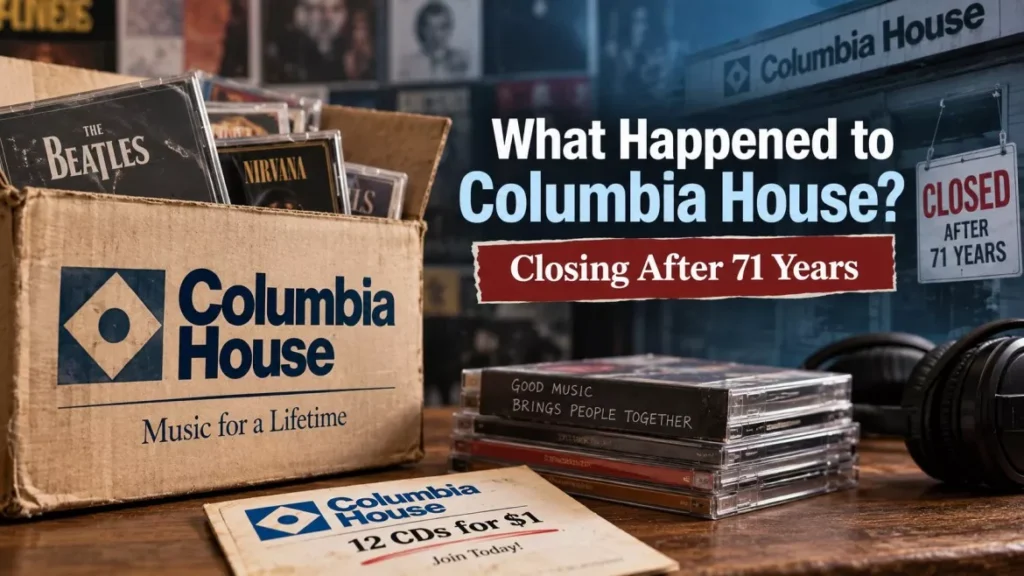

Columbia House is shutting down after 71 years. A notice on its website said the mail-order club would stop accepting new orders after 15 September 2026, and a customer service representative confirmed to CNN that the company is ceasing operations. The notice was then quietly removed.
The Closure Notice That Appeared, Then Vanished
Columbia House announced its own ending in a short message on its website in mid-August 2026, then took the message down within days.
The notice said that after 15 September 2026, Columbia House would no longer be accepting new orders. It added that existing memberships and outstanding purchases would be honored while the business wound down. It was a plain administrative note, not a farewell statement, and there was no press release alongside it.
The message was first spotted by the YouTube channel Channel 33 RPM, which covers records and music collecting, and reporters then confirmed the wind-down through the company’s customer service line. Within about 48 hours the story had travelled from a niche YouTube channel to national news outlets.
Then the notice disappeared. By Tuesday 18 August 2026 it was gone from the site, according to CBC News, which said it had asked Columbia House for clarification and had not received a response.
The removal did not reverse the decision. On 19 August 2026, CNN reported that a Columbia House customer service representative confirmed by phone that the company was soon ceasing operations, even though the written notice was no longer posted online.
The sequence left the story in an odd position. A company had confirmed its own closure, deleted the confirmation, and kept selling — without ever explaining why the notice came down. No public statement has been issued by Columbia House or Edge Line Ventures accounting for the removal.
Is Columbia House Still Taking Orders Right Now?
Yes. As of 4 September 2026, the Columbia House website was still live, still listing DVDs for sale, and still inviting new members to sign up, with no closure notice anywhere on it.
The storefront was promoting free shipping on orders of three or more DVDs and offering select DVDs at $11.95 each to start a membership. The footer carried a 2026 copyright in the name of Edge Line Ventures LLC, the company that runs the brand.
The catalog is a fraction of what it once was. When CNN examined the site in August 2026, it found roughly a dozen DVD titles on offer, including the second season of the AMC series Dark Winds and the 2023 film Blackberry — several of them years old despite being listed as new releases.
So the accurate status, stated plainly: the company has told both customers and reporters that it is closing, 15 September 2026 is the date it gave for the last new orders, and the shop remains open in the meantime. Anyone treating the site’s continued operation as proof the closure was called off is reading too much into it.
What Current Members Should Do Before 15 September
Members should check whether their membership is still billing them, place any final order before the cut-off, and cancel directly if they no longer want the account open.
Columbia House’s own membership terms, as published on its site, state that there is no obligation to buy and that a membership can be cancelled at any time online or by calling 1-888-667-9431. That matters because the club’s billing has always been opt-out by design rather than opt-in.
Three practical points are worth attention as the deadline approaches:
- Outstanding orders. The original notice said existing memberships and outstanding purchases would be honored during the wind-down, so orders already placed were not simply cancelled.
- Stored payment details. A closing company still holds card details on file until an account is closed, so cancelling is cleaner than letting the account lapse.
- Written confirmation. Because the closure notice was posted and then removed without explanation, keeping a dated record of any cancellation or final order is sensible.
None of this is urgent for the vast majority of people who assume they cancelled in 1998. It matters for the small remaining base of active members, which is who the 15 September date actually affects.
How “12 CDs for a Penny” Actually Worked
The famous offer was real, and the catch was the billing model behind it: members received the introductory albums for almost nothing, then had to actively decline each new selection or be shipped and charged for it automatically.
Columbia House ran variations of the pitch for decades — “Any 11 tapes or records for $1”, eight CDs for a penny, 12 CDs for a cent — in magazine inserts, comic books and TV spots. The introductory haul was genuine. The obligation attached to it was the business.
This is known as negative-option billing. Every few weeks the club nominated a featured selection, and silence counted as consent. Members who forgot to return the reply card, or missed the window, received the album and the invoice. Full club prices, plus shipping and handling, made back what the penny offer gave away.
The model was legal and disclosed in the fine print, and it was also a durable source of consumer complaints for as long as the club existed. It is the single detail most people remember, usually attached to a story about a relative who kept receiving albums for years.
The current DVD club still runs on a softer version of the same structure. Columbia House says it reveals a new Director’s Selection every few weeks, which members are free to take or skip, with savings of up to 60% off regular club prices.
From $1.4 Billion to a Dozen DVDs
Columbia House went from one of the most powerful distribution channels in the music industry to a niche DVD catalog over roughly 30 years.
At its peak in 1996, the company reported revenue of about $1.4 billion and around 16 million members. In 1994, music clubs of its kind accounted for 15.1% of all CD sales in the United States — a share no online retailer had yet come close to taking.
What followed was a textbook case of a distribution advantage evaporating. The club existed because buying music by mail was easier than driving to a record shop. Once Amazon made physical albums a two-click purchase, and iTunes and streaming services made the disc itself optional, the premise stopped holding.
By 2014, annual revenue had fallen to about $17 million. On 10 August 2015, parent company Filmed Entertainment Inc. filed for Chapter 11 bankruptcy protection in Manhattan and moved to sell the Columbia House DVD club.
The club changed hands repeatedly on the way down, which is part of why it proved so hard to kill. It began as a division of Columbia Records and passed to Sony in the late 1980s, became a Sony and Time Warner joint venture in 1991, and was sold in 2002 to The Blackstone Group, which took an 85% stake while the two music companies kept the rest. Further sales followed through the 2000s, and by 2013 the surviving entity was named Filmed Entertainment Inc.
Each transaction moved the business further from the record labels that gave it its purpose. A club built to sell Columbia Records albums ended up as a standalone catalog operation with no label behind it.
| Year | Development |
|---|---|
| 1955 | Columbia Records launches the Columbia Record Club |
| 1979 | A Canadian division is established |
| 1994 | Music clubs account for 15.1% of US CD sales |
| 1996 | Peak year: about $1.4 billion in revenue, roughly 16 million members |
| 2002 | The Blackstone Group acquires an 85% stake |
| 2009-2010 | The music club is wound down; the business continues as a DVD and Blu-ray club |
| 2014 | Annual revenue falls to about $17 million |
| 2015 | Filmed Entertainment Inc. files for Chapter 11 on 10 August; a vinyl subscription relaunch fails |
| 2026 | Closure notice posted, then removed; last new orders stated for 15 September |
Accounts differ slightly on exactly when the music club stopped: some place the shutdown of music mail-order operations in 2009, others say the company moved exclusively to DVDs in 2010. Either way, the part of Columbia House that people actually remember had ended by the start of the 2010s.
The brand is not the only long-running consumer name being retired in this period. Coca-Cola discontinued Minute Maid frozen juice concentrates in 2026, closing out an 80-year product line in much the same way.
Why Did the Brand Survive Eleven Years After Bankruptcy?
Columbia House outlived its own bankruptcy because the brand and the business were separated: a small operator licensed the name and ran a lean mail-order catalog with it.
After the 2015 Chapter 11 filing, the remaining assets were acquired by John Lippman through Edge Line Ventures. The Columbia House trademark itself is licensed from Sony Music Entertainment, the corporate descendant of the Columbia Records division that started the club in 1955.
That structure explains the decade of afterlife. There was no need to sustain a billion-dollar operation — only a website, a fulfilment arrangement and a name with enough residual recognition to attract collectors and nostalgic buyers.
Attempts to grow it did not work. A vinyl subscription relaunch around 2015 aimed at the record revival failed to establish itself, and an effort to move into streaming never secured competitive licensing deals. What remained was the DVD club, shrinking steadily until it reached a catalog of about a dozen titles.
Where to Buy Physical Media Now
The disc-by-mail club is disappearing, but buying physical media is not: the market has moved to general online retailers, specialist labels and direct-from-studio releases.
For most buyers the practical replacements are the large online retailers that carry DVDs and Blu-rays, boutique labels that produce restored and special editions for collectors, and second-hand marketplaces where out-of-print discs circulate. Record shops and their online stores have absorbed much of the vinyl demand the club once served.
The wider lesson is that a digital storefront is not automatically more permanent than a mail-order one. Google Play Movies & TV shut down in January 2024, and streaming catalogs remove titles routinely. A disc on a shelf remains one of the few formats that cannot be withdrawn by a licensing decision.
Frequently Asked Questions
Is Columbia House Closing for Good?
Yes. Columbia House stated that it would stop accepting new orders after 15 September 2026, and a customer service representative confirmed to CNN in August 2026 that the company was soon ceasing operations, after the written notice was removed from its website.
Does Columbia House Still Sell CDs?
No. The music club ended around 2009 to 2010, and since then Columbia House has operated only as a DVD and Blu-ray club. Its final catalog contained roughly a dozen film and television titles.
Who Owns Columbia House?
Edge Line Ventures LLC operates Columbia House, after John Lippman acquired the remaining assets following the 2015 bankruptcy of parent company Filmed Entertainment Inc. The trademark itself is licensed from Sony Music Entertainment.
How Do I Cancel a Columbia House Membership?
Columbia House states that there is no obligation to buy and that members can cancel at any time online or by calling 1-888-667-9431. Members with pending orders should note that outstanding purchases were said to be honored during the wind-down.
How Big Was Columbia House at Its Peak?
Columbia House peaked in 1996 with about $1.4 billion in annual revenue and roughly 16 million members. In 1994, music clubs accounted for 15.1% of all CD sales in the United States.
Why Did Columbia House Fail?
Its advantage was convenience, and that advantage vanished. Online retailers made buying discs easier than mail order, and downloads and streaming reduced demand for physical albums altogether, cutting revenue from about $1.4 billion in 1996 to roughly $17 million by 2014.