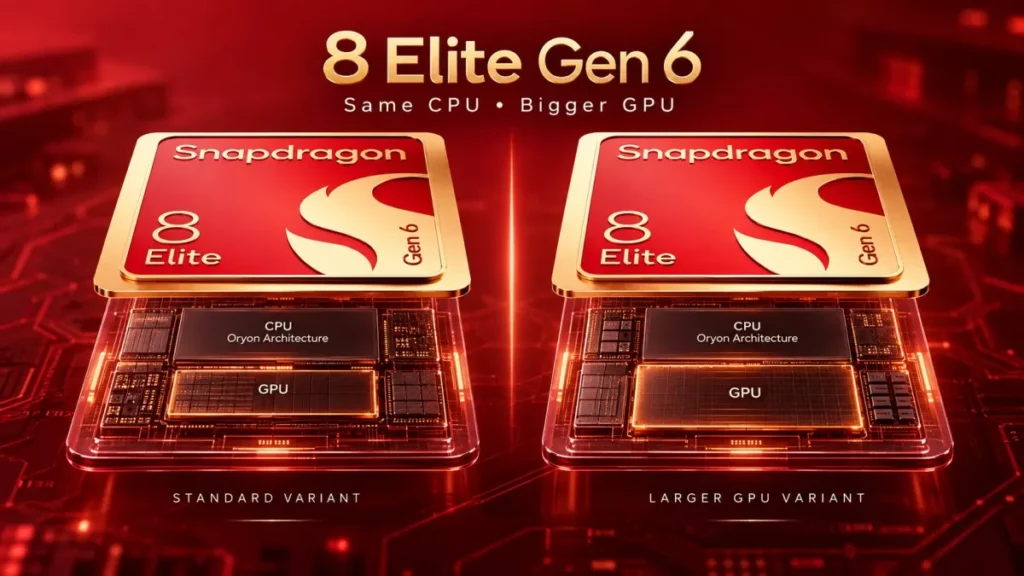

Qualcomm has split its flagship mobile chip into two tiers. The Snapdragon 8 Elite Gen 6 and the Snapdragon 8 Elite Extreme Gen 6, both announced at Snapdragon Summit on 22 September 2026, share an identical eight-core CPU running at 5GHz. The Extreme tier adds graphics, camera and on-device AI hardware.
What Qualcomm Announced on 22 September 2026
Qualcomm, the San Diego company that supplies the processors in most premium Android phones, opened its annual Snapdragon Summit in Maui by confirming two chips rather than one. Previous years brought a single flagship part. This year the Snapdragon 8 Elite Gen 6 becomes the standard flagship platform, and the Snapdragon 8 Elite Extreme Gen 6 sits above it as an ultra-premium option.
Both are built on a 2nm manufacturing process at TSMC, the Taiwanese contract chipmaker. Both use a new generation of Qualcomm’s custom Oryon CPU design, arranged as two prime cores at 5.0GHz and six performance cores at 4.0GHz, sharing 16MB of what Qualcomm calls Oryon Flex Cache. Qualcomm describes these as the first mobile processors to reach 5GHz.
Snapdragon 8 Elite Gen 6 vs Extreme Gen 6: What Actually Differs
The two chips are identical in CPU, modem and wireless hardware, and differ in graphics, camera and AI memory. The table below sets out every confirmed difference.
| Feature | Snapdragon 8 Elite Gen 6 | Snapdragon 8 Elite Extreme Gen 6 |
|---|---|---|
| CPU configuration | 2 prime cores at 5.0GHz, 6 performance cores at 4.0GHz | Identical |
| CPU gain vs Gen 5 | 10% faster | 13% faster |
| CPU power efficiency | 37% improvement | 37% improvement |
| GPU gain vs Gen 5 | 35% faster | 44% faster |
| Adreno matrix cores | Not included | Included |
| Dedicated graphics memory | Not included | 18MB Adreno high-performance memory |
| NPU shared memory | Standard | 50% larger |
| Largest on-device model | Not specified by Qualcomm | Mixture-of-Experts models above 30 billion parameters |
| Maximum video capture | 8K at 30fps, 4K at 120fps | 8K at 60fps, 4K at 240fps |
| Modem | Qualcomm X105 5G | Qualcomm X105 5G |
| Wireless | FastConnect 8800, Wi-Fi 8 | FastConnect 8800, Wi-Fi 8 |
What the Extreme Tier Buys You
The Extreme tier adds hardware in three places, and none of them is the processor that runs your apps. Because the CPU is the same in both chips, everyday tasks such as opening apps, scrolling and browsing should feel the same on either.
The first addition is graphics. The Extreme carries dedicated Adreno matrix cores, which are circuits built for the matrix arithmetic that AI models use, plus 18MB of high-performance memory reserved for the GPU. Qualcomm uses this for Adreno Neural Fusion, a feature that generates extra frames and upscales images in games. Qualcomm says Neural Fusion cuts rendering power by up to 40% compared with its earlier Snapdragon Game Super Resolution 2 technique.
The second is video. Only the Extreme records 8K at 60 frames per second and 4K slow motion at 240 frames per second. HotHardware reported that the standard Gen 6 tops out at 8K30 and 4K120; Qualcomm has published the Extreme figures but not drawn the comparison itself.
The third is AI memory. The Extreme has 50% more shared memory attached to its Hexagon neural processing unit, which Qualcomm says lets it run Mixture-of-Experts models above 30 billion parameters on the phone. A Mixture-of-Experts model activates only part of itself for each request, so it behaves like a smaller model while holding more knowledge. The practical effect is that larger assistants can run without sending data to a server.
What Both Chips Share
Everything outside graphics, camera and AI memory is common to the two tiers. That includes the parts that determine call quality, download speed and battery life.
- CPU: Two Oryon prime cores at 5.0GHz and six performance cores at 4.0GHz, with 16MB of Flex Cache.
- Modem: The Qualcomm X105, rated at a peak 14.8Gbps downlink and 4.2Gbps uplink, ready for 3GPP Release 19 and capable of satellite connections.
- Wireless: FastConnect 8800 with Wi-Fi 8, a peak 11.6Gbps link rate, Bluetooth 6.0 and ultra-wideband.
- Efficiency: A 37% reduction in CPU power draw and a 40% improvement in GPU efficiency against the Snapdragon 8 Elite Gen 5.
- Camera processing: A Spectra image signal processor that Qualcomm says handles 256 times more AI data per pixel than the previous generation.
The shared Wi-Fi 8 support is worth a note of caution. The IEEE has not finished the 802.11bn standard that Wi-Fi 8 is based on, so early hardware follows a draft.
Which Phones Get Which Chip
As of 23 September 2026, two devices have been publicly tied to the new platform, and neither has a global price.
- Xiaomi 18 Pro series: Xiaomi launches the Xiaomi 18 Pro and 18 Pro Max in mainland China on 23 September 2026 at 7pm local time, and has confirmed a 2nm chipset and a dual 200-megapixel Leica camera system.
- Motorola Signature 27: Revealed at the Summit on 22 September 2026 with the Extreme Gen 6, a 50-megapixel Sony LYTIA 910 main sensor, a 200-megapixel periscope telephoto and seven years of operating system upgrades.
Samsung’s Galaxy S27 series is widely expected to use the platform in early 2027, but Samsung has announced nothing. Readers weighing an upgrade may find our earlier comparison of the Snapdragon 8 Elite and Google’s Tensor G4 a useful guide to how these tier choices play out in shipping phones, and our note on the Oryon CPU design covers the architecture both new chips extend.
What Qualcomm Has Not Said
Several things a buyer would want to know remain unpublished as of 23 September 2026.
- Pricing: Qualcomm does not publish chip prices, and no phone maker has announced what the Extreme tier adds to a handset’s cost.
- Model-by-model tiers: Qualcomm has not published a list of which phone models take which tier. Lowyat.NET reported that the Xiaomi 18 Pro uses the standard Gen 6 and the 18 Pro Max the Extreme, but Xiaomi has not confirmed this.
- Core generation: Qualcomm described the Oryon cores only as a new, custom-built successor, without naming the generation.
- Foundry capacity: Qualcomm has not said how many chips TSMC’s 2nm line can supply, which is what usually decides whether a tier stays scarce.
One naming point is worth clearing up. Before the launch, benchmark listings and leak reports referred to a “Snapdragon 8 Elite Gen 6 Pro” clocked at 5.11GHz. The official name is Snapdragon 8 Elite Extreme Gen 6, and the official prime-core figure is 5.0GHz. Treat the earlier numbers as pre-release listings, not specifications.
Frequently Asked Questions
What Is the Difference Between the Snapdragon 8 Elite Gen 6 and the Extreme Gen 6?
They use the same CPU, modem and Wi-Fi hardware. The Extreme adds Adreno matrix cores, 18MB of dedicated graphics memory, 50% more AI shared memory, and 8K60 and 4K240 video capture.
Is the Snapdragon 8 Elite Gen 6 Faster Than the Gen 5?
Qualcomm claims the standard Gen 6 is 10% faster on CPU and 35% faster on GPU than the Snapdragon 8 Elite Gen 5, with 37% better CPU power efficiency. The Extreme claims 13% and 44%.
Which Phones Use the Snapdragon 8 Elite Gen 6?
The Xiaomi 18 Pro series launches in China on 23 September 2026 and the Motorola Signature 27 was revealed on 22 September 2026. No other devices have been confirmed.
Are Both Chips Made on a 2nm Process?
Yes. Qualcomm says both the Snapdragon 8 Elite Gen 6 and the Extreme Gen 6 are built on a 2nm process at TSMC.
Does the Snapdragon 8 Elite Gen 6 Support Wi-Fi 8?
Both tiers include the FastConnect 8800 system with Wi-Fi 8 support at a peak 11.6Gbps. The underlying 802.11bn standard is not yet final, so early devices follow a draft specification.