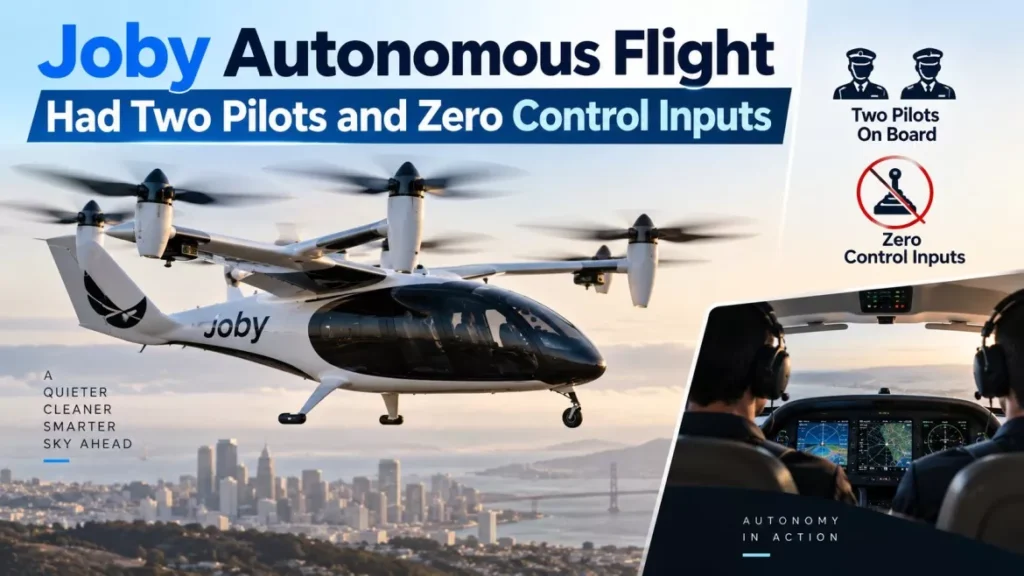

A Joby autonomous flight crossed 3,199 miles from California to North Carolina with no control inputs from the pilot on board. A second pilot, on the ground, was in command the whole way. The converted Cessna Caravan taxied, took off, navigated and landed on its own, and Joby announced the result on 18 September 2026.
Who Was Actually Flying the Aircraft
Two qualified pilots were involved in a flight widely described as pilotless, and neither touched the controls. Joby Aviation, the Santa Cruz company best known for its electric air taxi, runs what it calls supervised autonomy.
Under that model, as Joby describes it, a ground-based remote pilot functions as pilot in command, overseeing the flight, modifying flight plans and handling air traffic control communications over the aircraft’s ordinary radios. A monitoring pilot sits in the cockpit on selected operations. On this crossing that monitoring pilot was aboard for the full distance and, by Joby’s account, made zero control inputs.
The ground crews worked from Joby’s autonomy headquarters in California and from Shaw Air Force Base in South Carolina, supervising the aircraft from as far as 2,323 miles away. That separation is the point of the exercise: the company has already run remote operations from Guam over distances approaching 4,000 miles during United States Air Force exercises.
The Route, Airport by Airport
The eastbound crossing ran in four legs over roughly a week, ending at the coast where powered flight began.
| Leg | Airport | Location |
|---|---|---|
| Departure | Buchanan Field (KCCR) | Concord, California |
| Stop 1 | Phoenix Deer Valley (KDVT) | Phoenix, Arizona |
| Stop 2 | Fort Worth Alliance (KAFW) | Fort Worth, Texas |
| Stop 3 | Shaw Air Force Base (KSSC) | Sumter, South Carolina |
| Arrival | Dare County Regional (KMQI) | Outer Banks, North Carolina |
The aircraft made a commemorative pass near Kitty Hawk before landing, 123 years after the Wright brothers flew there. The tour began on 10 September 2026 and is scheduled to cover ten states in a month, with the westbound return calling at Raleigh, the Washington area, Louisville, Wichita, Oklahoma City, Salt Lake City and Portland.
JoeBen Bevirt, Joby’s founder and chief executive, said the crossing “offers a glimpse into a new era of aviation”. The company frames the uses as cargo delivery, emergency response and military logistics rather than carrying passengers.
What the J208 Is, and Why That Matters
The aircraft is not a new design. It is a Cessna 208B Grand Caravan, a single-engine turboprop registered N101XW, flying under an experimental airworthiness certificate issued for research and development, according to reporting on the aircraft’s registration. The Caravan family has held a Federal Aviation Administration type certificate since October 1984.
That choice is deliberate. Fitting an autonomy system to an airframe the regulator approved four decades ago is a far shorter route to commercial work than certifying a new aircraft and a new control system at the same time. The autonomy stack itself came from Xwing, whose autonomy division Joby bought in June 2024, and Joby says the J208 has logged more than 400 flights and 800 automated flight hours in both controlled and uncontrolled airspace.
Joby has separately been building out the defence side of this work, including an Air Force contract through AFWERX and a partnership with L3Harris Technologies. Those are business arrangements rather than certification milestones, and neither changes what the aircraft is allowed to do today.
What It Does Not Mean for Passenger Flights
Nothing in this flight brings an uncrewed passenger aircraft closer to carrying you. An experimental certificate permits research flying; it does not permit commercial passenger service, and demonstrating hands-off flight is a different problem from persuading a regulator to certify an aircraft with nobody in the cockpit.
Joby’s own electric air taxi is a separate programme on a separate clock. It remains in Federal Aviation Administration type certification testing, and the company has not tied it to the autonomy work demonstrated here. Autonomy in commercial aviation is expected to reach cargo operations before passenger ones, for the straightforward reason that the regulatory bar is lower when there is no one in the back.
As of 20 September 2026, the westbound leg of the tour is still under way, and Joby has given no date for removing the monitoring pilot from the cockpit or for a commercial autonomous cargo service. The same distinction between a working demonstration and an approved service runs through autonomy on the ground, as our report on the Tesla Cybercab investigation and the 45 cars actually running in Austin shows, and the wider push to get new aircraft types flying is covered in our piece on Alef’s vertical-takeoff Model Zero.
Frequently Asked Questions
Was Anyone on Board the Joby Autonomous Flight?
Yes. A monitoring pilot was in the cockpit for the whole 3,199 miles. Joby says that pilot made no control inputs at any point, including during taxi, takeoff, navigation and landing.
Who Was the Pilot in Command?
A remote pilot on the ground. Joby’s supervised autonomy model puts a ground-based remote pilot in command, responsible for the flight plan and for radio communications with air traffic control.
What Aircraft Made the Flight?
A Cessna 208B Grand Caravan that Joby designates the J208, fitted with an autonomy system Joby acquired from Xwing in June 2024. The aircraft flies under an experimental airworthiness certificate for research and development.
Where Did the Flight Start and Finish?
It ran from Buchanan Field in Concord, California to Dare County Regional Airport in North Carolina’s Outer Banks, with stops at Phoenix Deer Valley, Fort Worth Alliance and Shaw Air Force Base.
When Will Autonomous Aircraft Carry Passengers?
No date has been set by Joby or by any regulator. Joby presents this technology for cargo, emergency response and defence logistics, and its passenger air taxi is a separate programme still in Federal Aviation Administration certification testing.