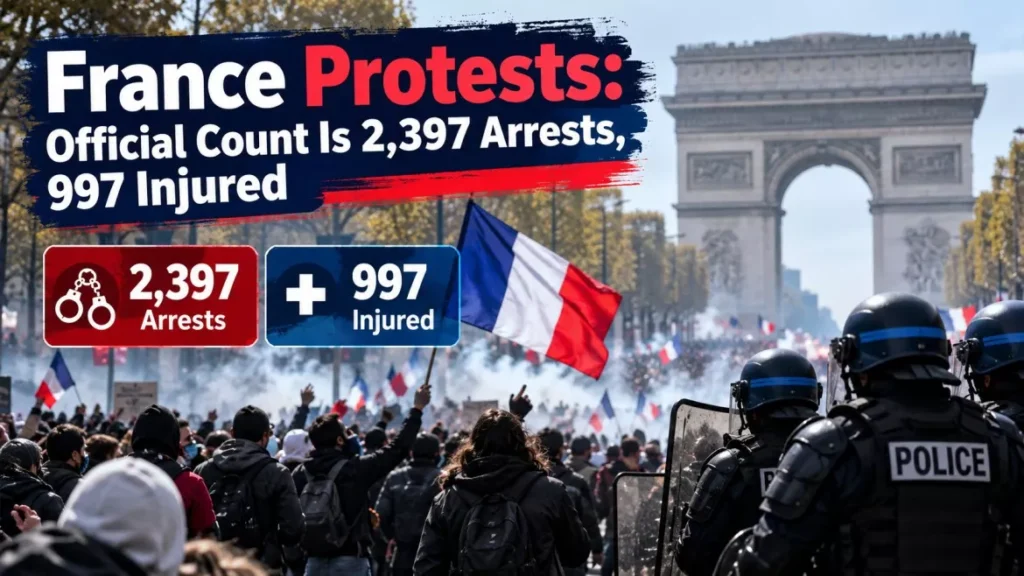

The France protests of Saturday 17 October 2026 ended with 2,397 people arrested and 997 police officers and gendarmes injured, the interior ministry said. Seven officers were badly hurt. The figures, released on Sunday 18 October, are far above the counts given while the demonstrations were still under way.
What the Official Figures Now Say
Saturday’s marches produced the largest single-day arrest total of the current movement, according to the interior ministry’s own tally. As of Sunday 18 October 2026, these are the latest figures and the bodies that published them.
| Measure | Latest figure | Published by | When |
|---|---|---|---|
| Arrests nationwide | 2,397 | Interior ministry | Sunday 18 October |
| Arrests, Paris region | 855 | Paris police | Sunday 18 October |
| Held in police custody, Paris | 557 | Paris prosecutors’ office | Sunday 18 October |
| Police and gendarmes injured | 997, seven seriously | Interior ministry | Sunday 18 October |
| Turnout | More than 550,000 | Interior ministry | Saturday 17 October |
| Turnout | About 800,000 | Protest organisers | Saturday 17 October |
The ministry’s arrest and injury totals cover Saturday alone. A separate figure given by Prime Minister Sebastien Lecornu, of 937 police officers and gendarmes injured, covers the whole protest movement rather than one day, which is one reason published numbers do not line up.
Why the Arrest Count Rose From 1,200 to 2,397
The gap between the figures in circulation is a matter of timing, not dispute. Each count was accurate when it was issued and was then overtaken.
- About 400: An early interior ministry figure given on Saturday while demonstrations were still in progress.
- Around 1,200: Prime Minister Sebastien Lecornu’s count on Saturday, issued alongside a figure of more than 150 injured officers.
- At least 1,800: The Associated Press tally, reported through Sunday and still carried in many headlines.
- 2,397: The interior ministry’s consolidated figure for Saturday, published on Sunday 18 October together with the 997 injured-officer total.
Anyone comparing coverage from Saturday evening with coverage from Sunday is therefore reading two different stages of the same count, not a correction.
What Macron Said From the Elysee
President Emmanuel Macron addressed the nation in a short televised statement from the Elysee Palace on Sunday 18 October 2026. He drew a line between the demonstrations themselves and the violence that followed them.
“Those who looted will have to pay back for the damage, and those who sought to bring down the Republic will be held accountable,” Macron said. He described public feeling as anger and shame, said nothing justified what he called unbridled violence, and attributed it to insurrectionist elements from radical far-left groups joined by numerous criminals. He urged people to distinguish those protesting peacefully over what he called legitimate demands from those using the marches as a pretext to destroy and loot.
Macron also promised “full transparency” over the policing of the day, after criticism that preparations had been inadequate. He asked Interior Minister Laurent Nunez to draw the necessary lessons, particularly on intelligence and anticipation, and said he expected clear answers. He said he had asked the government to convene students, teachers and trade unionists during the week to discuss concrete proposals, and that local authorities would work with mayors to protect public buildings.
Nunez set out the government’s position on the right to protest in a post on X: “The right to protest is a fundamental right. Deliberately and collectively sowing disorder through violence is not.”
The Cost to Shops, and the Town Hall That Burned
Shops were looted in Paris, Marseille, Lyon, Bordeaux, Rennes, Strasbourg, Grenoble, Nice and Limoges, according to French authorities. The scale is still being counted, and the two public estimates differ: Nunez spoke of hundreds of businesses looted, while Carrefour’s chief executive referred to about 1,500 shops belonging to retail chains other than his own.
Carrefour, France’s largest supermarket group, gave the clearest company-level account. Chief executive Alexandre Bompard said 50 of its shops were targeted, including 19 convenience stores and supermarkets, in Paris, Rennes, Lille, Bordeaux and elsewhere. He said the cost of repairs “will run to well over ten million euros”, about $11 million, and that dozens of employees at franchise partners would be placed on short-time working. Some outlets reported the number of Carrefour shops looted as 20 rather than 19.
In Limoges, a fire set during the protests largely destroyed the 19th-century town hall. Maurice Barate, the prefect of Haute-Vienne, said the roof had collapsed onto the lower floors except in the west wing and that two-thirds of the exterior had gone, calling it a catastrophe for heritage. He told the broadcaster LCI the fire had been set deliberately. The spire collapsed overnight, and the police prefect said the fire had been contained by Sunday. Around 7,000 people marched in Limoges the following day. A tourist office in Lyon was also set alight, and city halls in Marseille and Lille were broken into.
In Paris, where damage concentrated around the Place de la Republique and central shopping areas, Mayor Emmanuel Gregoire asked for an emergency task force to assess damage and help shopkeepers with administrative and insurance procedures. “You bring Paris to life every day. Today, it’s Paris’ turn to stand by your side,” he said. Compensation arrangements for affected businesses had not been set out in detail as of 18 October 2026, and what any individual shop recovers will depend on its own policy terms.
What the Protests Are About: the 2027 Budget
The demonstrations began as student-led protests over teacher shortages and school conditions and widened into a movement over living costs and public services, with members of the “yellow vests” movement joining the 17 October marches. The specific target is the 2027 finance bill put forward by Prime Minister Sebastien Lecornu’s minority government.
The bill would cut France’s budget deficit to about 5% of gross domestic product from 5.4%, chiefly by freezing public-sector pay and limiting the annual uprating of pensions. The CGT, one of France’s largest trade union confederations, said in a statement published on 21 September 2026 that the government planned 54 billion euros of savings, about $58 billion, and objected that cutting pension indexation would cost retirees 6 billion euros while the tax on large companies fell by 3 billion euros. The union said public employees had already lost more than 15% of their purchasing power since 2017.
Parliament is still working through the bill. The National Assembly rejected a preliminary motion from the Socialist Party to throw out the 2027 budget by 236 votes to 149 on 13 October 2026, with deputies from the National Rally declining to support it, and examination of the revenue section began that evening. No final vote had been held as of 18 October 2026. Because the government has no majority, the bill’s passage depends on opposition abstentions, as happened with earlier governments appointed by Macron.
Where Else in Europe People Marched
Separate demonstrations took place in three other European countries on Saturday 17 October 2026. They were not a coordinated action, and each had its own trigger.
- Belgium: Police used tear gas and water cannon against student protesters in Brussels, and water cannon in Liege. The immediate grievance was university registration fees. The ABVV trade union federation has warned that a general strike could follow during the week of 23 November if budget talks fail.
- Italy: A march in Milan against wars and rising living costs began peacefully before masked protesters threw objects at riot police, and there were clashes in Bologna. The LaPresse news agency reported about 50 people detained, many of them minors, and at least two officers injured. Prime Minister Giorgia Meloni condemned the violence.
- Portugal: A march in Lisbon called by the CGTP union, with tents pitched in Rossio Square, was largely peaceful. Protesters cited low wages, fuel costs and housing, with house prices having more than doubled since 2017. Parliamentary Affairs Minister Carlos Abreu Amorim said the government would not yield to shouts from the street.
Alberto Alemanno, a professor of European Union law at HEC Paris, said the protests might not be the last and that new flashpoints could emerge, noting that national elections are expected in Spain, France, Italy and Poland within 12 months. The pattern follows days of unrest in Albania earlier in the month.
What Is Confirmed, What Is Claimed and What Is Not Verified
Several elements of this story remain open, and they are worth separating.
Confirmed by officials: the arrest and injury totals above; the Limoges fire and the prefect’s assessment that it was deliberate; the looting of shops in at least nine cities; Macron’s remarks and Nunez’s statement.
One death, details not established: The Associated Press reported that one person died of a heart attack. Paris police did not give details and the Paris prosecutor’s office is investigating. Reuters described the person who died as a demonstrator. The circumstances had not been established as of 18 October 2026.
Two protester injuries under investigation: French media reported that a 17-year-old boy lost a hand in Saint-Etienne in what appeared to be a crowd-control grenade blast, and the local prosecutor’s office asked the national police watchdog, the IGPN, to investigate the cause. Separately, a 17-year-old girl lost an eye at a protest in Mulhouse, and local authorities are investigating. Neither investigation has reported findings.
Claimed and disputed: United States President Donald Trump posted “France is burning!” on Truth Social and linked the unrest to immigration. The Associated Press noted that authorities have not linked immigrants to the rioting. Marine Le Pen of the National Rally said on X that rioters had again spoiled demonstrations held to protect purchasing power, while Jean-Luc Melenchon of the left accused Lecornu of playing with fire and said those who share his cause had no business looting. These are political characterisations, not findings.
What Happens Next
Three things are scheduled or pending rather than predicted. The government is to convene students, teachers and unions during the week beginning 19 October 2026 on Macron’s instruction. The National Assembly continues its examination of the 2027 finance bill, with no final vote date confirmed as of 18 October 2026. And Nunez has been asked to account for the policing of 17 October, with Macron saying he expects clear answers on intelligence and anticipation. No further nationwide protest date had been confirmed by the main unions as of 18 October 2026.
Frequently Asked Questions
How Many People Were Arrested in the France Protests?
France’s interior ministry said 2,397 people were arrested in connection with the protests of Saturday 17 October 2026, in a figure published on Sunday 18 October. Paris police separately reported 855 arrests in the capital region, of whom 557 were held in police custody according to the Paris prosecutors’ office.
Why Do Different News Reports Give Different Arrest Numbers?
The counts were issued at different points. An early interior ministry figure on Saturday was about 400, Prime Minister Sebastien Lecornu gave around 1,200 later that day, the Associated Press reported at least 1,800, and the ministry’s consolidated total of 2,397 came on Sunday 18 October 2026.
What Are the Protesters in France Demanding?
The movement began over teacher shortages and school conditions and broadened to living costs and public services. Its current focus is the 2027 finance bill, which would freeze public-sector pay and limit pension uprating in order to cut the deficit to about 5% of GDP from 5.4%.
Was the Limoges Town Hall Destroyed?
Largely, yes. Maurice Barate, the prefect of Haute-Vienne, said the roof had collapsed onto the lower floors except in the west wing and that two-thirds of the exterior had gone. The spire collapsed overnight and the fire was contained by Sunday 18 October 2026. He said the fire was set deliberately.
Which Other Countries Saw Protests on the Same Day?
Belgium, Italy and Portugal held separate demonstrations on Saturday 17 October 2026. They were not coordinated with the French marches: the Belgian protests centred on university registration fees, the Italian ones on wars and living costs, and the Portuguese ones on wages, housing and fuel costs.