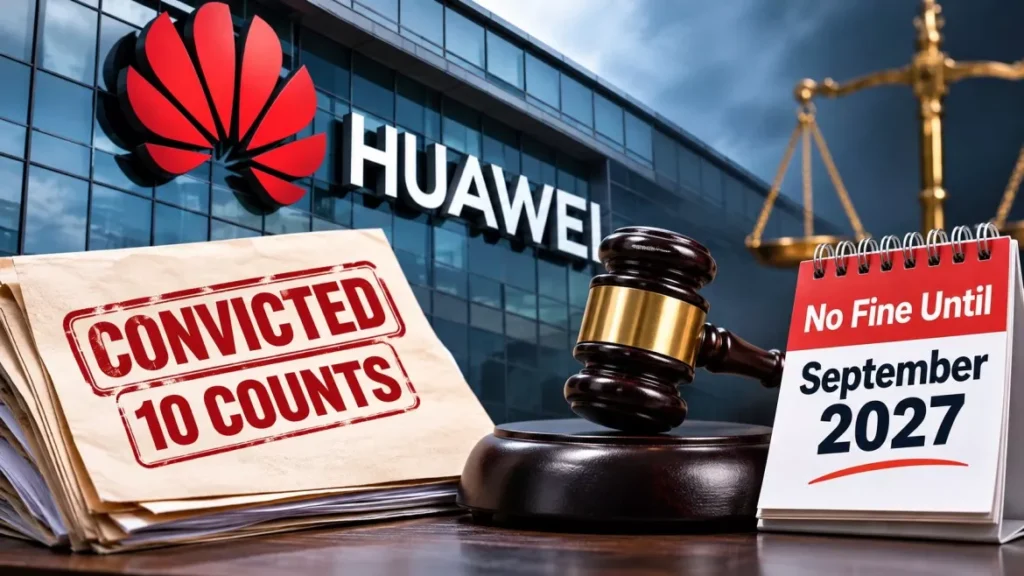

Huawei was convicted on 10 of 12 criminal counts by a federal jury in Brooklyn, New York, on 24 November 2026, along with three subsidiaries. The jury acquitted them of racketeering conspiracy. The verdict leaves Huawei convicted but not yet penalised; Judge Ann Donnelly is listed to sentence the companies on 14 September 2027.
The case is a United States federal prosecution, brought in the Eastern District of New York under US law against a Chinese company. It does not by itself change Huawei’s legal position in any other country.
What the Jury Decided
The jury returned guilty verdicts on 10 counts and not-guilty verdicts on two. The charges fall into eight groups, and the table below shows how each group ended.
| Charge | Outcome |
|---|---|
| Conspiracy to steal trade secrets | Convicted |
| Bank fraud and conspiracy to commit bank fraud | Convicted |
| Wire fraud and conspiracy to commit wire fraud | Convicted |
| Conspiracy to defraud the United States | Convicted |
| Violating and conspiring to violate the International Emergency Economic Powers Act | Convicted |
| Conspiracy to commit money laundering | Convicted |
| Racketeering conspiracy (RICO) | Acquitted |
| Conspiracy to obstruct justice | Acquitted |
The International Emergency Economic Powers Act, usually shortened to IEEPA, is the US statute that lets the president impose economic sanctions; the Iran sanctions programme at the centre of this case rests on it. The four convicted defendants are Huawei Technologies Co. Ltd., Huawei Device Co. Ltd., Futurewei Technologies Inc. and Huawei Device USA Inc.
Outlets have not reported a uniform count-by-count breakdown showing which of the four entities was convicted of which individual count, and the published accounts differ on how the 10 convictions distribute across them. Courthouse News Service reported that prosecutors dropped two of the original 14 counts shortly before trial, which is why 12 went to the jury.
Why the Racketeering Acquittal Matters
The racketeering conspiracy count was the government’s lead charge, and it was the only one that put Huawei’s business structure at risk. A RICO conviction can carry forfeiture of the assets of the enterprise itself, rather than a fine measured against particular transactions.
The jury rejected it, along with the charge of conspiring to obstruct justice. That removes the broadest financial exposure in the case while leaving the fraud, sanctions and trade secrets convictions standing.
No Penalty Has Been Set
As of 27 November 2026, no fine, forfeiture or restitution has been ordered against Huawei in this case, and no amount has been proposed in court. Reporting on the verdict says the companies face fines, forfeiture and restitution, with the amounts to be decided by the court at sentencing.
Figures in the billions of dollars have circulated in coverage of the verdict. Those are commentators’ estimates of possible exposure. Neither the Justice Department nor the court has published a number, and the statutes carry different maximum penalties for different counts, which the judge will apply at sentencing.
A criminal fine against a company is also not the same thing as restitution to the companies named as trade secret victims, and the two are decided separately. None of that happens before September 2027 on the current schedule.
What the Prosecution Was Built On
Two distinct strands ran through the trial. The first concerned Iran. Prosecutors said Huawei ran its Iranian business through Skycom Tech, a wholly owned subsidiary it presented to banks as an independent company, and that this deception secured credit and preserved access to US-dollar clearing. Three banks were named in the case: HSBC, Standard Chartered and BNP Paribas.
The second strand concerned intellectual property. Prosecutors alleged Huawei targeted proprietary technology at five companies:
- T-Mobile: robotic handset-testing equipment.
- Cisco Systems: router source code.
- CNEX Labs: semiconductor technology.
- Quintel: antenna technology.
- Fujitsu Network Communications: networking equipment information.
The jury convicted on conspiracy to steal trade secrets. It did not return separate verdicts naming each company, so the verdict is a finding on the conspiracy charge rather than a ruling on each of the five disputes. Huawei has been an active party in patent and licensing negotiations throughout the period, including the Huawei Qualcomm patent deal announced in October 2026.
What Huawei Said, and What It Did Not Say
Huawei published a statement on its own newsroom after the verdict. It welcomed the racketeering acquittal and said the government’s other charges are “equally without legal or factual merit”. It said the five trade secret disputes the government cited were civil matters resolved over the past two decades, and that no court ever found Huawei liable for wilful intellectual property misappropriation.
The statement did not use the word “appeal”. It said the company would review the verdicts and “take all necessary legal actions to defend our rights and interests”. The commitment to appeal came separately, from defence lawyer Brian Heberlig, who told reporters the company fully expects to appeal and argued that prosecutors “began with guilt and worked backwards”.
For the government, Attorney General Todd Blanche said “no person or company is above the law”. China’s foreign ministry has called the prosecution politically motivated, with spokesperson Guo Jiakun saying Beijing firmly opposes US suppression and containment of Chinese companies.
What It Changes for Huawei’s Business
Very little takes effect now. Huawei has been on the US Entity List since 2019 and has been effectively shut out of selling its products in the United States since then, so the conviction does not add a fresh commercial restriction in that market.
Huawei reported revenue of 880.9 billion yuan, about $126 billion, in its most recent full financial year, employs more than 200,000 people and operates in more than 170 countries. Its domestic business has continued to expand under existing restrictions, including its Ascend accelerator line. Dexter Tiff Roberts of the Atlantic Council’s Global China Hub told Fortune the verdict is unlikely to slow the company, and that Beijing may increase its support.
The verdict also arrived days after President Donald Trump met President Xi Jinping in Shenzhen, part of a wider run of summit diplomacy in November 2026. Beijing has pledged to take necessary measures to protect its companies, without naming any specific countermeasure.
What Happens Next
- Third week of January 2027: pre-sentencing motions are expected to begin, according to reporting on the verdict.
- 14 September 2027: sentencing before Judge Ann Donnelly in the Eastern District of New York, when fines, forfeiture and restitution would be decided.
- October 2027: a separate criminal case against two Huawei subsidiaries is scheduled for trial in Seattle.
- After sentencing: any appeal of the convictions would follow, to the US Court of Appeals for the Second Circuit.
All of those dates are court schedules and can move. The convictions stand unless and until an appeal succeeds.
Frequently Asked Questions
What Was Huawei Convicted Of?
A Brooklyn jury convicted Huawei and three subsidiaries of conspiracy to steal trade secrets, bank fraud, wire fraud, conspiracy to defraud the United States, violating and conspiring to violate US Iran sanctions, and conspiracy to commit money laundering.
Was Huawei Found Guilty of Racketeering?
No. The jury acquitted Huawei of racketeering conspiracy, which was the government’s lead charge, and of conspiracy to obstruct justice. Those were the two counts of 12 that did not produce convictions.
How Much Does Huawei Have to Pay?
Nothing has been ordered. As of 27 November 2026 no fine, forfeiture or restitution figure has been set by the court or proposed by the Justice Department in this case. Amounts would be determined at sentencing.
When Is Huawei’s Sentencing?
Sentencing is listed for 14 September 2027 before US District Judge Ann Donnelly in the Eastern District of New York. Court dates can be rescheduled.
Is Huawei Appealing the Conviction?
Huawei’s defence lawyer Brian Heberlig said the company fully expects to appeal. Huawei’s own written statement stopped short of the word, saying it would review the verdicts and take all necessary legal actions.
Does the Verdict Ban Huawei in the United States?
No. The verdict is a criminal conviction, not a trade restriction. Huawei was placed on the US Entity List in 2019 and has been effectively excluded from selling its products in the United States since then, independently of this case.