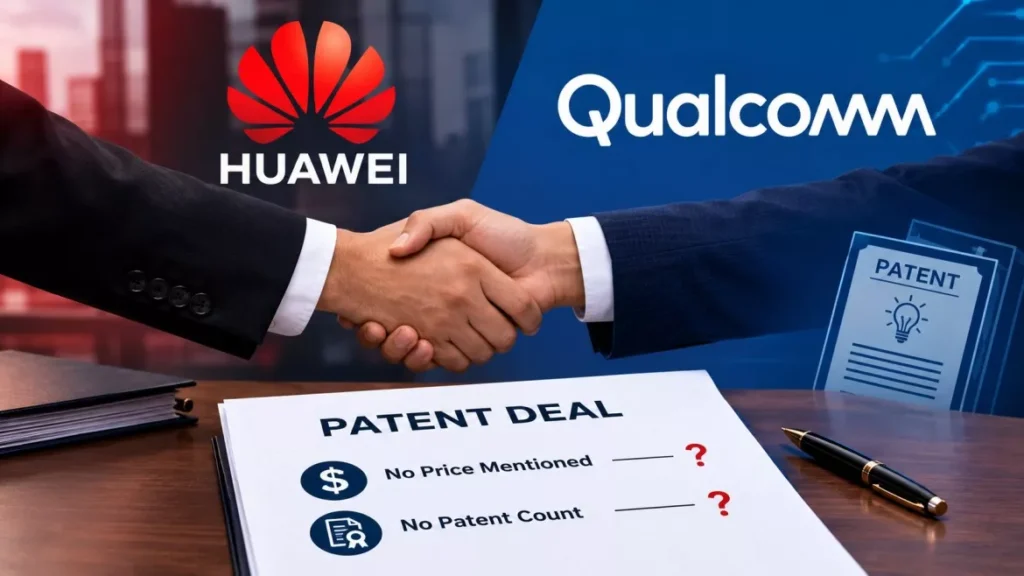

The Huawei Qualcomm patent deal announced on 5 October 2026 covers 5G, compute, AI and networking, and includes Qualcomm buying certain Huawei United States patents. The joint announcement names no price, no term length and no patent count. Headlines saying Qualcomm will pay Huawei for the first time rest on reporting by Nikkei Asia, not on the companies’ own statement.
What the Joint Announcement Confirms
Huawei and Qualcomm issued a joint announcement from Shenzhen on 5 October 2026. Stripped of interpretation, it establishes four things.
- A multi-year cross-licence: each company licenses the other’s patent portfolio across 5G, compute, AI and networking.
- A patent purchase: Qualcomm buys certain Huawei United States patents in compute, AI, networking and other technologies.
- A condition: “This transaction will close following receipt of the necessary regulatory approvals.”
- A framing: both describe the terms as consistent with fair, reasonable and non-discriminatory, or FRAND, principles, the standard that governs licensing of patents essential to a technical standard.
Alan Fan, Huawei’s Chief Intellectual Property Officer, said the agreement “not only demonstrates the value of Huawei’s innovations, but also recognizes Qualcomm’s foundational contributions to modern communication technologies”. John Han, Qualcomm’s Executive Vice President and General Manager of Technology Licensing, said it “reaffirms industry recognition of Qualcomm’s 5G technology leadership”.
What Is Reported but Not in the Announcement
Most of the widely repeated details about this deal come from outside the joint statement. The table separates the two.
| Claim | Where it comes from | Status |
|---|---|---|
| Qualcomm becomes the net payer for the first time | Nikkei Asia | Reported, not in the announcement |
| More than 680 Huawei patents are licensed | Trade reports including TrendForce | Reported |
| Those patents are 0.23 per cent of Huawei’s 296,248 active or pending patents | Trade reports | Reported |
| Huawei’s cumulative licensing revenue passes $6.9 billion once the deal closes | Huawei statements outside the joint release | Company claim |
| The portfolio includes LogicFolding and near-packaged optics patents | Trade reports | Reported |
| Royalty rates, purchase price, term length | Nowhere | Undisclosed |
The distinction is not pedantry. The only payment either company has confirmed is Qualcomm’s purchase of the United States patents, and a purchase price is not a royalty balance. Without rates or volumes from either side, no one outside the two companies can calculate who pays more.
What LogicFolding Is and Why It Matters Here
LogicFolding is Huawei’s chip-stacking architecture, and it is the most technically interesting thing reported to be inside the licensed portfolio. Instead of laying a processor out flat and shrinking its features, it splits the digital paths, memory and some analogue blocks across two active layers bonded together, with millions of vertical connections between them.
The point is distance. Replacing long horizontal wires with short vertical ones cuts how far a signal has to travel, which is the goal Huawei calls its Tau Scaling Law: optimise for signal delay rather than for feature size alone. Huawei reports the approach shortens core routing by about 20 per cent and some timing paths by as much as 70 per cent.
Huawei has already shipped it. The Kirin 9050 Pro commercialises LogicFolding, and Huawei cites roughly 55 per cent higher transistor density against a conventional planar part, with power down about 66 per cent on the neural processing unit, 58 per cent on the graphics unit and 41 per cent on the performance CPU cores. Those are Huawei’s own figures and have not been independently verified.
Huawei developed this while cut off from the most advanced chipmaking equipment, which is also the backdrop to Chinese memory makers moving to finer process nodes and to Huawei’s own Ascend accelerator roadmap.
Twenty-Five Years of Payments in One Direction
Huawei signed its first patent licence with Qualcomm in 2001. In the quarter-century since, Huawei says it has paid more than $6 billion in patent royalties, with close to 80 per cent of that going to United States companies.
That history is why the deal is being read as a reversal, and it is also why the framing deserves care. The verifiable change is narrower than the headlines: this is the first licence between the two companies to cover 5G, and the first in which Qualcomm is buying Huawei patents rather than only selling access to its own.
Which Approvals the Deal Still Needs
The transaction closes only after regulatory clearance, and United States review is expected because the agreement transfers United States patents to a buyer from a company under American trade restrictions. Reports note the deal value is understood to exceed the Hart-Scott-Rodino Act notification threshold of $133.9 million, which would trigger an antitrust filing.
Neither company has named the agencies involved, given a timetable, or said what happens if approval is refused or conditioned. As of 7 October 2026 the agreement is signed but not in force.
What It Changes for Phones and Chips
Nothing changes for anyone’s handset today. Patent cross-licences settle who may use which inventions without being sued; they do not alter products already on sale, and no device, price or feature changes on the strength of this announcement.
The longer-term consequence is about freedom to operate. If the deal closes, Qualcomm gains rights to use Huawei techniques in future compute, AI and networking silicon, and Huawei secures 5G rights it previously licensed on one-sided terms. Whether any of it appears in a shipping Snapdragon part is unannounced and would take years.
Frequently Asked Questions
Is Qualcomm Really Paying Huawei?
Qualcomm has confirmed it is buying certain Huawei United States patents, which involves payment. The claim that Qualcomm becomes the net payer overall comes from Nikkei Asia’s reporting, not from the joint announcement, and neither company has published the figures needed to verify it.
How Much Is the Huawei Qualcomm Patent Deal Worth?
Neither company has disclosed a value, a royalty rate or a term length. Huawei has said its cumulative patent licensing revenue will exceed $6.9 billion once the deal closes, which is a lifetime total rather than the value of this agreement.
When Does the Agreement Take Effect?
Only after regulatory approvals are received. The companies have not given a target date, named the regulators, or said what happens if clearance is withheld.
What Technologies Does the Cross-Licence Cover?
5G, compute, AI and networking, according to both companies. Trade reports add that the licensed Huawei patents include near-packaged optics interconnects and the LogicFolding chip architecture, though the companies have not published a patent list.
Does This Affect My Phone?
No. The agreement settles patent rights between two companies and does not change any device, price or feature that is on sale now.