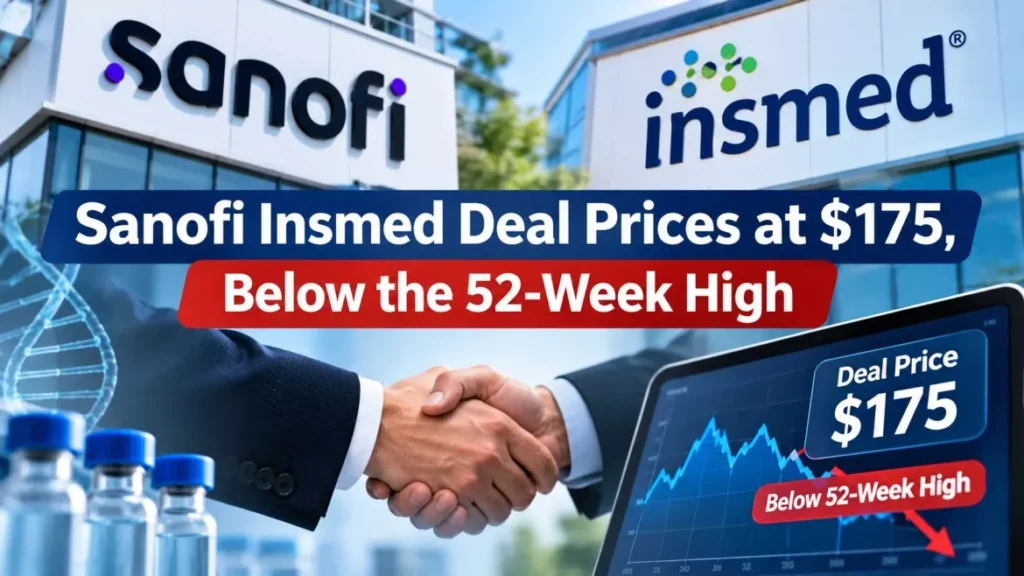

Sanofi will buy Insmed for $175 a share in cash, valuing the United States respiratory drugmaker at about $41 billion. The two companies signed the merger agreement on 23 November 2026 and expect to complete it in the first half of 2027. The Sanofi Insmed deal still needs shareholder approval.
Insmed Shareholders Are Offered Less Than the Stock Fetched Last Year
The $175 offer sits below Insmed’s highest share price of the past 12 months. Google Finance data on 24 November 2026 showed an intraday 52-week high of $212.75 and a 52-week low of $90.39, so the cash price lands between the two rather than above the range.
The 46% premium both companies cite is measured against a date six days before the announcement. Insmed’s statement to the Securities and Exchange Commission, the United States markets regulator, describes it as a premium of approximately 46% to the unaffected closing price on 18 November 2026, the day before media reports of a possible deal appeared.
By the last trading session before the announcement, most of that gain had already happened. Insmed closed at $149.09 on Monday 23 November 2026, according to Fierce Pharma, which puts the $175 offer about 17% above the final pre-deal close rather than 46% above it. CNBC reported that the shares had jumped 24% on 19 November, after Bloomberg reported a deal was under discussion.
As of 24 November 2026, no shareholder vote date had been set, no antitrust clearance had been announced, and the transaction remained unconditionally incomplete. Insmed shares rose 14.3% on 24 November to roughly $170.40, CNBC reported, still under the offer price — a normal pattern while a deal’s conditions are outstanding.
| Reference point | Price per Insmed share | As of |
|---|---|---|
| Sanofi’s cash offer | $175.00 | Announced 24 November 2026 |
| Unaffected close (deal premium baseline) | Basis for the stated 46% premium | 18 November 2026 |
| Last close before announcement | $149.09 | 23 November 2026 |
| Trading price after announcement | About $170.40 | 24 November 2026 |
| 52-week intraday high | $212.75 | Google Finance, 24 November 2026 |
| 52-week intraday low | $90.39 | Google Finance, 24 November 2026 |
Share prices move every trading day, and every figure above is a reading on a stated date rather than a standing value. Roth Capital lowered its rating on Insmed from buy to neutral on 24 November and cut its price target from $204 to $175, matching the offer — a routine adjustment once a cash price is agreed.
The Price Is Fixed in Cash, So It Will Not Drift
Insmed holders are being offered a fixed sum, not a floating one. The merger agreement sets the consideration at $175.00 in cash per share, without interest and subject to any required tax withholding, so the figure does not rise or fall with either company’s share price between signing and closing.
That distinguishes it from an all-stock purchase, where the headline value is only an estimate that moves with the buyer’s shares. The CrowdStrike and Zscaler all-stock deal announced the same week works the other way, paying in shares at a fixed exchange ratio whose cash equivalent changes daily.
Sanofi said it will fund the purchase with a combination of debt financing and cash on hand and has secured committed financing. It expects the deal to leave its 2026 financial guidance unchanged, to keep its progressive dividend policy, and to maintain a strong credit rating. Sanofi expects the acquisition to add to its business earnings per share by the end of 2028.
Which Medicines Sanofi Is Buying, and Who Can Take Them
The deal brings two approved medicines and one Phase 3 candidate, and the approved uses are narrower than the diseases they treat. Brinsupri and Arikayce are both on the market; treprostinil palmitil inhalation powder, known as TPIP, is not approved anywhere.
| Medicine | What it treats | Where approved | Reported revenue |
|---|---|---|---|
| Brinsupri (brensocatib) | Non-cystic fibrosis bronchiectasis | United States, European Union, United Kingdom, Japan | $1.09 billion from its August 2025 United States launch through 30 September 2026 |
| Arikayce (amikacin liposome inhalation suspension) | MAC lung disease, used with a multidrug regimen | United States, European Union, Japan | $433.8 million in 2025, up 19% year on year |
| TPIP (treprostinil palmitil inhalation powder) | Pulmonary hypertension and lung fibrosis conditions under investigation | Not approved in any jurisdiction | None; in Phase 3 development |
Brinsupri is a once-daily tablet that blocks DPP1, an enzyme involved in the inflammation driven by neutrophils, a type of white blood cell. It treats non-cystic fibrosis bronchiectasis, a long-term condition in which the airways widen and scar, causing repeated chest infections, in people who do not have cystic fibrosis.
The label is not the same everywhere. In the United States and Japan, Brinsupri is approved for adults and patients aged 12 and over. In the European Union and the United Kingdom, approval is limited to patients aged 12 and over who had two or more exacerbations — flare-ups of infection and symptoms — in the previous 12 months. Sanofi’s announcement also notes that live attenuated vaccines should be avoided in patients taking Brinsupri.
Arikayce is an inhaled antibacterial for MAC lung disease, an infection caused by Mycobacterium avium complex, a group of slow-growing bacteria that settle in the lungs. Its United States indication is the narrowest of the three: it covers adults with limited or no alternative treatment options who have not achieved negative sputum cultures after at least six months of a multidrug background regimen. That United States clearance is an accelerated approval based on sputum culture conversion, which means clinical benefit has not yet been established, and the medicine carries a United States boxed warning for increased respiratory adverse reactions. Insmed said in September 2026 that the Food and Drug Administration had accepted an application for a combination-regimen indication under priority review.
TPIP is a once-daily inhaled prostanoid whose safety and efficacy have not been established. It is in three Phase 3 programmes — PALM-PAH in pulmonary arterial hypertension, PALM-ILD in pulmonary hypertension associated with interstitial lung disease, and PALM-PPF in progressive pulmonary fibrosis — with a further Phase 3 study in idiopathic pulmonary fibrosis planned to start in the first half of 2027. Sanofi describes it as a possible growth driver beyond 2030, subject to clinical, regulatory and commercial success.
How Many Patients Are Diagnosed in Each Market
Sanofi published diagnosed patient counts by market, and they are larger than the groups the labels cover. The figures below come from Insmed data cited in Sanofi’s announcement of the acquisition.
- Non-cystic fibrosis bronchiectasis, United States: about 500,000 diagnosed patients.
- Non-cystic fibrosis bronchiectasis, five European markets: about 600,000 diagnosed patients across France, Germany, Italy, Spain and the United Kingdom combined.
- Non-cystic fibrosis bronchiectasis, Japan: about 150,000 diagnosed patients.
- MAC lung disease, United States: 95,000 to 115,000 diagnosed patients.
Sanofi’s own wording draws the distinction clearly: these are diagnosed populations, and only some of those patients in each jurisdiction are eligible for Brinsupri under its current labels. A diagnosed-patient total is not a forecast of how many people will be treated, and it is not a count of anyone’s individual eligibility, which depends on the label in their country and on a clinician’s judgement.
What the Deal Does to Insmed Employees’ Shares and Options
Insmed’s filing sets out how staff equity converts, and the treatment differs by award type and grant year. The terms below apply at the effective time of the merger, not at signing.
- Vested stock options in the money: cashed out for the difference between $175 and the exercise price.
- Options priced at or above $175: cancelled for no payment.
- Time-vested restricted stock units: cashed out at $175 per share, apart from 2026 and 2027 grants.
- Performance stock units: cashed out at $175 per unit, with any performance period not yet finished deemed achieved at maximum performance.
- 2026 grants of options and restricted stock units: for the last-vesting portion, half converts into cash awards that pay out on the earliest of the original vesting date, six months after closing, or a qualifying termination.
- 2027 grants of restricted stock units: converted into cash awards that keep their original vesting, settlement and payment schedules.
Neither company’s announcement says anything about Insmed’s workforce, its sites or who will lead the business after closing. That silence is worth noting rather than filling: no headcount decision, no site decision and no post-closing management structure has been disclosed.
The Conditions Outstanding and a Deadline That Can Move Twice
Three things must happen before the deal can close, and the contract allows the deadline to slip twice. Both boards have already approved the transaction, so the remaining steps sit with Insmed’s shareholders and with competition and investment regulators.
- Insmed shareholder approval: the agreement requires the affirmative vote of more than two-thirds of all the votes entitled to be cast by holders of outstanding Insmed common stock. Because the threshold counts all shares entitled to vote rather than only those voted, shares that abstain or are not voted have the same practical effect as votes against.
- United States antitrust clearance: the expiration or termination of the applicable waiting period under the Hart-Scott-Rodino Antitrust Improvements Act of 1976, the law requiring large deals to be notified to United States antitrust agencies before completion.
- Foreign clearances: the receipt of certain foreign antitrust and foreign direct investment clearances, which the filing does not name country by country.
The merger agreement sets an outside date of 11:59 p.m. Eastern Time on 23 August 2027. That date extends automatically to 23 November 2027, and then to 23 February 2028, in specified circumstances — so the first-half-of-2027 target the companies have given is an expectation, not the contractual limit.
Insmed would owe Sanofi a termination fee of $1,125,000,000 in specified circumstances, according to Insmed’s filing describing the merger agreement, including a change in the board’s recommendation or a decision by Insmed to terminate in order to accept a superior proposal. A fee of that size is the mechanism that prices a rival bid, much as the $300 million regulatory break fee in the Salesforce purchase of Braze did on a smaller deal. Insmed said it will file a proxy statement with the Securities and Exchange Commission; no vote date had been published as of 24 November 2026.
Why Sanofi Is Buying Before the Dupixent Patent Cliff
Sanofi is replacing revenue it expects to lose when its biggest medicine loses protection. Dupixent, its immunology blockbuster, accounts for roughly two-fifths of Sanofi group revenue and faces United States patent expiry in 2031, Fierce Pharma reported; Jefferies analysts expect loss of exclusivity around 2031 to 2032.
Belen Garijo, Chief Executive Officer of Sanofi, who took the role in May 2026 after the board chose not to renew her predecessor Paul Hudson’s mandate, said in the announcement: “I am delighted to welcome Insmed to Sanofi.” Will Lewis, Chair and Chief Executive Officer of Insmed, said the transaction “delivers immediate, certain cash value for Insmed shareholders.”
Analysts read it as time bought rather than a pipeline fixed. Barclays called the deal a “breath of fresh air” for Sanofi’s Dupixent patent outlook, while Jefferies analysts wrote that “the deal does not fix Sanofi’s R&D/pipeline questions, but it buys time.” CNBC reported Sanofi shares climbed 8% in Paris on 24 November, an unusual reaction for a buyer announcing a purchase of this size.
On scale, Fierce Pharma described it as Sanofi’s largest transaction since the Aventis merger in 2004, above the $20.1 billion paid upfront for Genzyme in 2011. CNBC reported it would be the pharmaceutical industry’s biggest deal since Pfizer bought Seagen for $43 billion in December 2023. Both characterisations come from single outlets.
Frequently Asked Questions
How Much Is Sanofi Paying for Each Insmed Share?
Sanofi is paying $175.00 per share in cash, without interest and subject to any required tax withholding. That values Insmed’s equity at about $41.0 billion, or €37.6 billion. The merger agreement was signed on 23 November 2026 and announced the following day.
Is $175 a Share Above What Insmed Traded at Before the Deal Leaked?
Yes, measured against 18 November 2026, which both companies use as the unaffected baseline for the stated 46% premium. Measured against the last close before the announcement, $149.09 on 23 November 2026, it is about 17% higher, because the shares had already risen after a 19 November report of a possible deal. It is below the 52-week intraday high of $212.75 recorded in Google Finance data on 24 November 2026.
Can Another Company Still Bid for Insmed?
The merger agreement contemplates the possibility of a superior proposal, and Insmed would owe Sanofi a $1,125,000,000 termination fee in specified circumstances if it ended the agreement to accept one. No competing bid had been announced as of 24 November 2026.
Does Anything Change for People Taking Brinsupri or Arikayce?
Neither company announced any change to supply, prescribing or pricing for either medicine. The approvals and labels remain with Insmed until the deal closes, which the companies expect in the first half of 2027, and the approved uses continue to differ between the United States, the European Union, the United Kingdom and Japan.
When Will Insmed Shareholders Vote on the Sanofi Insmed Deal?
No date had been set as of 24 November 2026. Insmed said it will file a proxy statement with the Securities and Exchange Commission, which is where the meeting date will be published. Approval requires more than two-thirds of all votes entitled to be cast.