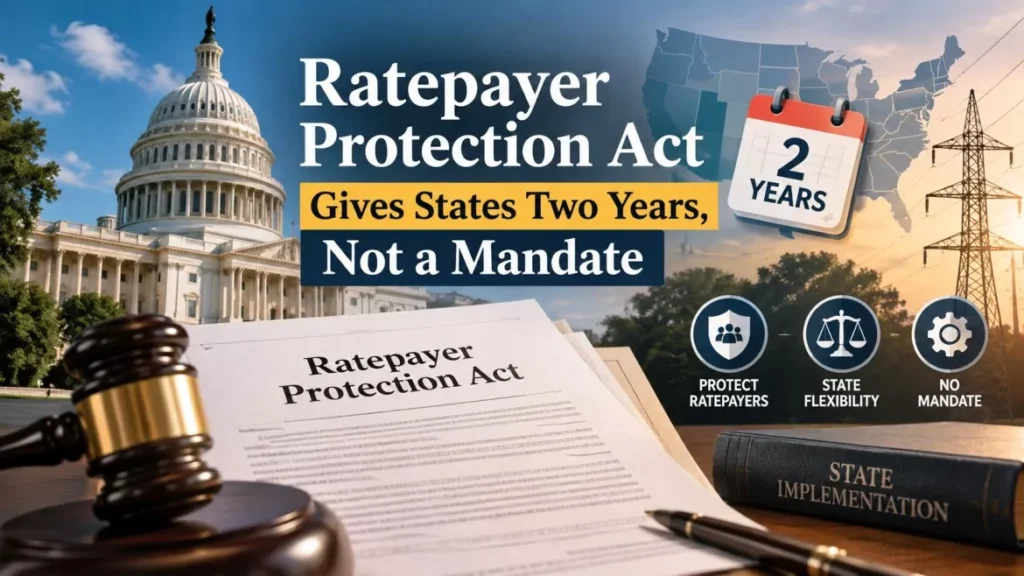

The United States House of Representatives passed the Ratepayer Protection Act by 417 votes to 3 on 16 September 2026. The bill would push electricity grid upgrade costs onto data centres drawing 100 megawatts or more. It does not set rates itself: state regulators keep that power.
What the Ratepayer Protection Act Actually Requires
The bill creates a federal ratemaking standard, not a federal rate. H.R. 9340 amends section 111(d) of the Public Utility Regulatory Policies Act of 1978, the law that lets Congress hand state utility regulators a list of pricing principles to weigh, by adding a new paragraph 22.
The standard itself is one sentence. Under the text of H.R. 9340 as reported to the House, a rate charged by an electric utility to a large-load customer “shall be designed to recover from the large-load customer the full, incremental cost of any generation, transmission, or distribution upgrade necessary to serve” that customer’s load.
In plain terms: if a data centre needs a new substation, a new transmission line or new generating capacity, the bill’s standard says the data centre pays for it, rather than the cost being spread across every household and small business on the same system.
Who the 100-Megawatt Threshold Covers
The bill covers a narrow band of very large electricity users, and the definition does the work. A “large-load customer” under H.R. 9340 is a non-residential consumer that needs electricity primarily to run information technology infrastructure, with peak demand of 100 megawatts or more at a single site or campus.
Three limits follow from that wording:
- Size: facilities below 100 megawatts of peak demand fall outside the standard entirely, however many of them a utility connects.
- Aggregation: the 100 megawatts is measured across facilities at one site or campus in aggregate, so a cluster counts as one customer.
- Type of user: the definition is tied to information technology infrastructure, so other heavy industrial loads of comparable size are not the target.
Demand at that scale is already reshaping the American grid. The US Energy Information Administration, the federal statistical agency for energy, said on 9 September 2026 that it expects US electricity generation to grow 2.2% to a record 4,368 billion kilowatt-hours in 2026, with a further 1.7% rise in 2027, and pointed to data centre development and manufacturing in the West South Central region as a particularly strong source of that demand.
The Clock Starts at Enactment, Not at the House Vote
None of the bill’s deadlines have begun. The timetable in H.R. 9340 runs from the date of enactment, which requires Senate passage and a presidential signature.
- Enactment: the deadlines below start only from this date; nothing is triggered by the House vote alone.
- Within one year of enactment: each state regulatory authority and each non-regulated electric utility must commence consideration of the standard.
- Within two years of enactment: each must complete its determination on whether to adopt it.
The word “consider” is the hinge. PURPA’s section 111(d) process obliges a state commission to open a proceeding and reach a documented decision; it does not oblige the commission to say yes. A state that opens a docket, takes evidence and declines to adopt the standard has complied with the statute.
Why the Senate Calendar Is the Obstacle
As of 18 September 2026, the Ratepayer Protection Act has passed only one chamber of the United States Congress and no Senate vote has been scheduled. The House cleared it under suspension of the rules, the fast-track procedure that bars amendments and requires a two-thirds majority, which the 417-3 tally comfortably met.
The wider calendar narrows the window further. House Speaker Mike Johnson cancelled votes scheduled for Thursday 17 September and adjourned the chamber until after the 3 November midterm elections. A Senate companion bill has been introduced by Senator Jon Husted, Republican of Ohio, according to reporting by Fox News, but it has not received a vote.
Most Very Large Loads Already Face State Tariffs
Much of what the bill asks states to consider, states have already been doing. Utility Dive reported on 31 March 2026, citing the Smart Electric Power Alliance’s Database of Emerging Large Load Tariffs, that 77 large-load tariffs were pending or in place across 36 states.
A large-load tariff is a separate rate class for very big customers, typically carrying higher upfront payments for engineering and infrastructure studies, minimum contract terms of several years, minimum-take obligations and exit fees. The same tracking found that regulators approved 29 such tariffs during 2025, against 14 approvals in total between 2018 and 2024, and that thresholds have been climbing from the 5 to 25 megawatt range towards 50 megawatts and above.
Because those tariffs already exist in much of the country, the practical effect of the federal standard would vary sharply by state. Where a commission has adopted a large-load tariff, the PURPA proceeding may largely confirm existing policy. Where none exists, the proceeding would be the first time the question is formally put.
What the Bill Does Not Do
The Act does not cap anyone’s electricity bill, set a rate for data centres or guarantee a household saving. Congress does not set retail electricity rates; state commissions do, and the bill leaves that division intact.
It also does not address the other objections raised against large data centres, including water use, siting and local land-use decisions, or the pace of artificial intelligence development.
Three members voted against it. NBC News reported that Representatives Summer Lee of Pennsylvania, Delia Ramirez of Illinois and Rashida Tlaib of Michigan, all Democrats, opposed the bill, with Tlaib saying it “fails to meaningfully protect our communities” and arguing for a national moratorium on new data centre construction instead. Supporters made the narrower case. Representative Gabe Evans, Republican of Colorado, who introduced the bill with Representative Kathy Castor, Democrat of Florida, said hardworking families should not have to subsidise the energy demands of data centres.
Frequently Asked Questions
What Does the Ratepayer Protection Act Do?
It adds a standard to the Public Utility Regulatory Policies Act of 1978 saying that rates for very large electricity users should recover the full incremental cost of the grid upgrades needed to serve them. It applies in the United States only, and it directs state regulators to consider the standard rather than imposing it.
Which Data Centres Does the 100-Megawatt Threshold Cover?
Non-residential customers that use electricity primarily for information technology infrastructure and have peak demand of 100 megawatts or more at a single site or campus, measured in aggregate. Facilities below that level are outside the standard.
Has the Ratepayer Protection Act Become Law?
No. As of 18 September 2026 it has passed the US House of Representatives only. It would need to pass the Senate and be signed by the President before any of its deadlines begin.
When Would US States Have to Decide?
If the bill were enacted, each state regulatory authority would have to begin considering the standard within one year of enactment and complete its determination within two years. A state may decline to adopt it after that process.
Would the Bill Lower Household Electricity Bills?
The bill does not set rates or promise a reduction. Its stated aim is to stop the cost of upgrades built for very large customers being recovered from other customers; what any individual household pays depends on its own utility, state commission and tariff.