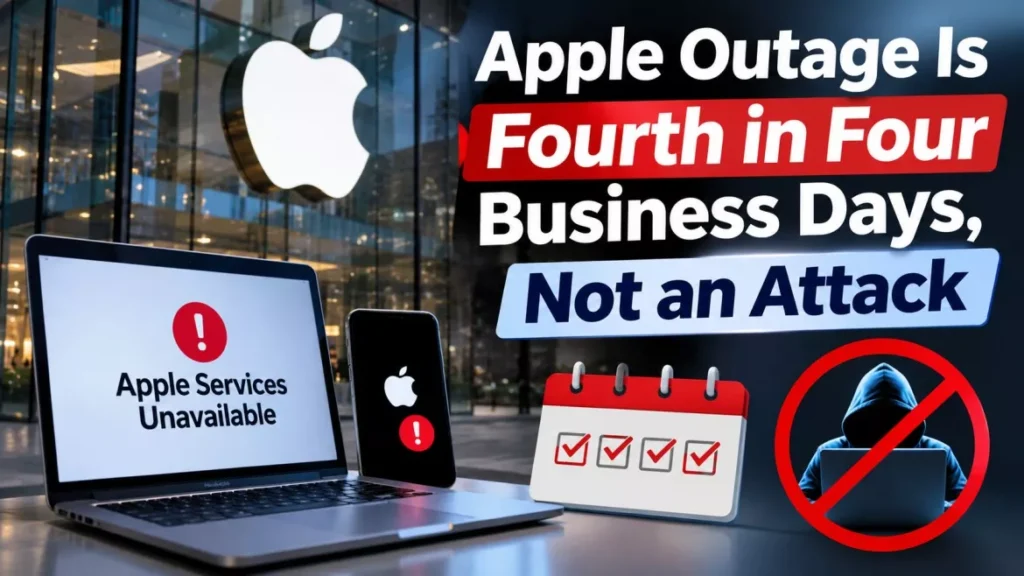

Apple has blamed an internal update for the outage that hit iCloud, the App Store and Apple Music on Tuesday 17 November 2026. The Apple outage began late that morning Eastern time and was the fourth major failure in four consecutive business days. Apple said it was not a cyberattack.
What Broke During the Apple Outage
The disruption hit sign-in and account services hardest, which is why it reached so many separate apps at once.
Apple’s own System Status page listed an AppleCare issue from 11:15 a.m. Eastern Time, according to TIME’s reading of the page. Engadget reported that user complaints began at about 11:30 a.m. Eastern Time and rose into the thousands by around 12:29 p.m.
Apple, the Cupertino company that makes the iPhone, eventually confirmed problems on both its general and developer status pages. The services listed or widely reported as affected were:
- iCloud Account and Sign In: Marked on Apple’s status page as affecting all users.
- App Store and Apple Music: Downloads, purchases and streaming failed for many users.
- AppleCare on Device: Apple’s page said AppleCare purchase was temporarily unavailable.
- iCloud Mail and iCloud.com web apps: Listed by Apple alongside Apple School Manager, Schoolwork and the Volume Purchase Program.
- Apple Support and device activation: Reported by users on Downdetector rather than confirmed on Apple’s status page.
- App Store Connect: Developers reported being unable to reach the publishing tool.
Apple Pay is the one service where the record is mixed. Downdetector logged a spike of Apple Pay complaints, and TIME counted roughly 2,000 reports across Apple Support, Apple Pay and iCloud shortly before 1 p.m. Eastern Time, but Apple’s public status feed did not list an Apple Pay incident when outlets checked it.
What Apple Said Caused It
Apple attributed the failure to a change it made itself, not to an attacker. A company spokesperson said: “Many of our systems are back up and running after an internal update caused some outages this morning.”
Apple gave that wording first to Bloomberg and then repeated it in Apple’s statement to TechCrunch, and CBS News carried the same sentence. The spokesperson also said the problems were not the result of a cyberattack, and said Apple was working to restore the remaining systems.
Apple has not said what the internal update changed, which systems it was applied to, or why it was not caught before release.
Four Outages in Four Business Days
Apple’s failure was the fourth large outage at a major institution in four consecutive business days, and each organisation has given a different cause. CNBC counted the run as four system problems in four consecutive business days.
| Date | Organisation | What Failed | Stated Cause | Status |
|---|---|---|---|---|
| Thursday 12 November | Microsoft | Outlook, Teams and other Microsoft 365 services | A latent software defect, undetected for months, exposed by a network capacity upgrade | Resolved; preliminary root cause published |
| Friday 13 November | US Federal Aviation Administration | Nationwide ground stop and flight delays | A router upgrade in southern Arkansas that overwhelmed the agency’s telecommunications network | Root cause still under investigation |
| Monday 16 November | JPMorgan Chase | Customer transactions and app access | A software bug in on-premise hardware systems | Resolved; Chase said it was not cyber-related |
| Tuesday 17 November | Apple | iCloud sign-in, App Store, Apple Music, AppleCare | An internal update | Most services restored the same day |
Microsoft’s preliminary explanation, given when it closed the incident, was that “the incident was introduced by an issue during an earlier network capacity upgrade that surfaced following a recent network change”. Charles Lamanna, Microsoft’s executive vice-president for Copilot, Agents and Platform, described a defect that made servers unresponsive under certain load conditions. Our earlier report on the Microsoft 365 outage was published before that cause was known.
The FAA pointed in part to a router installed during a network upgrade overseen by the contractor L3Harris Technologies, which flooded its telecommunications network and destabilised older air traffic control equipment. The agency said it had no indication of a cyberattack and that the investigation remains open.
A fifth incident fell on the same Tuesday as Apple’s: the National Security Agency’s internal communications network went down. The NSA attributed that to temporary degradation during scheduled routine maintenance. The pattern of a single operator’s change taking down consumer-facing services also matched the Google Cloud outage that hit UK banks in October.
Who Ruled Out a Cyberattack
The most senior statement came from the top US intelligence official, who said the cluster was neither an attack nor coordinated.
Jay Clayton, the Director of National Intelligence, told CNBC’s Closing Bell on 17 November: “This is not cyber attack, and this is not a coordinated effort by a nation state.” He added that officials had “looked very closely”.
Not everyone accepted that the matter is settled. Representative Hakeem Jeffries, the House Minority Leader, said it was “too premature” to rule out malicious activity and called for a congressional briefing.
A separate explanation came from Homeland Security Secretary Markwayne Mullin, who suggested on Fox News that artificial intelligence might be involved, citing an unnamed industry contact and saying, “I believe that it’s the SI,” a reference to super intelligence. Fortune reported those remarks. Mullin also said he could tell Americans “with 98% certainty, we’re not seeing a cyber attack”. Microsoft has said its own outage was not related to cyber or AI agents.
Where Apple Services Stand
As of 18 November 2026, Apple has restored most affected services but has published no post-incident report. By 3:30 p.m. Eastern Time on 17 November, Apple had marked the App Store issue resolved, while the AppleCare on Device entry was still listed as ongoing and affecting all users, according to TIME. CBS News reported that Apple’s status page still showed disruption to some services, including iCloud sign-in, on Tuesday afternoon.
Apple has not given a full restoration time, has not said how many users were affected, and has not committed to publishing a technical review.
What Apple Users Should Do Now
Most of the steps people took during the outage were unnecessary, because the fault was on Apple’s servers rather than on their devices.
- Check the status page first: Apple’s System Status page shows whether sign-in, iCloud and the App Store are affected before you reset anything on your own device.
- Do not repeat failed purchases: Check your App Store purchase history before buying a download again, in case the original charge went through.
- Re-check iCloud syncing: Open iCloud Mail and iCloud.com to confirm that anything created during the outage window has synced.
- Treat sign-in failures as server-side: Apple said there was no cyberattack, so repeated password changes were not needed. Our guide to the closure of the Apple Support Community covers where Apple is directing help requests from 20 November.
What Is Still Unknown
Several details remain unconfirmed a day after the Apple outage.
- The update itself: Apple has not described what the internal update did or which infrastructure it touched.
- Apple Pay: Whether payments were genuinely affected is unresolved, because user reports and Apple’s status feed disagreed.
- The FAA root cause: The agency and L3Harris Technologies have not finished their investigation.
- The timing: No agency has published a combined technical review explaining why four unrelated failures landed in four business days.
Apple Outage FAQ
What Caused the Apple Outage?
Apple said an internal update caused it. A spokesperson said many systems were back up “after an internal update caused some outages this morning”. Apple has not said what the update changed.
Was the Apple Outage a Cyberattack?
No. Apple said the outage was not the result of a cyberattack. Jay Clayton, the Director of National Intelligence, said on 17 November that the week’s outages were not a cyberattack or a coordinated nation-state effort.
Which Apple Services Were Affected?
Apple listed iCloud Account and Sign In, the App Store, Apple Music, AppleCare on Device, iCloud Mail, iCloud.com web apps, Apple School Manager, Schoolwork and the Volume Purchase Program. Users also reported problems with Apple Support, device activation and App Store Connect.
Are the Apple, Microsoft, FAA and Chase Outages Connected?
There is no evidence that they are. Each organisation gave a separate technical cause, and the Director of National Intelligence said the incidents were not coordinated. No agency has published a combined review.
Is the Apple Outage Fixed?
Most services were restored on 17 November, including the App Store. Apple’s status page still listed disruption to some services, including iCloud sign-in, on Tuesday afternoon, and as of 18 November 2026 Apple has not published a post-incident report.