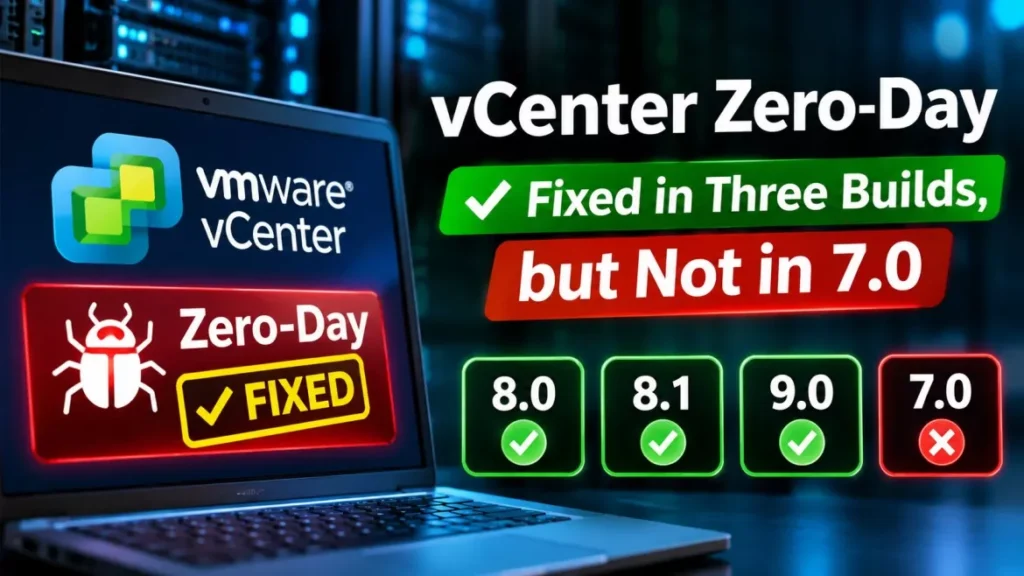

Broadcom has patched a vCenter zero-day that attackers used for more than two months before any fix existed. CVE-2026-123890 scores 9.8 out of 10 and was fixed on 19 November 2026 in vCenter builds 9.1.1.0200, 9.0.2.0200 and 8.0 U3m. Version 7.0 receives no public patch.
What the vCenter Flaw Lets an Attacker Do
CVE-2026-123890 lets anyone who can reach a vCenter server over the network sign in as its highest-privilege administrator without a password. The flaw sits in the VMware Directory Service, the component that handles vCenter logins, which listens on TCP port 2012.
Google’s Mandiant, the incident response arm of Google Cloud, describes it as a session key disclosure in that service that allows a remote authentication bypass as [email protected], the built-in superuser account. No valid credentials and no prior foothold on the server are needed.
vCenter is the management console for VMware virtualisation, so an administrator session on it carries authority over every virtual machine and host that server controls. Mandiant reported that the attackers used the access to copy vCenter’s identity database, extract the private key the server uses to vouch for logins, and create an administrator account of their own.
Which vCenter Builds Contain the Fix
Broadcom published the fix on 19 November 2026 in advisory VMSA-2026-0009, with one patched build for each supported vCenter line.
| vCenter line | Build that contains the fix |
|---|---|
| vCenter 9.1.x | 9.1.1.0200 |
| vCenter 9.0.x | 9.0.2.0200 |
| vCenter 8.0 | 8.0 U3m |
| vCenter 7.0 and earlier | No public fix |
Anything below those build numbers on the 8.0, 9.0 and 9.1 lines is still exposed. Decryption Digest, which published a technical breakdown on 22 November, reports that the builds shipped in Broadcom’s previous advisory — 8.0 U3k and 9.0.2.0100 — do not contain this fix; that detail comes from a single outlet rather than from Broadcom’s own wording.
The patch is applied as a full update rather than a quick patch, so administrators should expect vCenter’s management interfaces to be unavailable during the maintenance window.
Why vCenter 7.0 and Earlier Get No Patch
vCenter 7.0 is vulnerable and has no public fix, because the line left general support on 2 October 2025. Mandiant states that the attackers’ exploitation tool “achieves full system compromise against vCenter Server 7.x and 8.x appliances”, so the exposure is demonstrated rather than theoretical.
Broadcom directs customers holding an extended support contract to its support organisation for a build. Organisations without one have nothing to install, which leaves two practical options: upgrade to a supported line, or restrict who can reach port 2012 on the appliance at the network layer. Restricting the port reduces exposure; it does not remove the flaw.
Broadcom has not published guidance treating vCenter 6.5 and 6.7 separately. Both are further out of support than 7.0 and should be assumed affected.
Why Applying the Patch Does Not Close the Incident
Installing the fix stops the authentication bypass, but it does not reverse anything an attacker did beforehand. This is the part that most coverage of the flaw treats as a footnote.
Mandiant found the group stealing the SAML signing key that vCenter uses to issue login assertions, creating an extra administrator in the vsphere.local single sign-on domain, and adding a backdoor machine account. None of those are removed by a software update. A forged login token signed with a stolen key continues to work on a fully patched server, which is the same pattern seen in the Plex Media Server vulnerability, where patching did not clean an already-compromised server.
Mandiant’s own conclusion in its 19 November report is that “relying solely on reactive patching is insufficient to protect it”, and the firm recommends network hardening and logging around vCenter alongside the update.
What to Do Now
The order matters: confirm what you are running, close the hole, then check whether it was already used.
- Identify your build: Check the running vCenter build against the table above, not the version label alone. An appliance can report 8.0 while sitting below U3m.
- Apply VMSA-2026-0009: Update to 9.1.1.0200, 9.0.2.0200 or 8.0 U3m, depending on the line.
- Restrict port 2012 if you cannot patch: On 7.0 and earlier, limit TCP 2012 to authorised vCenter peers at the firewall as an interim measure, and open a support case or plan the upgrade.
- Audit single sign-on administrators: Review the vsphere.local administrators group for accounts you did not create, and check when each was added.
- Replace trust material: If compromise is suspected, rotate the SAML signing certificate and the single sign-on credentials, because a stolen signing key survives patching.
- Look for the tooling: Mandiant published detection rules and indicators for the malware families used in these intrusions, including files dropped in /tmp on the appliance and SSH being switched on through the management interface.
Who Exploited the vCenter Zero-Day, and What Broadcom Has Not Said
Google’s Threat Intelligence Group attributes the attacks to ARMORY CASTLE, a suspected Chinese state-linked espionage group it previously tracked as UNC5221. The earliest forensic evidence places the group’s exploitation tool on a vCenter server in early September 2026, roughly ten weeks before the patch.
Initial access did not come through vCenter. Mandiant reports the group first exploited a separate zero-day in BeyondTrust Remote Support, CVE-2026-102764, then moved laterally to Linux appliances inside the network before reaching the virtualisation layer. The same pattern of patient, infrastructure-level intrusion by China-linked operators appeared in the Volt Typhoon relay network built on compromised home routers.
Two limits are worth stating plainly. Broadcom’s advisory credits Mandiant with reporting the flaw but does not itself mention exploitation in the wild, according to SecurityWeek’s report of 19 November, so the exploitation timeline rests on Mandiant’s forensics rather than a vendor acknowledgement. Neither company has said how many organisations were affected, nor named any victim.
The CISA Deadline and Who It Binds
The 23 November deadline circulating alongside this flaw is a United States government obligation, not a global one. CISA, the US Cybersecurity and Infrastructure Security Agency, added CVE-2026-123890 to its Known Exploited Vulnerabilities catalogue on 20 November 2026 with a due date of 23 November 2026.
That date binds federal civilian executive branch agencies under Binding Operational Directive 26-04, which also requires forensic triage rather than patching alone. Private companies and organisations outside the United States are not covered by it, though a three-day window on a flaw with confirmed espionage use is a reasonable benchmark. CISA set a comparable short deadline for the Ivanti Connect Secure zero-day in October 2026.
CISA added three other actively exploited flaws to the catalogue the same day, affecting Apache Roller, Cisco Expressway and SAP NetWeaver, all carrying the same 23 November due date.
As of 23 November 2026, fixes exist for vCenter 8.0, 9.0 and 9.1; no public fix exists for 7.0 or earlier; and neither Broadcom nor CISA has published a figure for how many servers were compromised.
Frequently Asked Questions
Which vCenter Versions Are Affected by CVE-2026-123890?
vCenter 7.x and 8.x are confirmed vulnerable by Mandiant’s testing, and unpatched 9.0 and 9.1 deployments are covered by Broadcom’s advisory. The fixed builds are 9.1.1.0200, 9.0.2.0200 and 8.0 U3m.
Is There a Workaround if I Cannot Patch Straight Away?
There is no vendor workaround that removes the flaw. Restricting TCP port 2012 on the vCenter appliance to authorised peers reduces who can reach the vulnerable service, and is the interim step recommended for versions with no available fix.
Does Installing the Patch Mean My vCenter Is Safe?
Not on its own. The update blocks the bypass but leaves behind any administrator account, machine account or stolen signing key an attacker created earlier. Reviewing single sign-on administrators and rotating trust material is the second half of the job.
Who Is Behind the vCenter Zero-Day Attacks?
Google’s Threat Intelligence Group attributes them to ARMORY CASTLE, a suspected Chinese state-linked espionage actor formerly tracked as UNC5221. The attribution is Google’s; Broadcom has not named any attacker.
Does the 23 November CISA Deadline Apply to Private Companies?
No. It is binding only on United States federal civilian agencies under Binding Operational Directive 26-04. Other organisations can treat it as a severity signal rather than a legal requirement.