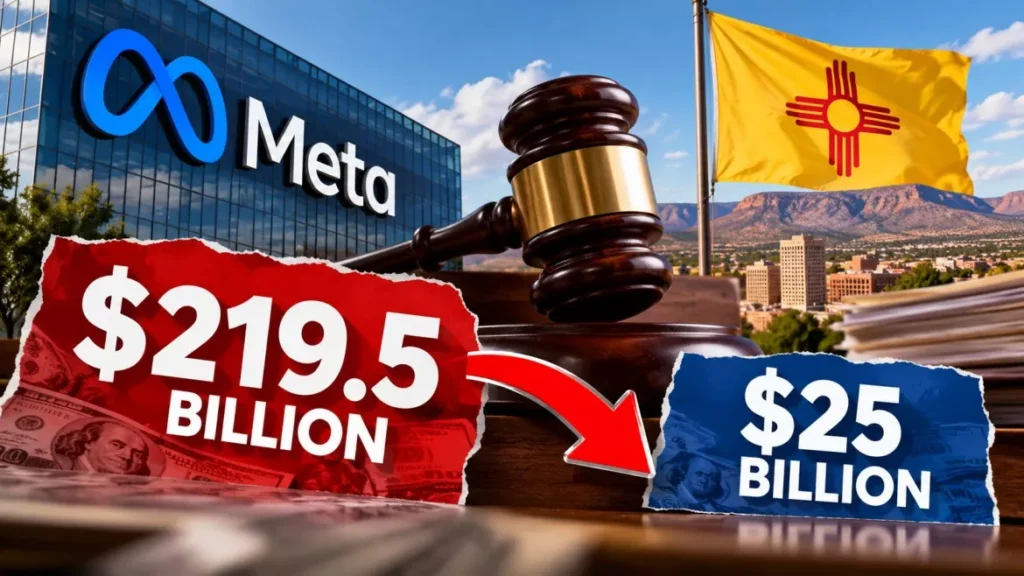

The Meta New Mexico ruling cut a $219.5 billion penalty calculation down to a $25 billion judgment. Judge Francis J. Mathew of New Mexico’s First Judicial District Court in Santa Fe signed the order on 21 October 2026, after a jury found the company liable in September. Meta says it will appeal.
How the Court Reached $219.5 Billion
The penalty was built by multiplication, not by estimating what anyone lost. New Mexico’s Unfair Practices Act allows a civil penalty of up to $5,000 for each willful violation, and the court applied that ceiling to every violation the jury counted.
The figure the court calculated before reducing it was $219,498,600,000, according to DiCello Levitt, the firm that led the state’s trial team. That sum divides exactly by the $5,000 statutory maximum into 43,899,720 violations — consistent with the “nearly 44 million willful violations” the same firm described, and with the “more than 43 million” most news organisations reported.
Judge Mathew then reduced the award to $25 billion. The state had asked for $35 billion to $40 billion, according to Reuters; ABC News put the state’s request at $35 billion to $45 billion. Meta had argued the penalty should be capped at no more than $3.45 billion.
Why 43.9 Million Violations in a State of 2.1 Million People
The violation count is about 21 times New Mexico’s population because each misleading statement was counted once for every resident who may have seen it, not once per statement and not once per person who was actually deceived.
The jury found that 26 of 29 statements made by Meta and its leadership were misleading. Multiplying those statements by the potential New Mexico audience produced the tally. For scale, Reuters reported the state had about 1.4 million active Facebook users and a population of 2.1 million as of 2020.
This is the mechanism almost no coverage spells out, and it is also the part Meta is expected to attack. The count does not rest on evidence that any particular person read a particular statement or acted on it.
What the Jury Decided and What the Judge Decided
The case ran in two stages, and the $25 billion figure belongs only to the second.
- 25 September 2026: The jury returned its verdict, finding Meta liable under the Unfair Practices Act and identifying 26 of 29 statements as misleading.
- 21 October 2026: Judge Mathew issued the penalty order, calculating $219,498,600,000 and entering judgment for $25 billion.
The case is State of New Mexico v. Facebook Inc., No. D-101-CV-2021-00132, filed in 2021 in the First Judicial District Court for the County of Santa Fe. The conduct at issue was Meta’s statements to users about privacy and content moderation, in a dispute rooted in Cambridge Analytica’s use of Facebook user data to build targeted political advertising around the 2016 United States general election.
What the Ruling Does Not Do
As of 25 October 2026 this is a money judgment and nothing more, and it is not final.
- No product changes: Reporting on the order describes no injunction and no court-ordered changes to how Facebook or Instagram operate.
- No criminal finding: This was a civil consumer-protection action brought by the state, not a prosecution.
- Not the child-safety case: A separate New Mexico action before a different judge produced a $375 million jury penalty in March 2026 and a further $567 million order on public-nuisance grounds. That is a distinct matter from this one.
- Not yet collectable: Meta has stated an intention to appeal both the verdict and the penalty, and no notice of appeal had been reported as filed as of 24 October 2026.
One outlet reported that the judgment accrues interest at 15% a year until paid. That figure did not appear in any second independent source and is not treated as established here.
Where the Money Would Go
Civil penalties recovered by New Mexico would go into the state’s current school fund, which supports public education. Attorney General Raúl Torrez’s office and the state’s trial counsel have both pointed to education as the destination.
No money moves while an appeal is live. Readers looking for the state-enforcement pattern this fits into can compare the recent multi-state action against OpenAI, which seeks fines and product conditions rather than a jury penalty.
What Happens on Appeal
Meta’s chief legal officer, C.J. Mahoney, said the company is “confident we will prevail on appeal” and told ABC News the ruling makes it “all but impossible to do business in the state of New Mexico”. Attorney General Torrez called the judgment the “single largest, if not the largest, single state verdict against the company in American history” and said the state is ready to defend it.
Three law professors interviewed by Reuters on 22 October identified the violation count as the weakest link. Peter Ormerod of Villanova University said “the most vulnerable basis on appeal is going to be the question about whether a violation is going to count.” Eric Goldman of Santa Clara University School of Law said “it felt like there was a lot of duplicative counting in the calculations.” Daryl Lim of Penn State Dickinson Law said the size of the penalty alone does not mean it will be overturned, because the statute permits a penalty for each willful violation.
Meta is also expected to argue that a penalty of this scale breaches constitutional protections against excessive fines and its due-process rights, and Ormerod noted the company could ultimately seek review in the United States Supreme Court. None of that has been briefed or decided. The company reported the scale of its finances in its most recent quarterly results.
Frequently Asked Questions
What Did the Meta New Mexico Ruling Order?
Judge Francis J. Mathew entered a $25 billion civil judgment against Meta on 21 October 2026 in the First Judicial District Court of New Mexico, in the United States. The order followed a jury verdict finding the company liable under the state’s Unfair Practices Act.
How Were 43.9 Million Violations Counted?
The jury found 26 of 29 statements by Meta and its leadership misleading, and each statement was counted once for every New Mexico resident who may have seen it. The count does not require proof that a specific person saw or relied on a statement.
Why Was the Penalty Reduced From $219.5 Billion?
The court calculated $219,498,600,000 by applying the $5,000 statutory maximum to every violation, then entered judgment at $25 billion. The order does not oblige a court to impose the statutory maximum.
Has Meta Paid Anything?
No. Meta has said it will appeal both the verdict and the penalty, and the judgment is not final while an appeal is pending. As of 24 October 2026 no notice of appeal had been reported as filed.
Is This the Same as the New Mexico Child-Safety Case?
No. That is a separate New Mexico action before a different judge, which produced a $375 million jury penalty in March 2026 and a further $567 million order on public-nuisance grounds.