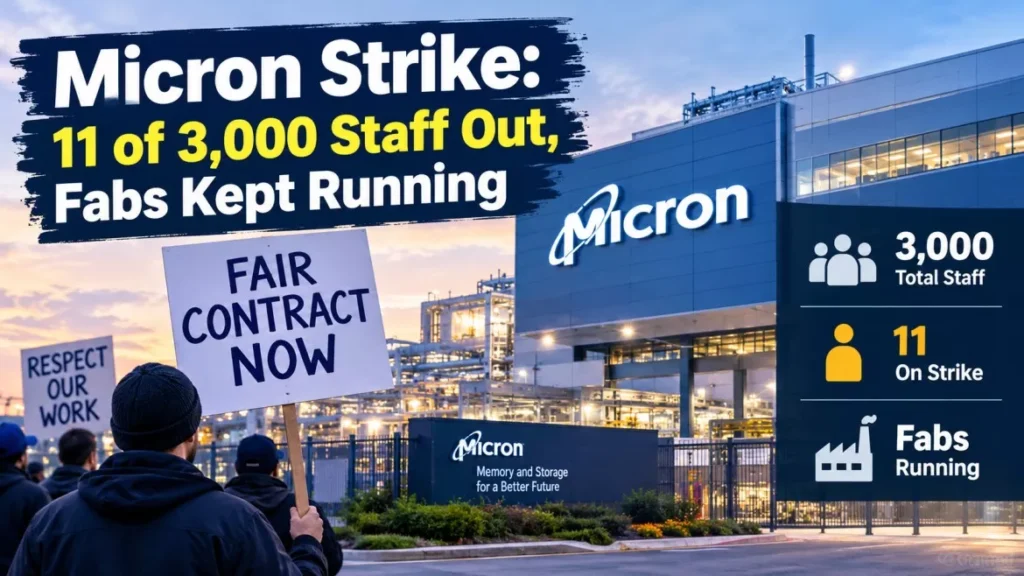

The Micron strike at the company’s Taoyuan site in Taiwan ran for 24 hours, from 09:00 on 22 October 2026 to 09:00 on 23 October. Eleven union officials took part, out of about 3,000 workers at the plant, and no effect on production was reported. Negotiations resume on Friday afternoon.
What Actually Stopped at Taoyuan
Very little stopped. The Taoyuan union of Micron Technology, the Idaho-based memory maker, called a one-day warning strike and staffed it with 11 of its own officials, who picketed the gate of the Taoyuan operations rather than pulling production workers off shift.
Turnout is one of the few contested facts. Taiwan’s Central News Agency reported 11 union officials taking part; the AFP news agency counted five people at the site. The union’s secretary-general, Wei Yu-ling, said the action was not intended to disrupt production, while warning that more members could join a future stoppage.
Nikkei Asia described it as Taiwan’s first strike in the semiconductor industry, which is why an action involving fewer than a dozen people drew global coverage. The mandate behind it was much broader than the turnout: in a ballot on 7 October, 1,994 of 2,012 voting members backed strike action, and the Taoyuan union has 2,335 members among roughly 3,000 staff at the site.
Why a Fab Keeps Running Through a Short Walkout
Memory fabs are built to survive thin staffing, and a day of notice is enough to arrange it. Wafer fabrication is largely automated and runs continuously, so a plant’s immediate need is not a full shift but enough people to cover maintenance, process monitoring and fault handling.
Two further cushions applied here. The strike was announced days in advance, which let Micron plan around it, and an industry source quoted by Taiwan’s China Times said existing inventory could absorb a one-day stoppage without reaching customers.
The wafers themselves are also slow. Memory takes weeks to move through fabrication and packaging, so a single day’s disturbance would surface, if at all, long after the dispute is settled — and only if output actually fell, which no party has said it did.
What the Taoyuan Union Is Demanding
The union wants a fixed share of profit, not a bonus decided each year. Its position, reported by the research firm TrendForce and others, has two parts: a one-time bonus for fiscal 2026 estimated at about 83 months of pay per Taiwan employee, and from fiscal 2027 a permanent scheme distributing 15 per cent of operating profit quarterly through a rebuilt Incentive Pay Plan, with no-free-rider and non-retaliation clauses attached.
Union chairman Jerry Lin said the existing Incentive Pay Plan lacks transparency and that “our four demands have never changed”. The benchmarks the union cites are its Korean rivals:
| Company | Profit-sharing arrangement, as reported by Reuters |
|---|---|
| Samsung Electronics | Set aside 10.5 per cent of chip division operating profit for special bonuses |
| SK hynix | Agreed in 2025 to distribute 10 per cent of annual operating profit, with no payout cap |
| Micron (union demand) | 15 per cent of operating profit, paid quarterly, from fiscal 2027 |
Micron’s September package was pitched in the range of 35 to 68 months of pay and was rejected by the Taoyuan union. The company had announced a fiscal 2026 employee incentive plan on 11 September that, according to TrendForce’s account, included a one-time cash bonus of NT$1 million for each eligible employee in Taiwan alongside performance bonuses and stock awards.
The Taichung Deal That Split the Two Unions
Micron settled with the larger union the day before the strike. On 21 October its Taiwan subsidiary signed a collective agreement with the Taichung union, which has around 11,000 members among about 12,300 staff at Micron’s biggest Taiwan site, and both sides withdrew from a mediation session booked for the 22nd.
Micron Taiwan chairman Donghui Lu said the agreement adds a quarterly profit-sharing bonus tied to company earnings on top of the existing Incentive Pay Plan. Reported terms also include structural salary adjustments, higher shift allowances, three additional days of paid leave, and a rise in the labour pension contribution rate from 8 to 10 per cent. Micron has declined to discuss specifics, citing a confidentiality clause in the agreement.
How that deal was approved is itself disputed. Central News Agency reported the result as nine in favour, two against and one invalid ballot. Lin argued that 12 Taoyuan representatives should also have voted, which on his arithmetic would have produced nine for and 14 against, and said “there should have been no consensus”. The Taoyuan Confederation of Trade Unions’ vice chair, Qu Jia-yun, called the agreement shocking and accused Taiwan’s Ministry of Labor of helping the company divide workers. The ministry said it respects the union’s legal right to strike and will keep facilitating talks.
Does This Change DRAM or Memory Prices?
Not on the evidence so far. No production loss has been reported, so there is no supply shortfall for the market to price in, and neither Micron nor the union has claimed output fell.
The reason the question gets asked is that Micron’s Taiwan exposure is real. “A majority of our DRAM production output in 2026 was from our fabrication facilities in Taiwan,” the company states in its annual report on Form 10-K for fiscal 2026. Analysis circulated during the dispute put Taiwan at 50 to 60 per cent of Micron’s output, and the Taichung union has said the two plants together account for more than 60 per cent; neither figure is confirmed by the company. The Taiwan sites make commodity DDR5 and LPDDR as well as high-bandwidth memory, the stacked DRAM used in AI accelerators.
Memory prices have been climbing this year for reasons that have nothing to do with Taoyuan: AI server demand has absorbed supply, which is why memory now accounts for about 40 per cent of a PC’s cost, and why DRAM capacity decisions elsewhere, such as CXMT’s move into 11.95nm production, are watched closely. A one-day picket by 11 people is not what is moving those prices.
The thing worth watching is duration, not drama. A sustained stoppage at Taichung — the bigger site, and the one with the newer advanced packaging capacity whose 2027 output Micron says is already fully sold out — would be a different matter. That union has just signed an agreement.
What Happens Next
The dispute moves back to the negotiating table rather than to the gate. The sequence Micron and the union have set out:
- Thursday 22 October, 10:00: Micron held a company-wide meeting, attended by chairman Donghui Lu, and put terms to Taoyuan members for a vote. Micron said afterwards that the Taoyuan talks had not reached consensus but that it hopes to continue dialogue.
- Friday 23 October, 09:00: The 24-hour strike ends as scheduled.
- Friday 23 October, 13:00: Negotiations resume at the Taoyuan City Government.
As of 23 October 2026, the Taoyuan dispute is unresolved, the Taichung agreement is signed, and no further strike date has been announced. The union has said additional action is possible but has not set one. Lu said the company respected the industrial action and appreciated the officials’ restrained approach.
Micron’s Taoyuan footprint is still growing through all of this: the Fab 11E facility there is scheduled to begin production in 2028 using extreme ultraviolet lithography. The company’s consumer-facing side has been shrinking by contrast, after it wound up the Crucial memory brand after 29 years.
Frequently Asked Questions
How Many Workers Joined the Micron Strike?
Eleven union officials, according to Taiwan’s Central News Agency, at a site employing about 3,000 people. The AFP news agency counted five people present. The union held back its wider membership deliberately.
Was Micron’s Chip Production Halted?
No halt has been reported. The union said the action was not intended to stop production lines, and an industry source cited by the China Times said inventory could cover a single day.
Why Did Only One of the Two Unions Strike?
Micron signed a collective agreement with the larger Taichung union on 21 October. The Taoyuan union, which was not party to it, went ahead with its walkout the next morning.
Will the Strike Make RAM More Expensive?
There is no reported output loss to pass on. Memory prices have been rising this year on AI server demand, a separate pressure from this dispute.
What Does Micron Make in Taiwan?
Commodity DDR5 and LPDDR memory plus high-bandwidth memory for AI accelerators. Micron’s Form 10-K says a majority of its 2026 DRAM output came from its Taiwan fabs.