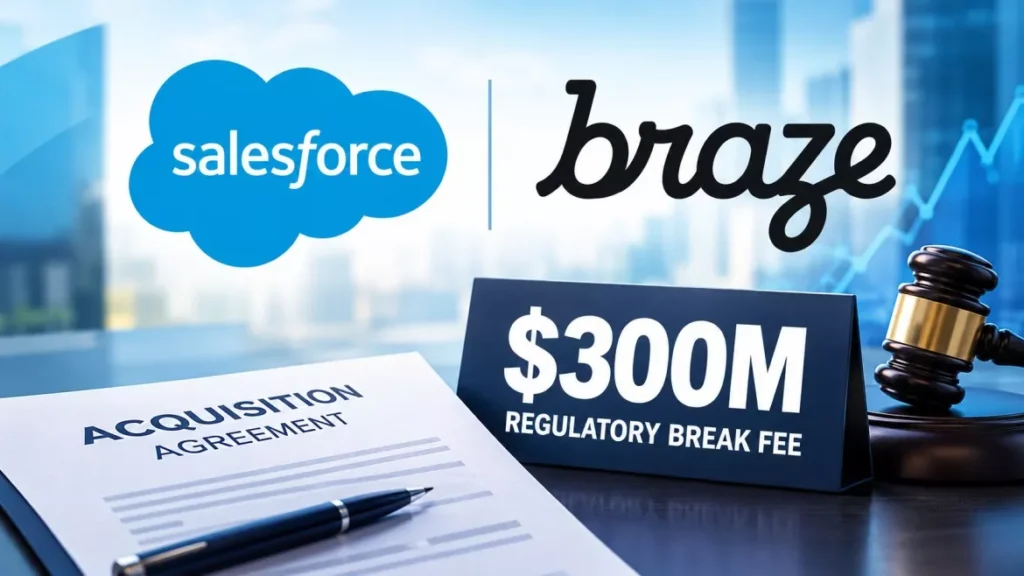

The Salesforce Braze acquisition will pay Braze Class A shareholders $47.50 a share in cash, valuing the United States customer engagement company at about $5.66 billion in enterprise value. Salesforce announced the agreement on 20 October 2026. It owes Braze $300 million if regulators block the deal.
The Terms Salesforce Agreed
Salesforce, the San Francisco customer relationship management company listed in New York, signed the merger agreement on 19 October 2026 and announced it the following day. Braze sells software that brands use to send personalised messages to customers across mobile apps, email and other channels.
| Term | Detail |
|---|---|
| Consideration | $47.50 in cash per Class A share, without interest |
| Enterprise value | Approximately $5.66 billion |
| Merger agreement dated | 19 October 2026 |
| Announced | 20 October 2026 |
| Expected close | Salesforce fiscal year 2028, which begins 1 February 2027 |
| Shareholder approval | Majority of outstanding Class A shares |
| Braze customers cited | About 2,770 |
The Salesforce release states there is “no anticipated change to Salesforce’s FY27 guidance”. The company has issued no fiscal 2028 guidance and no update to its long-term targets.
Braze shares closed at $45.57 on 20 October, up 51.70%, against the $30.04 close on 19 October. The offer is roughly 58% above that pre-announcement price. The gap between the $45.57 close and the $47.50 offer is the market’s discount for the risk that the deal does not complete.
The Two Break Fees, and What the Gap Signals
Braze’s filing with the Securities and Exchange Commission sets out two termination fees, and they are not the same size.
- Payable by Braze: “a termination fee equal to $191,390,000 in cash”, in specified circumstances including a failure of shareholders to approve the merger or a change in the board’s recommendation.
- Payable by Salesforce: “a termination fee equal to $300,000,000 in cash”, if the agreement ends because the merger has not closed by the outside date, or because a final, non-appealable injunction or regulatory law permanently prohibits it.
Salesforce’s fee is about 57% larger than Braze’s. In merger agreements, the fee a buyer accepts for regulatory failure is one of the few public signals of how the two sides divided that risk. A larger buyer-side fee means the seller extracted more protection against the deal being stopped by an authority rather than by its own shareholders.
For scale, the Proofpoint and Varonis agreement announced days earlier carried a $211.7 million break fee. Deal-protection terms in enterprise software have been running at similar proportions, as the Schneider Electric purchase of PTC showed this month.
Neither fee is a forecast. Both are contractual amounts that apply only if specified events occur.
How Long This Can Run
Salesforce said it expects to close in its fiscal year 2028. That year begins on 1 February 2027, so February 2027 is the earliest realistic completion. The agreement allows considerably longer.
- 19 October 2027: the outside date, the first anniversary of the merger agreement, after which either party may walk away.
- First extension: up to 90 further days to obtain required regulatory approvals.
- Second extension: a further period of up to 90 days on the same basis.
Taken together, the timetable can extend into the first half of 2028 before either side is free to terminate on timing grounds. As of 22 October 2026, no shareholder meeting date has been announced and no regulatory filings have been reported as cleared.
What the Deal Needs to Clear
The conditions listed in Braze’s filing are more specific than the phrase “regulatory approval” used in most coverage.
- Shareholder vote: approval by a majority of outstanding Class A common stock.
- United States antitrust: expiry of the waiting period under the Hart-Scott-Rodino Act, the law requiring large deals to be notified to United States antitrust agencies before closing.
- Other jurisdictions: approvals under specified antitrust and foreign investment laws, which the filing does not name individually.
- No burdensome condition: the merger must not be subject to an order imposing a condition the agreement defines as burdensome.
- No material adverse effect: no continuing material adverse effect at Braze.
Braze has also agreed not to solicit alternative transactions and, with limited exceptions, not to enter discussions about one. The filing does not describe a go-shop period.
What Changes for Customers Before Close
Nothing contractual changes while the deal is pending. Braze remains an independent public company until completion, and existing Braze and Salesforce Marketing Cloud contracts run on their current terms.
What the announcement does not say is as notable as what it does. The release does not state whether Braze will continue as a separate product or be folded into Marketing Cloud, does not address pricing or packaging for either customer base, and sets out no integration roadmap or migration path.
Bill Magnuson, Braze’s chief executive and co-founder, said the company will keep investing in its customer and partner community and that Salesforce’s platform will help it innovate faster. Patrick Stokes, Salesforce’s president for applications and marketing, framed the rationale around combining Braze with Marketing Cloud, CRM and Data 360. Neither statement is a commitment on price or product continuity.
Customers evaluating renewals during the pending period are negotiating with a company whose ownership is expected to change, but whose obligations under signed contracts are unchanged until it does.
Frequently Asked Questions
What Is the Salesforce Braze Acquisition Price?
$47.50 in cash for each Braze Class A share, valuing the company at approximately $5.66 billion in enterprise value. The merger agreement is dated 19 October 2026 and was announced on 20 October 2026.
What Break Fees Apply?
Braze would pay Salesforce $191,390,000 in specified circumstances, including a failed shareholder vote or a change in board recommendation. Salesforce would pay Braze $300,000,000 if the deal is terminated for missing the outside date or because a final regulatory prohibition blocks it.
When Will the Salesforce Braze Acquisition Close?
Salesforce expects completion in its fiscal year 2028, which starts on 1 February 2027. The outside date is 19 October 2027, extendable twice by up to 90 days each for regulatory approvals.
What Approvals Are Needed?
A majority of outstanding Braze Class A shares must approve the merger, the Hart-Scott-Rodino waiting period in the United States must expire, and approvals under specified antitrust and foreign investment laws in other jurisdictions must be obtained.
Does Anything Change for Braze Customers Now?
No. Braze remains an independent public company until the merger completes, and existing contracts continue on their current terms. Salesforce has published no pricing, packaging or product roadmap decisions for either customer base.