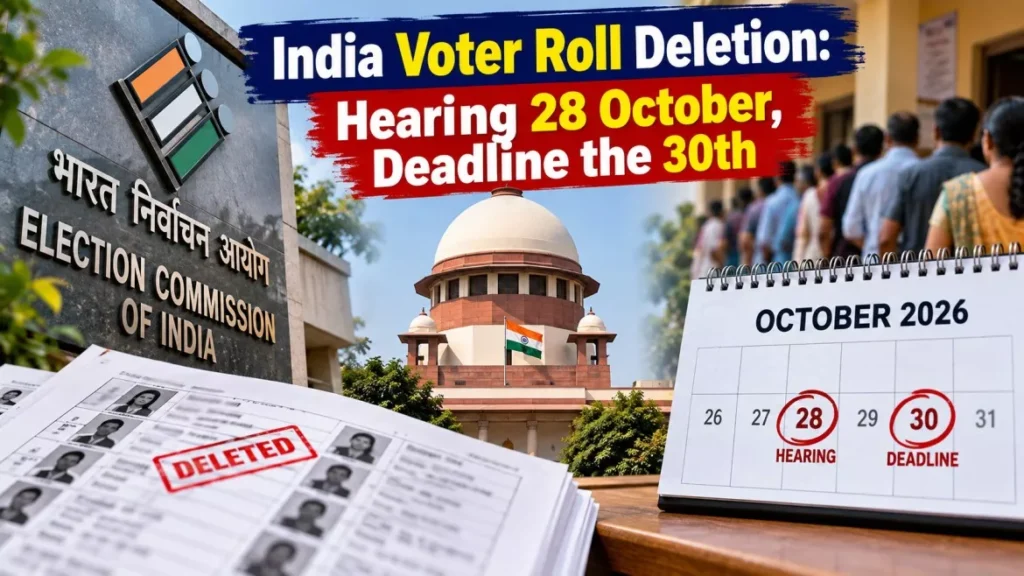

The India voter roll deletion dispute reaches the Supreme Court on 28 October 2026, two days before corrections close. The court moved the hearing forward from 30 October after petitioners said voters removed from the rolls were being told to re-register as first-time voters. At issue is which application form applies.
What the Court Moved, and Why
A bench of Chief Justice Surya Kant and Justice Joymalya Bagchi advanced the hearing from 30 October to 28 October 2026, LiveLaw reported on 14 October. The application was filed by Anjali Bhardwaj and Amrita Johri and argued by the advocate Prashant Bhushan.
The timing is the point. 30 October 2026 is the last date for correcting deletions in the current round, so a hearing on that day would have come too late to matter. Bhushan argued that even 28 October might not leave enough time. Chief Justice Surya Kant said the court was “thinking of passing an order that will take care of” the issue, but did not pass one.
All of this concerns India, and specifically the Special Intensive Revision, or SIR — a nationwide re-verification of electoral rolls that the Election Commission of India, the constitutional body that runs Indian elections, began in June 2025.
Form 6 or Form 8: What the Argument Is About
The dispute is narrow and procedural, and it decides whether a removed voter can realistically get back on the roll.
| Form | What it is for | What it requires |
|---|---|---|
| Form 6 | Application for inclusion in an electoral roll | A declaration that the applicant is applying for inclusion for the first time |
| Form 8 | Change of residence, or correction of an existing entry | An existing entry on the roll to correct or transfer |
Voters whose names were removed are being directed to Form 6. The objection is that someone who has voted before cannot truthfully declare they are enrolling for the first time. Petitioners point to Section 31 of the Representation of the People Act, 1950, which provides for imprisonment of up to one year, a fine, or both, for a false declaration.
The petitioners want the Commission directed to accept Form 8, which covers people already enrolled who have moved, or to create a form that fits the situation. A separate SIR declaration asks whether an applicant or their family appeared in the previous revision; the Supreme Court plea also seeks to stop applications being rejected only because that box was left blank.
What the High Courts Have Already Said
Two high courts have touched the question, and they did not resolve it.
In Delhi, two removed voters asked the High Court to let them use Form 8. The Commission’s counsel, acting on the instructions of the electoral registration officer, said they could apply through Form 6 under the Registration of Electors Rules, 1960, and that the officer would assist them. The court held that the petitioners’ fear of a false-declaration accusation was “misplaced” and recorded that they “may fill Form 6, which shall be processed in accordance with law”. It closed the petition without restoring either name, and left the wider question open.
In the Bombay High Court, a family’s Form 8 applications were rejected after they moved within the same Santa Cruz constituency. The bench asked the Commission: “Why must you (EC) reject it? Why can’t you just keep it in abeyance?”
The Commission’s Own Figures
The Election Commission has published national totals, and they are the firmest numbers in the story because the Commission itself issued them.
- Scrutinised: 95.40 crore electors, about 954 million, across three phases of the revision.
- Categorised: 13.39 crore, about 133.9 million, placed under ASDD — absent, shifted permanently, dead or duplicate — and other categories. The figure was reported on 7 October 2026 by Outlook India.
- Checking: The Commission says lists were checked by more than 10 lakh booth level officers and shared with more than 22 lakh booth level agents of political parties before being finalised.
- Delhi: About 47.56 lakh electors were left out of the draft roll published on 31 August 2026, from roughly 1.45 crore. Of those, 31.59 lakh were categorised as permanently shifted.
Where the Commission has given a reason-by-reason split, it has done so at state level. In Bihar, after the Supreme Court ordered on 14 August 2025 that the roughly 65 lakh names missing from the draft roll be published district by district with reasons, the Commission said 22.34 lakh were dead, 36.28 lakh had permanently shifted or were absent, and 7.01 lakh were enrolled in more than one place.
Where the Larger Figures Come From
The number most widely quoted internationally is not the Commission’s, and the distinction matters.
An estimate of about 130 million names removed, cited by NPR in a report published on 21 October 2026, is attributed to Yogendra Yadav, an elections specialist and a prominent critic of the governing Bharatiya Janata Party, in an Indian Express column. It is close in scale to the Commission’s 13.39 crore, but it is an outside estimate of removals, while the Commission’s figure is its own count of electors placed in the ASDD and other categories. The two are not the same measure.
The description of the exercise as “the largest disenfranchisement exercise in human history” comes from Kaustubh Chaturvedi, a lawyer who has filed several petitions against the revision. NPR reported that the rolls previously listed about 980 million names.
What Is Agreed and What Is Alleged
On a contested story, the two should be kept apart.
Agreed by both sides: a revision on this scale took place; the Commission’s own total for the ASDD and other categories is 13.39 crore; the revision required documentation that many voters had not previously been asked for; and the Commission has said it will help eligible people who were removed to be reinstated. The Supreme Court upheld the legitimacy of the revision in May 2026.
Alleged and disputed: opposition parties allege that the revision was managed to favour the Bharatiya Janata Party, and some have accused the Chief Election Commissioner, Gyanesh Kumar, of partiality. The Commission and the BJP reject that. The Commission has said it acted with “complete integrity”, and told the Supreme Court that allegations of mass deletion in West Bengal were “highly exaggerated”. Nothing has been established as a finding against any official.
The purpose is also contested. Amit Shah, India’s home minister, framed the exercise around “detecting, deleting and deporting infiltrators”; critics say that framing targets Muslim voters. The BJP says the removed names belonged to people who had died, moved, were absent or were duplicated.
Some claims rest on single outlets. The Wire reported that more than 5.38 lakh voters in West Bengal were removed through auto-generated rejections that gave no reason, a figure it attributes to the Commission’s own software. That has not been independently confirmed.
What Happened in West Bengal
The state is the clearest documented case because an official account exists. News On AIR, the Indian government’s broadcaster, reported on 8 April 2026 that about 91 lakh names were removed from the West Bengal roll ahead of the state election: roughly 63 lakh in earlier deletions, and about 27 lakh declared ineligible after judicial adjudication.
The highest deletions were recorded in Murshidabad, North 24 Parganas, Malda, Nadia and South 24 Parganas, and Kolkata lost close to 7 lakh voters. The Trinamool Congress, which governs the state, said the revision fell hardest on minorities, migrants and poorer households. The BJP defended it as necessary to remove invalid entries.
What Is Still Undecided
As of 22 October 2026, the central procedural question is open, and the deadline is unchanged.
- Which form applies: The Supreme Court has not ruled on whether the Commission must accept Form 8, or create another route, instead of Form 6.
- Disclosure: Whether the Commission must publish the names of voters who received notices, and the reasons, is still before the court.
- How voters were flagged: The main petition seeks the criteria, definitions and algorithmic parameters behind the “logical discrepancies” classification. The court has said the basis needs clarification, and noted that notices appeared to have been issued “almost mechanically”.
- The deadline: 30 October 2026 remains the last date for correcting deletions in this round unless the court orders otherwise.
A voter seeking inclusion is dealt with by the electoral registration officer for their constituency, through the claims and objections process, and the Commission’s own notices set out what it currently requires.
Frequently Asked Questions
How Many Names Did India’s Voter Roll Revision Remove?
The Election Commission of India says 13.39 crore, about 133.9 million, electors were categorised under ASDD — absent, shifted permanently, dead or duplicate — and other categories, out of 95.40 crore scrutinised. A widely quoted figure of about 130 million removed is an outside estimate attributed to the elections specialist Yogendra Yadav.
What Is the Difference Between Form 6 and Form 8?
Form 6 is the application for inclusion in an electoral roll and carries a declaration that the applicant is applying for the first time. Form 8 covers a change of residence or a correction to an existing entry. The dispute is over which one a previously registered voter who was deleted should use.
When Is the Supreme Court Hearing?
28 October 2026, before a bench of Chief Justice Surya Kant and Justice Joymalya Bagchi. The court advanced it from 30 October, which is the last date for correcting deletions in the current round.
What Does the Election Commission Say?
It says the revision removed duplicate, deceased, shifted and otherwise ineligible entries, that it acted with “complete integrity”, and that eligible voters left out can seek inclusion through the claims and objections process. It told the Supreme Court that allegations of mass deletion in West Bengal were “highly exaggerated”.
Has Any Court Found the Revision Unlawful?
No. The Supreme Court upheld the legitimacy of the Special Intensive Revision in May 2026. Specific questions about notices, disclosure and the forms remain before the courts, and no finding has been made against any official.