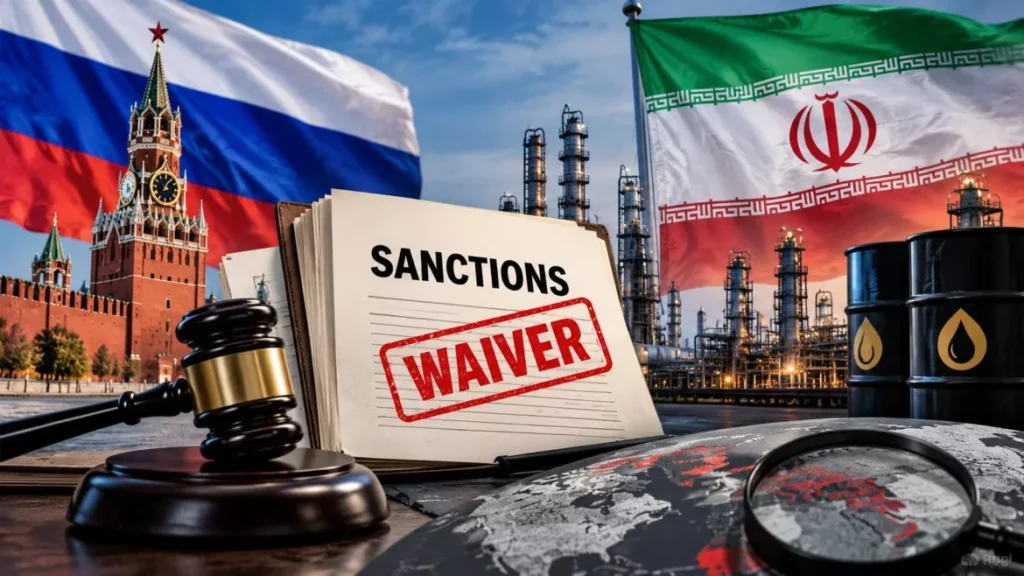

President Donald Trump has signed a Russia sanctions waiver suspending nearly all of the Graham Act’s Russia measures in the United States. The order, dated 16 October 2026, drops duties of up to 500% on Russian goods two days before they were due to take effect. The waivers carry no expiry date.
The order, titled “Implementing the Lindsey O. Graham Sanctioning Russia and Iran Act of 2026”, does not repeal the law. It uses a waiver power written into the Act itself, and it leaves a significant part of the statute, plus the entire pre-existing sanctions architecture, untouched.
What the 16 October Order Waives
The order waives 13 numbered provisions of the Graham Act and both of its tariff powers. Trump certified to Congress that issuing the waiver “at this time is in the national interests of the United States”, the wording required by the Act, according to the text of the executive order.
| Provision | What it would have required |
|---|---|
| Sections 112 and 113 (duties) | Duties of up to 500% on all goods imported from Russia, and up to 100% on all goods from designated third countries that keep buying Russian crude oil or natural gas |
| Sections 102(a), 102(d), 102(e) | Blocking sanctions and visa, admission or parole restrictions on listed Russian officials, defence and energy figures, sanctioned vessels and port operators |
| Sections 103 to 111 | Sanctions on the Central Bank of Russia and major state banks, penalties on foreign banks transacting with them, and restrictions on securities, investment, energy exports, sovereign debt, financial messaging services and uranium imports |
| Section 117 | The termination rules governing sanctions on the covered Russian banks |
Section 4(d) of the order sets no end date. The waivers “shall remain in effect until such time as the President or the Secretary of State” decides further action is appropriate, with the Secretary of State acting in consultation with the Treasury Secretary and the United States Trade Representative. Each waiver was accompanied by a certification and “a report explaining the basis for the certification”, as section 115(b) of the Act requires. The White House has not published that justification.
What the Graham Act Still Requires
Three parts of the picture survive the order, and most coverage has not separated them from the waivers.
- The Iran extension: Section 201 of the Act extends the Iran Sanctions Act of 1996 through 2031. It is not among the waived provisions, and the order addresses Russia measures only.
- Earlier executive orders: Section 4(b) states that nothing in the order affects any sanctions or other measures provided for under any executive order addressing the Russia-related national emergency, “including all persons sanctioned under any such Executive Order”. Individuals and entities already designated stay designated.
- The statute itself: The law remains on the books. Its provisions other than the Iran extension are due to expire five years after enactment, on 18 September 2031.
The Graham Act was signed into law on 18 September 2026 as H.R. 5334, after passing both chambers with bipartisan support. It is named for the late Senator Lindsey Graham of South Carolina. Most of its measures had to be implemented within 30 days of enactment, which set the 18 October deadline the waiver pre-empted. The Iran section extends an existing authority rather than imposing new designations.
Which Countries the Tariffs Would Have Reached
Section 113 aimed at the largest buyers of Russian energy, which makes the waiver’s reach widest outside the United States. The Centre for Research on Energy and Clean Air (CREA), a Finland-based research organisation that tracks fossil-fuel trade, put the leading purchasers of Russian crude oil in September 2026 as follows, in figures reported by Al Jazeera on 17 October 2026:
- China: about €6 billion ($6.74 billion)
- India: about €3.6 billion ($4.04 billion)
- Hungary and Slovakia combined: about €290 million ($326 million)
- Türkiye: about €172 million ($193 million)
For refined oil products over the same month, CREA ranked Saudi Arabia first at about €534 million ($600 million), ahead of Türkiye at about €321 million ($361 million), China at about €304 million ($342 million) and India at about €161 million ($181 million). No third country had been formally designated under section 113 before the waiver, so none of these states had a confirmed tariff rate attached to it.
European Union members remain buyers of Russian gas rather than crude. CREA recorded about €817 million ($918 million) of EU pipeline gas purchases and about €615 million ($691 million) of liquefied natural gas in September 2026. Al Jazeera reported that the EU plans to phase out Russian gas imports next year. Valdis Dombrovskis, the European Commissioner for economy, said of the volumes: “If we look at the volumes, they are not of any macroeconomic significance.”
Where the Measures Stand as of 18 October 2026
As of 18 October 2026, the date the Graham Act’s Russia measures were due to take effect, none of the waived provisions is in force in the United States. No duties have been collected under sections 112 or 113, no new designations have been made under the waived sections, and the waivers have no scheduled end. Sanctions imposed under earlier executive orders continue to apply, and the Iran Sanctions Act extension continues to run to 2031.
What Ukraine, Russia and Lawmakers Have Said
The order follows an arrangement under which the Kremlin agreed to release diesel into the global market, struck as diesel prices climbed. Readers following that thread can see the earlier terms in our report on the Russian diesel deal and the pricing backdrop in record United States diesel prices.
Reaction divided sharply, and the claims on each side are contested rather than settled.
- Ukraine: President Volodymyr Zelenskyy called the diesel arrangement “a gift” to President Vladimir Putin and said of it: “It’s a mistake. I’m sure this diesel will not help Americans but will help Putin.” He said Ukraine had not been told in advance. On X on 17 October he wrote: “Pressure is needed to stop this.”
- Russia: Kirill Dmitriev, an envoy for Putin, called the decision “an important and truly historic moment”, according to reporting carried by Al Jazeera and Outlook India.
- United States lawmakers: RFE/RL reported that Senator Richard Blumenthal, a Democrat who co-authored the bill, said Trump “confirms again that he stands on the side of a bloodthirsty thug”, and that Representative Don Bacon, a Republican, said: “The President is prolonging the war, not ending it.” Representative Don Beyer, a Democrat, called the waiver a “surrender to Putin”.
- Trump: Axios quoted him saying of the law: “This Act could have helped enormously – and still can! But it needs to actually work.”
Separately, at a Brussels meeting on 16 October, Zelenskyy asked European Union leaders for at least €70 billion more in assistance for 2027 and put Ukraine’s war costs for that year at about €155 billion. EU leaders did not approve that sum. They agreed to release a further €6.6 billion in military aid through the European Peace Facility and called for further assessment of Ukraine’s funding needs.
What Could Bring the Measures Back
Because the Act was waived rather than repealed, the provisions can be revived without new legislation. Under section 4(d) of the order, either the President or the Secretary of State can determine that further action is appropriate, which would end the suspension.
Congress’s own route is narrower than it may appear. The Act’s section 115 waiver requires only a national-interest certification and an explanatory report, not congressional consent. The joint-resolution-of-disapproval mechanism in the statute applies to the termination of the bank sanctions under section 117, not to a waiver. Members of both parties have instead introduced separate legislation; Representative Gregory Meeks, the senior Democrat on the House Foreign Affairs Committee, has brought forward a bipartisan bill aimed at blocking the proposed Russian diesel arrangement. None of those measures has become law.
Two dates are worth watching. United States midterm elections fall on 3 November 2026, and the waived sections sit alongside the Act’s 18 September 2031 sunset. The Iran component, which is governed separately and traces back to the 1996 statute, connects to a wider enforcement picture set out in our report on the Iran UN Security Council referral.
Frequently Asked Questions
Did Trump Lift Russia Sanctions?
No. The executive order of 16 October 2026 waives new measures created by the Graham Act before they took effect. Sanctions imposed on Russia under earlier United States executive orders remain in force, and everyone designated under them stays designated.
When Does the Russia Sanctions Waiver Expire?
It has no expiry date. Section 4(d) of the order says the waivers continue until the President or the Secretary of State determines that further action is appropriate.
Were the 500% Tariffs on Russian Goods Ever Charged?
No. The duties under sections 112 and 113 were due to be in place by 18 October 2026 and were waived on 16 October, before any were imposed or collected.
Does the Waiver Cover the Iran Part of the Graham Act?
No. Section 201, which extends the Iran Sanctions Act of 1996 through 2031, is not among the waived provisions. The order addresses the Act’s Russia measures.
Can Congress Overturn the Waiver?
Not through the Act’s disapproval mechanism, which covers termination of the bank sanctions under section 117 rather than a waiver. The waiver power in section 115 requires a national-interest certification and a report to Congress, not congressional approval.